INDIAN TELECOM SECTOR              an industry analysis.Tanmay JauharyTelecom Sector- introductionMost vibrant sector with highest growth rate – more than 60 lakh customers are added every monthPlethora of servicesEasier access/ availabilityDrastic reduction in tariffWorld class service
Major classes of ServicesFixed          Copper, Optical Fibre, Wireless
Mobile      	 GSM and CDMA based
Narrow band   Voice, Internet, Fax
Broad bandHigh speed Internet, VideoMobile Tariffs in India one of the LowestUSD
Key Policy Initiatives/milestonesNew Economic Policy (1991)Opening up of Telecom service sector (Mobile –metros)National Telecom Policy 1994Telecom, key for developmentInadequacy of public resource to meet demand Private sector to supplement Govt.Provide world class telecom service at affordable cost
Technology TrendOptical fiber based wirelinenetworksWireless networks GSM,CDMA based mobileNext Generation Networks: Voice , Data, Video  convergenceTelecom networks increasingly software   intensive
Issues to be addressed in the Indian Scenario Unique Rural Scenario : low teledensity
Need for Spectrum re-farming & re-allocation
Lack of Content in Local Languages
Network SecurityMobile. 2699.270 M   	Fixed.1229.987 M        Total.     3929.257 MPopulation 6563.69 M                                Teledensity. 60.02
Market StructureJammu & KashmirHimachal PradeshPunjabUttar Pradesh WHaryanaDELHIRajasthanUttar Pradesh EBiharWest BengalMadhya PradeshGujaratKOLKATAOrissaMaharashtraMUMBAIAndhra PradeshKarnatakaMETRO CirclesCHENNAIA CirclesTamil NaduB CirclesKeralaC CirclesDivided into 23 circles4 metros 19 circlesFurther divided into A, B and C category. Division based on economic parameters and revenue potentialEach circle has a licenses, which are a saleable.North Eastern StatesSource :COAI
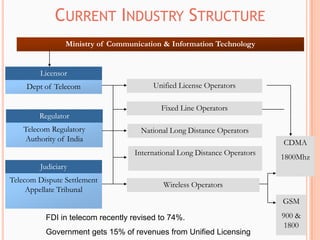
Current Industry StructureMinistry of Communication & Information TechnologyLicensorUnified License Operators Dept of TelecomFixed Line Operators RegulatorTelecom Regulatory Authority of IndiaNational Long Distance OperatorsCDMA1800MhzInternational Long Distance OperatorsJudiciaryTelecom Dispute Settlement Appellate TribunalWireless OperatorsGSM  900 & 1800FDI in telecom recently revised to 74%.Government gets 15% of revenues from Unified Licensing
Telecom Regulatory Authority of IndiaSetup in 1997
Protection of Consumer Interest
Nurture Conditions for Growth of Telecom in India
Major Activities
Reduced levies on Operators.
Reduced upper limit in tariff (Local, STD & ISD) and other Inter-operators tariffs.
Directives on number of network access service providers.
Policy guidelines on new services like 3G, Wi-MAX, Internet Telephony, Radio Paging, VSAT, etc.
Regular monitoring of Quality of Service parametersMajor players of Indian telecom industryThe Top five companies, on the basis of ‘Market Share’ as on 31st January, 2009 are:1. BhartiAirtel Ltd.2. Reliance Communications Ltd.3. Vodafone Essar Ltd.4. BSNL5. Idea Cellular + SpiceBottom five companies, on the basis of ‘Market Share’ as on 31st January, 2009 are:1. Aircel Cellular Ltd. + Dishnet2. Mahanagar Telephone Nigam Ltd. (MTNL)3. BPL Mobile Communications Ltd.4. HFCL Infotel Ltd.5. Shyam Telecom Ltd.
Market share of telecom companies as on January, 2009
Porter five forces model
Threat of substitutes- LOWSome Substitutes:VOIP (Skype, Messenger etc.)Online Chat EmailSatellite phonesNone of the above a major threat in current scenario, but a potential threat for near future.
Threat of new entrants- LOWDeclining Average Revenue Per User.Infrastructure tenancy costs.Brand pull exists to some extent for brands like Airtel / Idea/ Vodafone.Extremely high infrastructure setup costsSpectrum License cost- Lotteries, auctions.Incumbent Advantages: Established brand image, Reliability of network
Power of supplier- LOWLarge number of suppliers.
Shared tower infrastructure.