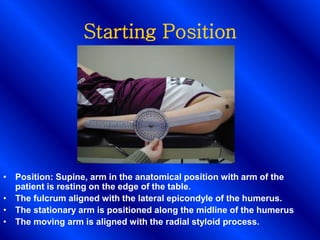
This document provides instructions for performing goniometry to measure range of motion at various joints in the body, including the shoulder, elbow, wrist, hip, knee, and ankle. Goniometry involves using a goniometer, which has a fulcrum, stationary arm, and moving arm, to measure joint angles. The document describes patient positioning and goniometer placement for range of motion tests for motions like shoulder flexion, elbow extension, wrist pronation, hip abduction, knee flexion, and ankle dorsiflexion. It also provides normal range of motion values for reference.