VALENCE BOND THEORY
Valence Bond Theory
Modern Concept of Covalent Bond (VBT)
(i) Introduced by Heitler and london.
(ii) This theory is bassed on the knowledge of Atomic orbitals electronic
configuration of electrons, the overlap criterion of atomic orbitals, the
hybridization of atomic orbitals and the principles of variation and
superposition.
Attractive forces arise between
(i) nucleus of one atom and its own electron that is HA – EA and HB – EB.
(ii) nucleus of one atom and electron of other atom i.e., HA – EB. HB– EA.
Similarly repulsive forces arise between
(i) electrons of two atoms like EA – EB ,
(ii) nuclei of two atoms HA – HB.
Attractive forces tend to bring the two atoms close to each other whereas
repulsive forces tend to push them apart.
Orbital Overlap Concept
 In the formation of H2 Molecule, In the minimum energy state when two
H atoms are so near that their atomic orbitals undergoes partial
interpenetration. This partial merging is called overlapping.
 Acc. to orbital overlap concept, The formation of a covalent bond
between two atoms results by pairing of electrons present in the valence
shell having opposite spins.
 The extent of overlap decides the strength of a covalent bond.
 Greater the overlap, stronger is the bond formed between two atoms.
Directional Properties of Bonds
The valence bond theory explains the formation and directional properties
of bonds in polyatomic molecules like CH4, NH3 and H2O, etc. in terms of
overlap and hybridisation of atomic orbitals.
Figure : Positive , negative and zero overlaps of s and p atomic orbitals
Types of Overlapping and Nature of Covalent Bonds
The covalent bond may be classified into two types depending upon the
types of overlapping :
(i) sigma(σ) bond, (ii) pi (π) bond
(i) Sigma (σ) bond : This type of covalent bond is formed by the end
to end (hand-on) overlap of bonding orbitals along the internuclear
axis. This is called as head on overlap or axial overlap.
s-s overlapping : In this case, there is overlap of two half filled s-
orbitals along the internuclear axis as shown below :
 s-p overlapping : This type of overlap occurs between half filled
s-orbitals of one atom and half filled porbitals of another atom.
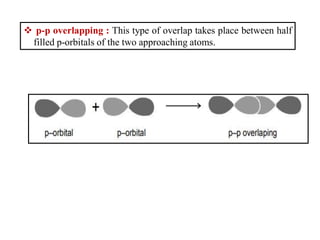
 p-p overlapping : This type of overlap takes place between half
filled p-orbitals of the two approaching atoms.
(ii) pi(π) bond : In the formation of π bond the atomic orbitals overlap
in such a way that their axes remain parallel to each other and
perpendicular to the internuclear axis. The orbitals formed due to
sidewise overlapping consists of two saucer type charged clouds above
and below the plane of the participating atoms.
Octet rule, Lewis dot structures
“Tendency of atoms to have eight electrons in their outermost shell is
known as Lewis octet rule". To achieve inert gas configuration atoms
lose, gain or share electrons.
(i) It has been observed that atoms of noble gases have little or no
tendency to combine with each other or with atoms of other elements.
(ii) It means that these atoms must have a stable electronic configuration.
(iii) These elements (noble gases) have 8 electrons (ns2 np6) except
helium which has 2 electrons (1s2) in their outer most shell.
(iv) It is therefore concluded that ns2 np6 configuration in the outer
energy level constitues a structure of maximum stability or minimum
energy.
Element Ne Ar Kr Xe Rn
Outer most shell configuration 2s22p6 3s23p6 4s24p6 5s25p6 6s26p6
The Octet rule can be understood by considering the formation of the
chlorine molecule, Cl2. The Cl atom with electronic configuration,
[Ne]10 3s2 3p5, is one electron short of the argon configuration. The
formation of the Cl2 molecule can be understood in terms of the sharing
of a pair of electrons between the two chlorine atoms, each chlorine
atom contributing one electron to the shared pair.
16