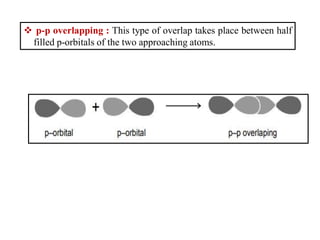
Valence bond theory describes the formation of covalent bonds between atoms through the overlap of atomic orbitals and the sharing of electron pairs. There are two types of orbital overlaps - sigma bonds form from head-on overlap along the internuclear axis, while pi bonds form from side-by-side overlap perpendicular to the axis. The extent of orbital overlap determines the bond strength. Valence bond theory also explains the directional properties of bonds in molecules and the octet rule by which atoms seek to attain the stable electron configuration of the nearest noble gas.


 Most read
 Most read
![Element Ne Ar Kr Xe Rn
Outer most shell configuration 2s22p6 3s23p6 4s24p6 5s25p6 6s26p6
The Octet rule can be understood by considering the formation of the
chlorine molecule, Cl2. The Cl atom with electronic configuration,
[Ne]10 3s2 3p5, is one electron short of the argon configuration. The
formation of the Cl2 molecule can be understood in terms of the sharing
of a pair of electrons between the two chlorine atoms, each chlorine
atom contributing one electron to the shared pair.](/proxy?url=https%3A%2F%2Fimage.slidesharecdn.com%2Fvalencebondteory-201128102853%2F85%2FValence-bond-teory-15-320.jpg)
 Most read


