Bioorganic chemistry study the relationship
between the structure of organic compounds
and their biological functions.
Studyind objects
 natural biologically important compounds
(biopolymers, vitamins, hormones, antibiotics,
pheromones, etc.);
 synthetic regulators of biological processes (drugs,
pesticides, etc.).
 a structure of molecular framework;
 the presence of functional groups in molecule.
Functional group is an atom or a group of
atoms of non-hydrocarbon origin that determine
chemical properties of a compound.
Nomenclature is an arrangement of terms
that describes complete structure of organic
molecules.
- trivial nomenclature
- radicofunctional nomenclature
- substitutive nomenclature IUPAC
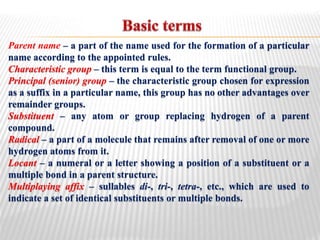
Parent name – a part of the name used for the formation of a particular
name according to the appointed rules.
Characteristic group – this term is equal to the term functional group.
Principal (senior) group – the characteristic group chosen for expression
as a suffix in a particular name, this group has no other advantages over
remainder groups.
Substituent – any atom or group replacing hydrogen of a parent
compound.
Radical – a part of a molecule that remains after removal of one or more
hydrogen atoms from it.
Locant – a numeral or a letter showing a position of a substituent or a
multiple bond in a parent structure.
Multiplaying affix – sullables di-, tri-, tetra-, etc., which are used to
indicate a set of identical substituents or multiple bonds.
Step 1
Determine the kind of characteristic group for
use as principal group, if any.
principal group
Step 2
Determine the parent structure (principal chain
or parent ring system).
Step 3
Name the parent structure and the principal
group(s).
pentane
al
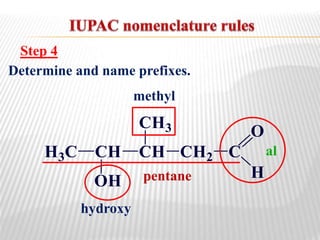
Step 4
Determine and name prefixes.
pentane
methyl
al
hydroxy
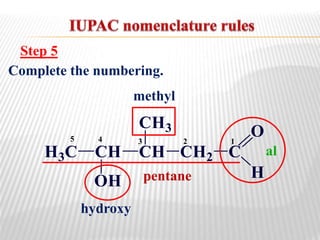
Step 5
Complete the numbering.
pentane
methyl
al
hydroxy
12345
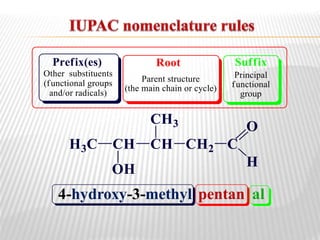
Step 6
Assemble the partial name into a complete name,
using the alphabetic order.
4-hydroxy-3-methylpentanal
12345
4-hydroxy-3-methyl pentan al