Life cycle of  λ phage

Presented by:
Minhaz Ahmed
BBI11014
Integrated M.Sc 3rd 
semester,MBBT,
Tezpur University, Assam
CONTENTS
 Introduction
 How genome is transferred
 Lytic cycle and lysogenic cycle
 Life cycle
 Lytic or lysogenic?
What is lambda phage?
 It is a bacterial virus, or
bacteriophage , that infects the
bacterial species Escherichia coli.
 This virus is a temperate phage.
 Temperate phages are basically
bacteriophages which can choose
between a lytic and lysogenic
pathway of development.

SOURCE:classes.midlandstech.edu
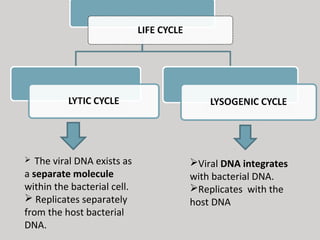
The viral DNA exists as
a separate molecule
within the bacterial cell.
 Replicates separately
from the host bacterial
DNA.


Viral DNA integrates
with bacterial DNA.
Replicates with the
host DNA
How it penetrates:
It binds to the target E. coli cell, via J protein in the tail
tip that interacts with the maltoporin of E. coli and
injects its linear genome.

TAIL FIBRE

TAIL

HEAD

1

DNA
COLLAR

BASE PLATE

DNA of E. coli

MALTOPORIN in E. coli

2

E. coli
LIFE CYCLE :

SOURCE: Pearson Education 2004
Lytic or lysogenic?
1.lytic life cycle:
occurs in cells with sufficient nutrients, protease
activity is high, which breaks down cII.
2.Lysogenic life cycle:
In cells with limited nutrients, protease activity is
low, making cII stable.

 Computer modeling and simulation suggest that random processes
during infection drive the selection of lysis or lysogeny within individual
cells.
However, recent experiments suggest that physical differences
among cells, that exist prior to infection, predetermine whether a cell
will lyse or become a lysogen.
THANK YOU