Downloaded 51 times


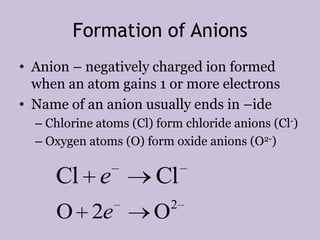


1) Chemical bonding involves the transfer or sharing of valence electrons between atoms. Valence electrons are in the outermost energy level and determine an element's chemical properties. 2) Atoms bond in order to achieve a noble gas electron configuration of 8 valence electrons, following the octet rule. Metals lose electrons to form cations, while nonmetals gain electrons to form anions. 3) Cations are positively charged ions formed when metals lose electrons. Group 1 cations have a +1 charge and Group 2 cations have a +2 charge. Transition metal cations can have varying charges. Anions are negatively charged ions formed when nonmetals gain electrons, taking on charges of -1.


