© Boardworks Ltd 2007
1 of 45
2 of 45 © Boardworks Ltd 2007
© Boardworks Ltd 2007
3 of 45
Why do atoms form bonds?
Bonds involve the electrons in the outer shells of atoms.
Filled electron shells are very stable.
1st shell holds a
maximum of 2 electrons
2nd shell holds a
maximum of 8 electrons
3rd shell holds a
maximum of 8 electrons
Each shell has a maximum number of electrons that it can
hold. Electrons fill the shells nearest the nucleus first.
© Boardworks Ltd 2007
4 of 45
Why do atoms form bonds?
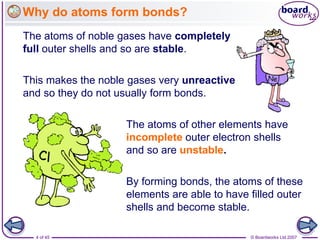
The atoms of noble gases have completely
full outer shells and so are stable.
The atoms of other elements have
incomplete outer electron shells
and so are unstable.
This makes the noble gases very unreactive
and so they do not usually form bonds.
By forming bonds, the atoms of these
elements are able to have filled outer
shells and become stable.
© Boardworks Ltd 2007
5 of 45
What is a covalent bond?
Non-metal elements usually just need one or two electrons
to fill their outer shells. So how do they form a bond?
The shared electrons join the atoms together. This is called
a covalent bond.
The two non-metal atoms cannot form a bond by transferring
electrons from one to another. Instead, they share electrons.
Each atom now
has a full, stable
outer shell.
incomplete
outer shells
Cl
Cl
Cl
Cl
© Boardworks Ltd 2007
6 of 45
Two common ways to represent a covalent bond are:
Only outer shells of electrons are involved in bonding, so the
inner shells do not always have to be included in diagrams.
solid
line
Cl Cl
–
–
Cl Cl
A covalent bond consists of a shared pair of electrons.
covalent bond
Cl
simplified
dot and
cross
diagram
Cl
How is a covalent bond drawn?
Cl Cl
© Boardworks Ltd 2007
7 of 45
Comparing covalent and ionic bonding
8 of 45 © Boardworks Ltd 2007
© Boardworks Ltd 2007
9 of 45
How are covalent bonds formed?
How do non-metal atoms form covalent bonds?
© Boardworks Ltd 2007
10 of 45
Covalent bonding in hydrogen
Many non-metal elements, such as hydrogen, exist as
simple diatomic molecules that contain covalent bonds.
How is a covalent bond formed in hydrogen?
Some molecules contain double or triple covalent bonds.
How are these are formed?
H H H
Each hydrogen atom needs one more electron in its outer
shell and so each atom shares its single unpaired electron.
H
This shared pair of electrons forms a covalent bond and so
creates a diatomic molecule of hydrogen.
© Boardworks Ltd 2007
11 of 45
What are the types of covalent bonds?
© Boardworks Ltd 2007
12 of 45
Can compounds contain covalent bonds?
Covalent bonding can also occur between atoms of different
non-metals to create molecules of covalent compounds.
These covalent bonds can be single, double or triple.
How is a covalent bond formed in hydrogen chloride (HCl,
also represented as H–Cl)?
H Cl
H Cl
Hydrogen and chlorine both need one more electron to fill
outer shells. By sharing one electron each, they both have
a stable outer shell and a covalent bond is formed.
© Boardworks Ltd 2007
13 of 45
Covalent bonding in water
Compounds can contain more than one covalent bond.
The oxygen atom shares 1
electron with 1 hydrogen
atom, and a second
electron with another
hydrogen atom.
H H
O
Oxygen (2.6) needs 2 more electrons, but hydrogen [1] only
needs 1 more. How can these three elements be joined by
covalent bonding?
What is the name of the molecule that is formed?
H2O (or H–O–H) is water.
© Boardworks Ltd 2007
14 of 45
How is the ratio of atoms calculated?
To calculate the ratio of atoms in a stable covalent compound:
For example, how
many nitrogen and
hydrogen atoms
bond together in an
ammonia molecule?
1. Work out how many electrons are needed by each
non-metal element to complete its outer electron shell.
2. Work out the ratio of atoms that will provide enough
shared electrons to fill all the outer shells.
N H
(2.5) (1)
3
electrons
needed
electron
configuration
ratio of
atoms
element
1
1 3
© Boardworks Ltd 2007
15 of 45
H
Covalent bonding in ammonia
How do nitrogen and hydrogen atoms form covalent bonds
in a molecule of ammonia?
NH3 or H N H
H
N H
(2.5) (1)
3
electrons
needed
electron
configuration
ratio of
atoms
element
1
1 3
H H
N
© Boardworks Ltd 2007
16 of 45
H
Covalent bonding in methane
How do carbon and hydrogen atoms form covalent bonds
in a molecule of methane?
CH4 or H C H
H
H
C H
(2.4) (1)
4
electrons
needed
electron
configuration
ratio of
atoms
element
1
1 4
H
H H
C
© Boardworks Ltd 2007
17 of 45
Covalent bonding in carbon dioxide
How do carbon and oxygen atoms form covalent bonds in
a molecule of carbon dioxide?
C O
(2.4) (2.6)
4
electrons
needed
electron
configuration
ratio of
atoms
element
2
1 2
CO2 or O C O
O O
C
double bonds
A double bond is when two pairs of electrons are shared.
In carbon dioxide there are two double bonds
– one between each oxygen atom and the carbon atom.
© Boardworks Ltd 2007
18 of 45
What are simple covalent structures?
Covalent molecules that contain only a few atoms are
called simple covalent structures.
weak bonds
between
molecules
strong bonds
within
molecules
Most substances that contain simple covalent molecules
have low melting and boiling points and are therefore liquids
or gases at room temperature, e.g. water, oxygen, carbon
dioxide, chlorine and hydrogen. Why?
The covalent bonds within these molecules are strong but
the bonds between molecules are weak and easy to break.
© Boardworks Ltd 2007
19 of 45
What is the structure of a molecular solid?
A few substances that contain simple covalent molecules
are solid at room temperature. These are molecular solids.
The solid is formed because
millions of iodine molecules
are held together by weak
forces of attraction to create
a 3D molecular lattice.
Two iodine atoms form a single covalent
bond to become an iodine molecule.
weak
forces of
attraction
What properties would you
expect molecular solids to have
with this type of structure?
Iodine is a molecular solid at room temperature.
© Boardworks Ltd 2007
20 of 45
What are the properties of molecular solids?
 low melting and boiling points;
 usually soft and brittle – they
shatter when hit.
The properties of a molecular solid, such as iodine, are:
Why do molecular solids have these properties?
The weak forces of attraction between the molecules can
be broken by a small amount of energy. This means that
the molecular solids are soft and brittle and melt and boil at
low temperatures.
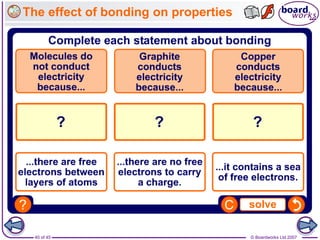
Molecular solids are also unable to conduct electricity
because there are no free electrons or ions to carry a charge.
 cannot conduct electricity.
© Boardworks Ltd 2007
21 of 45
Covalent bonds – true or false?
22 of 45 © Boardworks Ltd 2007
© Boardworks Ltd 2007
23 of 45
What are giant covalent structures?
In some substances, such as sand, diamond and graphite,
millions of atoms are joined together by covalent bonds.
All the bonds are covalent, so giant covalent structures have
very high melting and boiling points, and are usually hard.
The covalent bonds in these substances do not form
molecules but vast networks of atoms called giant covalent
structures.
© Boardworks Ltd 2007
24 of 45
What is the structure of sand?
Sand is mostly made of the mineral quartz, which is silicon
dioxide. It has a giant covalent structure made up of silicon
and oxygen atoms.
Each silicon atom (2.8.4) is bonded to four oxygen atoms,
and each oxygen atom (2.6) is bonded to two silicon atoms.
Si
O
O
O
O
© Boardworks Ltd 2007
25 of 45
What are the allotropes of carbon?
Diamond and graphite appear to be very different substances
but what do they have in common?
Both diamond and graphite are made up of carbon atoms.
These allotropes of carbon have different properties because
the atoms are bonded in different arrangements which create
different giant structures.
Different forms of the same element are called allotropes.
© Boardworks Ltd 2007
26 of 45
How does structure affect properties?
How do the different structures of diamond and graphite
influence their properties?
© Boardworks Ltd 2007
27 of 45
What is the structure of diamond?
© Boardworks Ltd 2007
28 of 45
What are the properties of diamond?
In diamond, all the electrons in the outer shell of each
carbon atom (2.4) are involved in forming covalent bonds.
This affects the properties of this allotrope of carbon:
 Diamond is very hard – the
hardest natural substance.
 Diamond has a very high
melting and boiling point
– a lot of energy is needed
to break the covalent bonds.
 Diamond cannot conduct
electricity – there are no
free electrons or ions to
carry a charge.
© Boardworks Ltd 2007
29 of 45
What is the structure of graphite?
© Boardworks Ltd 2007
30 of 45
What are the properties of graphite?
In graphite, only three of the four electrons in the outer shell
of each carbon atom (2.4) are involved in covalent bonds.
 Graphite is soft and slippery
– layers can easily slide over
each other because the weak
forces of attraction are easily
broken. This is why graphite is
used as a lubricant.
 Graphite conducts electricity
– the only non-metal to do so.
The free electron from each
carbon means that each layer
has delocalized electrons,
which can carry charge.
This affects the properties of this allotrope of carbon:
© Boardworks Ltd 2007
31 of 45
Are there other allotropes of carbon?
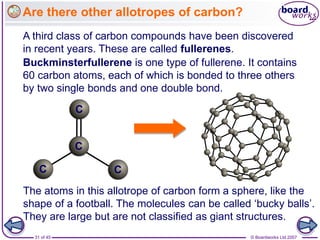
A third class of carbon compounds have been discovered
in recent years. These are called fullerenes.
Buckminsterfullerene is one type of fullerene. It contains
60 carbon atoms, each of which is bonded to three others
by two single bonds and one double bond.
The atoms in this allotrope of carbon form a sphere, like the
shape of a football. The molecules can be called ‘bucky balls’.
They are large but are not classified as giant structures.
C
C
C
C
© Boardworks Ltd 2007
32 of 45
Complete the sentences
33 of 45 © Boardworks Ltd 2007
© Boardworks Ltd 2007
34 of 45
Bonding and structure
© Boardworks Ltd 2007
35 of 45
Simple or giant covalent structure?
© Boardworks Ltd 2007
36 of 45
How does bonding affect properties?
Does the type of bonding in a substance affect its properties?
© Boardworks Ltd 2007
37 of 45
State at room
temperature
Particles in
structure
Bonding
Bonding and structures
The type of bonding in a substance affects the properties of
that substance. Can you fill in the gaps in the table below?
Type of
structure
giant ionic
lattice
millions of
metal and
non-metal ions
solid
ionic
covalent
metallic
simple
molecular
few non-metal
atoms
usually liquid
or solid
giant covalent
lattice
millions of non-
metal atoms
solid
giant metallic
lattice
millions of
metal ions
solid (except
mercury – liquid)
© Boardworks Ltd 2007
38 of 45
Substances with giant structures generally have high
melting and boiling points because all the atoms are
strongly bonded together to form a continuous 3D lattice.
A large amount of energy is needed to break these bonds.
strong ionic
bonds holds
ions together
strong covalent
bonds holds
atoms together
strong metallic
bonds holds
ions together
Melting and boiling point: giant structures
© Boardworks Ltd 2007
39 of 45
Effect of structure on properties
© Boardworks Ltd 2007
40 of 45
The effect of bonding on properties
41 of 45 © Boardworks Ltd 2007
© Boardworks Ltd 2007
42 of 45
Glossary (1/2)
allotrope – A structurally different form of an element with
different physical properties.
covalent bond – A strong bond between two atoms in
which each atom shares one or more electrons with the
other.
covalent compound – A compound containing atoms
joined by covalent bonds.
double bond – A covalent bond in which each atom
shares two of its electrons.
giant structure – A structure containing millions of atoms
or ions bonded together. The structure extends in three
dimensions until all available atoms are used up.
© Boardworks Ltd 2007
43 of 45
Glossary (2/2)
molecule – A small group of atoms which are held together
by covalent bonds.
 molecular solid – A solid substance made up of
molecules held together by weak forces of attraction, forming
a lattice.
single bond – A covalent bond in which each atom shares
one of its electrons.
triple bond – A covalent bond in which each atom shares
three of its electrons.
© Boardworks Ltd 2007
44 of 45
Anagrams
© Boardworks Ltd 2007
45 of 45
Multiple-choice quiz