General AnaestheticsGeneral Anaesthetics
General Anesthesia
“Global but reversible depression of CNS function
resulting in the loss of response to and perception of all
external stimuli”
Characteristics
– Analgesia
– Amnesia
– Attenuation of sensory & autonomic responses
– Muscle relaxation - Immobility
– Unconsciousness (no response to external stimuli)
History: ether/chloroform/N2O/cyclopropane/halothane
Pre-anaesthetic MedicationPre-anaesthetic Medication
AimsAims
– Relief of anxiety and apprehensionRelief of anxiety and apprehension
– AmnesiaAmnesia
– Supplement analgesiaSupplement analgesia
– Decrease secretions and vagal stimulationDecrease secretions and vagal stimulation
– Anti-emetic effect (peri & postoperative)Anti-emetic effect (peri & postoperative)
– Decrease acidity-avoid aspiration of gastric contentsDecrease acidity-avoid aspiration of gastric contents
– Reduce dose of gen. anestheticsReduce dose of gen. anesthetics
Timing & Route of administration (30 m-1h prior, I/V)Timing & Route of administration (30 m-1h prior, I/V)
Sedative / Hypnotic / AnxiolyticsSedative / Hypnotic / Anxiolytics
– Benzodiazepines (diff DOAs)Benzodiazepines (diff DOAs)
Diazepam (longest acting)Diazepam (longest acting)
LorazepamLorazepam (0.05mg/kg)
MidazolamMidazolam (0.07mg/kg)
– BarbituratesBarbiturates (100-200mg)
SecobarbitalSecobarbital
PentobarbitalPentobarbital
CharacteristicsCharacteristics
1. relieve anxiety / relax pt.1. relieve anxiety / relax pt.
2. sedate pt.2. sedate pt.
3. provide amnesia3. provide amnesia
Pre-anaesthetic MedicationPre-anaesthetic Medication
Opioid AnalgesicsOpioid Analgesics (10-20mg)
– Morphine (IV)Morphine (IV)
– Pethidine (IV)Pethidine (IV)
– Fentanyl (transdermal patch) +Fentanyl (transdermal patch) +
congenerscongeners
Characteristics (delayed awakening,Characteristics (delayed awakening,
constipation, asthma, urine retention,constipation, asthma, urine retention,
excessive hypotension—morphine)excessive hypotension—morphine)
H2 Rec. blockers / PPIs (emergencies-dec.
gastric secr.-dec. aspiration pneumonia)
−− Cimetidine & Ranitidine (150 mg)
AntiemeticsAntiemetics
– MetoclopramideMetoclopramide (10-20mg IM)
– AntihistaminesAntihistamines (25-50mg)
– Phenothiazines (Promethazine)Phenothiazines (Promethazine)
– 5HT5HT33 Receptor BlockersReceptor Blockers
OndansetronOndansetron
TropisetronTropisetron
GranisetronGranisetron
CharacteristicsCharacteristics
– Used in cancer chemotherapy ptsUsed in cancer chemotherapy pts
Anticholinergics:Anticholinergics:
1. decrease secretions1. decrease secretions
2. inhibit vagal stimulation2. inhibit vagal stimulation
– AtropineAtropine (0.4-0.6mg IV)
– Hyoscine (crosses BBB)Hyoscine (crosses BBB)
– Glycopyrronium (doesn’t cross BBB)Glycopyrronium (doesn’t cross BBB)
Anti HistaminesAnti Histamines
─Diphenhydramine
─Dimenhydrinate
Characteristics (anti-emetics, sedatives,Characteristics (anti-emetics, sedatives,
anxiolytics & anti-cholinergics)anxiolytics & anti-cholinergics)
Used in combinations according to:Used in combinations according to:
1. patient’s requirement1. patient’s requirement
2. patient’s clinical status2. patient’s clinical status
3. type of operation3. type of operation
4. duration of operation4. duration of operation
Classification of General AnaestheticsClassification of General Anaesthetics
Inhalational Anaesthetics
Volatile Liquids
Halothane, Isoflurane, Sevoflurane,
Methoxyflurane, Desflurane, Enflurane,
Ethyl chloride, Trichloroethylene,
Chloroform
Gases
Nitrous Oxide, Cyclopropane
Intravenous Anaesthetics
Ultra Short Acting Barbiturates
Thiopentone Sodium
Methohexital
Phencyclidine Derivatives
Ketamine
Steroids
Althesin
Eugenol Derivatives
Propanidid
Alkyl Phenols
Propofol
Etomidate
Neurolept anaesthesia (used in psychiatry)
Droperidol + Fentanyl + Nitrous oxide
Stages ofStages of General AnesthesiaGeneral Anesthesia
GGuedel’s Signs – with Ether (not newer agents)
Stage-I Stage Of Analgesia
(no pain, drowsy, reflexes intact, no amnesia,
HR/BP normal, pupil size normal)
Stage-II Stage Of Excitement-most dangerous
(excited, delirious, RR inc., jerky movements –
injury, rapid eye movements, vagal stimulation
-cardiac arrest, catecholamines - arrhythmias)
Stage-III Stage Of Surgical Anesthesia
– Plane-I : pupils constricted, inc. regular resp.,
muscles relax, corneal/conjunctival reflexes lost
Stages ofStages of General AnesthesiaGeneral Anesthesia
– Plane-II : pupils dilate, dec. regular resp., eye-
balls fixed, dec. muscle tone, abdominothoracic
resp., no light reflex
– Plane-III : thoracic resp. ceases, pupils dilated,
muscles relaxed, laryngeal/pharyngeal reflexes
dec. – surgery performed in this plane
– Plane-IV : abdominal resp. ceases, all reflexes
lost – warning sign
Stage-IV Stage Of Medullary Paralysis (CVS &
resp. centers suppr – CVS collapse + Resp. failure)
Monitoring by anesthetist
Inhalational AnestheticsInhalational Anesthetics
Mode of Delivery
– Open Drop method - Ether
– Anaesthetic machines assisted methods
Open System – accurate
Closed System – sodalime
- Trichloroethylene
Semiclosed System
Depth of anesthesiaDepth of anesthesia
– PotencyPotency
Dose-response characteristicsDose-response characteristics
MACMAC – definition– definition
- example- example**
-- Partial Pressure (PP) in brainPartial Pressure (PP) in brain
Inhalational AnestheticsInhalational Anesthetics
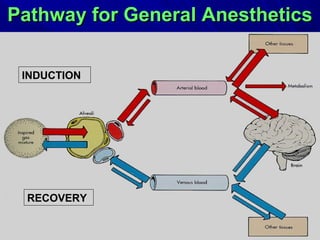
Pathway for General AnestheticsPathway for General Anesthetics
INDUCTION
RECOVERY
PharmacokineticsPharmacokinetics
Administration, Uptake, distribution & eliminationAdministration, Uptake, distribution & elimination
Induction & RecoveryInduction & Recovery******
– Rate of change of PPRate of change of PP
FACTORSFACTORS
Related to drugRelated to drug
– Concentration in inspired airConcentration in inspired air
Fick’s lawFick’s law
– SolubilitySolubility
In blood – Blood:gas partition coefficientIn blood – Blood:gas partition coefficient****
- Inverse relation with induction- Inverse relation with induction
In tissues – Tissue:blood partition coefficientIn tissues – Tissue:blood partition coefficient**
- Arteriovenous conc gradient- Arteriovenous conc gradient
Related to bodyRelated to body
– Pulmonary ventilationPulmonary ventilation
Rate & depthRate & depth
Hyperventilation / Resp depessionHyperventilation / Resp depession
– Pulmonary blood flow / perfusionPulmonary blood flow / perfusion
ShockShock
– Alveolar exchangeAlveolar exchange
Pul vent / perfusionPul vent / perfusion
Lung diseaseLung disease
– Cerebral blood flowCerebral blood flow
COCO22
AnaestheticAnaesthetic Blood: GasBlood: Gas
PartitionPartition
CoefficientCoefficient
MinimalMinimal
Alveolar ConcAlveolar Conc
(MAC) %(MAC) %
Metaboli-Metaboli-
smsm
CommentsComments
Nitrous OxideNitrous Oxide 0.470.47 >100>100 NoneNone Incomplete anesthetic rapidIncomplete anesthetic rapid
onset & recoveryonset & recovery
DesfluraneDesflurane 0.420.42 6-76-7 <0.05%<0.05% Low volatility; poorLow volatility; poor
induction agent; rapidinduction agent; rapid
recoveryrecovery
SevofluraneSevoflurane 0.690.69 2.02.0 2-5%2-5% Rapid onset & recovery;Rapid onset & recovery;
unstable in soda-limeunstable in soda-lime
IsofluraneIsoflurane 1.1401.140 1.401.40 <2%<2% Medium rate of onset andMedium rate of onset and
recoveryrecovery
EnfluraneEnflurane 1.801.80 0.750.75 >8%>8% Medium rate of onset &Medium rate of onset &
recoveryrecovery
HalothaneHalothane 2.302.30 0.750.75 >40%>40% Medium rate of onset andMedium rate of onset and
recoveryrecovery
MethoxyfluraneMethoxyflurane 1212 0.160.16 >70 %>70 % Slow onset & recoverySlow onset & recovery
PROPERTIES OF INHALED ANESTHETICS
AnaestheticAnaesthetic Blood: GasBlood: Gas
PartitionPartition
CoefficientCoefficient
Brain: BloodBrain: Blood
PartitionPartition
CoefficientCoefficient
MetaboMetabo
l-isml-ism
CommentsComments
Nitrous OxideNitrous Oxide 0.470.47 1.11.1 NoneNone Rapid onset & recoveryRapid onset & recovery
DesfluraneDesflurane 0.420.42 1.31.3 <0.05%<0.05% Low volatility; poorLow volatility; poor
induction agent; rapidinduction agent; rapid
recoveryrecovery
SevofluraneSevoflurane 0.690.69 1.71.7 2-5%2-5% Rapid onset & recovery;Rapid onset & recovery;
unstable in soda-limeunstable in soda-lime
IsofluraneIsoflurane 1.1401.140 2.62.6 <2%<2% Medium rate of onset andMedium rate of onset and
recoveryrecovery
EnfluraneEnflurane 1.801.80 1.41.4 >8%>8% Medium rate of onset &Medium rate of onset &
recoveryrecovery
HalothaneHalothane 2.302.30 2.92.9 >40%>40% Medium rate of onset andMedium rate of onset and
recoveryrecovery
MethoxyfluraneMethoxyflurane 1212 2.02.0 >70 %>70 % Slow onset & recoverySlow onset & recovery
PROPERTIES OF INHALED ANAESTHETICS
Elimination
Recovery Depends on
– Routes
Lung
Hepatic Metabolism**
– Concentration in lungs
– Variable tissue concentration
– Duration of exposure
Second gas effect : Nitrous oxideSecond gas effect : Nitrous oxide
Diffusion hypoxia : Nitrous oxideDiffusion hypoxia : Nitrous oxide
Clearance & Metabolism
Mechanism of Action of GeneralMechanism of Action of General
AnestheticsAnesthetics
Old Theories
– Unitary Theory
– Meyer-Overton Theory
– Pauling’s Theory
– Ferguson’s Theory
– Mullen’s Theory
Newer Concepts
– Specific Targets
– Differential Sensitivity of Neurons- Stages
Newer Mechanisms
– Molecular Actions
Channels & Receptors
–Different binding sites
–GABAA receptor-chloride channels
Inhalational agents, barbiturates, propofol,
etomidate
–Glycine receptor-chloride channels
Inhalational agents, barbiturates, propofol
–Glutamate receptor-NMDA channels
Ketamine, nitrous oxide, cyclopropane
–K+
channels (TREK) – Hyperpolarization
Inhalational agents, nitrous oxide,
cyclopropane
–Nicotinic receptor-activated cation channels
Inhalational agents
Neurotransmitters
–Acetylcholine
–Endorphin
HalothaneHalothane
Chemical and Physical PropertiesChemical and Physical Properties
– 2-bromo-2-chloro-1,1,1-trifluoroethane2-bromo-2-chloro-1,1,1-trifluoroethane
– VolatileVolatile // odourlessodourless // colourlesscolourless
– Non-irritantNon-irritant // non-explosivenon-explosive // non-inflammablenon-inflammable
– Light-sensitiveLight-sensitive // corrosivecorrosive // interaction - rubberinteraction - rubber
PharmacokineticsPharmacokinetics
– MAC -MAC - 0.750.75
– B:G part. coef. -B:G part. coef. - 2.32.3
– Medium rate of onset & recoveryMedium rate of onset & recovery
– Metabolism – trifluoroacetic acidMetabolism – trifluoroacetic acid
- trifluoroacetylchloride- trifluoroacetylchloride
– Clearance (hepatic)Clearance (hepatic)
Pharmacological EffectsPharmacological Effects
– CVSCVS
↓↓BP / HRBP / HR
Myocardial sensitization to catecholaminesMyocardial sensitization to catecholamines
Atropine / beta-blockersAtropine / beta-blockers
Redistribution of blood flowRedistribution of blood flow
– Respiratory systemRespiratory system
↑↑ RR, ↓ Tidal vol., dec. ventilatory response to CO2RR, ↓ Tidal vol., dec. ventilatory response to CO2
Inc. PaCOInc. PaCO2,2, raised apneic thresholdraised apneic threshold
Bronchodilator – larnygeal/pharyngeal reflexesBronchodilator – larnygeal/pharyngeal reflexes
abolishedabolished
– CNSCNS
inc CBF & dec CMRinc CBF & dec CMR
If CBF inc.—ICP inc.If CBF inc.—ICP inc.
EEG:initial activation-low dose, slowing-high doseEEG:initial activation-low dose, slowing-high dose
– Kidneys (dec. GFR & RBF), -GITKidneys (dec. GFR & RBF), -GIT
– Liver (dec. portal bl. flow, raised LFTs)Liver (dec. portal bl. flow, raised LFTs)
– Skeletal muscles (relaxation, inc. curare eff)Skeletal muscles (relaxation, inc. curare eff)
– UterusUterus (conc. dependant relaxation)(conc. dependant relaxation)
UseUse
– Maintenance anesthesia – 0.5-1%Maintenance anesthesia – 0.5-1%
– Induction of anesthesia – 2-4%Induction of anesthesia – 2-4%
– Used in childrenUsed in children
– Low costLow cost
Adverse effectsAdverse effects
– Halothane shake/shivering during recoveryHalothane shake/shivering during recovery
– CVS / Resp. sys depressionCVS / Resp. sys depression
– Chronic toxicity - not carcinogenic/mutagenicChronic toxicity - not carcinogenic/mutagenic
– HepatitisHepatitis
Pathophysiology: immune responsePathophysiology: immune response
against triflouroacetylated proteinsagainst triflouroacetylated proteins
Predisposing factors: elderly, obese,Predisposing factors: elderly, obese,
females, electrolyte imbalance, enzymefemales, electrolyte imbalance, enzyme
inducers, halothane exposureinducers, halothane exposure
Clinical S/S: nausea, vomiting, lethargy,Clinical S/S: nausea, vomiting, lethargy,
fever, rash, gen. weakness (days later)fever, rash, gen. weakness (days later)
Biochemical tests: eosinophilia, LFTsBiochemical tests: eosinophilia, LFTs
deranged, autoantibodies,deranged, autoantibodies,
triflouroacetylated proteinstriflouroacetylated proteins
Treatment: liver transplant in severe casesTreatment: liver transplant in severe cases
– Malignant HyperthermiaMalignant Hyperthermia
(seen with halothane & succinylcholine)(seen with halothane & succinylcholine)
Pathophysiology:Pathophysiology:
autosomal dominant genetic diseaseautosomal dominant genetic disease
–Ryanodine Rec (RyR1) gene mutationRyanodine Rec (RyR1) gene mutation
–L-type CaL-type Ca+2+2
channels gene mutationchannels gene mutation
Clinical S/S: hyperthermia, hypertension,Clinical S/S: hyperthermia, hypertension,
hypercapnia, hyperkalemia, inc. HR,hypercapnia, hyperkalemia, inc. HR,
metabolic acidosis, muscle rigiditymetabolic acidosis, muscle rigidity
Biochemical tests: acidosis, hyperkalemia,Biochemical tests: acidosis, hyperkalemia,
deranged electrolytes, inc. free cytosolicderanged electrolytes, inc. free cytosolic
Ca conc. in skeletal muscle cells (in vitroCa conc. in skeletal muscle cells (in vitro
caffeine - halothane contracture test)caffeine - halothane contracture test)
Treatment :Treatment :
Dantrolene (reduces Ca release from SR)Dantrolene (reduces Ca release from SR)
Symptomatic Rx for feverSymptomatic Rx for fever
Restoration of electrolyte & acid-Restoration of electrolyte & acid-
HALOTHANE
ADVANTAGESADVANTAGES DISADVANTAGESDISADVANTAGES
POTENT NOT AN ANALGESIC
LESS IRRITANT VARIABLE MUSCLE
RELAXATION
INDUCTION SMOOTH AND
RAPID
SENSITIZES HEART TO
CATECHOLAMINES
QUICK RECOVERY HYPOTENSION
NON – INFLAMMABLE BRADYCARDIA
COMPATIBLE WITH SODA LIME HEPATITIS
BRONCHODILATOR RESPIRATORY DEPRESSION
UTERINE RELAXANT SHIVERING DURING RECOVERY
ADVANTAGESADVANTAGES DISADVANTAGESDISADVANTAGES
LESS INCIDENCE OF POST-
OPERATIVE NAUSEA/VOMITING
MALIGNANT HYPERPYREXIA
DOES NOT CAUSE
LARYNGOSPASM
ENZYME INDUCER
EASIER ENDOTRACHEAL
INTUBATION DUE TO
RELAXATION OF MASSETER
MUSCLES
CORRODES METALS
COST-EFFECTIVE REACTS WITH RUBBER
EQUIPMENTS
ENFLURANE
Chemically it is halogenated ether
Non inflammable
Non irritant
Clear, colorless liquid with sweet odor
Blood : Gas coefficient 1.80
MAC : 0.75
Metabolism 8%
Stable with soda lime
Medium rate of onset & recovery
ENFLURANE
Pharmacological actions:
CVS
Resp System
CNS
Renal System
Better Muscle Relaxant
Produces convulsions and involuntary movements
during induction or recovery
Liver damage is rare
Not recommended in children & epileptics
USE:
ISOFLURANE
Volatile liquid
Non inflammable
B:G partition coefficient; 1.4
MAC : 1.4
Metabolism: 2%
Costly
Medium rate of onset & recovery
Pharmacological Actions
ISOFLURANE
Most widely used volatile anesthetic.
Resemble Halothane Except:
Less incidence of hypotension
Less sensitization of heart to Catecholamines
Less toxic
Powerful Coronary vasodilator, may cause coronary
steal phenomenon
No pro-convulsive properties
Not cost effective
Irritant, resp depression
USE:
Maintenance of anesthesia
DESFLURANE
Volatile halogenated compound
TEC 6, an apparatus required for vapourization
Non inflammable, Non explosive
Pungent smell (not for induction, but maintenance)
B:G partition coefficient: 0.42
MAC: 6-7
Metabolism: 0.05%
Rapid induction & rapid recovery (low B:G coeff)
Pharmacological actions
DESFLURANE
Newer drug
Chemically similar to Isoflurane
Faster induction and recovery due to lower solubility
in blood ,so preferred for use in day case surgery
No significant metabolism
Less potent due to high MAC about 6 %
Concentration used for induction is 10 %.It can cause
respiratory irritation leading to coughing, salivation
and bronchospasm
USE:
Maintenance and ideal for outdoor procedures
SEVOFLURANE
Clear, colourless, volatile liquid
Non inflammable, non irritant, pleasant smell
B:G 0.69
MAC: 2
Metabolism: 2-5% ( Nephrotoxic)
Rapid induction & recovery (low B:G coeff)
SEVOFLURANE
CVS
Resp System
CNS
Renal System
Less toxic
Can cause malignant hyperthermia
USE:
Outpatient anesthesia & induction
METHOXYFLURANE
Properties Same as Halothane Except:
Good muscle relaxation
Good analgesic effect
Slow induction & recovery
Cause severe renal damage
Not used any more
DesfluraneDesflurane
– Rapid onset & recoveryRapid onset & recovery
– Pungent / irritantPungent / irritant
– Low volatilityLow volatility
SevofluraneSevoflurane
– Rapid onset & recoveryRapid onset & recovery
– NephrotoxicNephrotoxic
Compound A - COCompound A - CO22 absorbent (soda lime)absorbent (soda lime)
- met. by beta-lyase (renal)- met. by beta-lyase (renal)
Hepatic – free inorganic FlHepatic – free inorganic Fl--
producedproduced
EnfluraneEnflurane
– Slow induction & recoverySlow induction & recovery
– Potential nephrotoxic – beta-lyasePotential nephrotoxic – beta-lyase
– Seizure-like activity (self limited)Seizure-like activity (self limited)
IsofluraneIsoflurane
– Rapid onset & recoveryRapid onset & recovery
– Coronary circulation (vasodilation)Coronary circulation (vasodilation)
– Pungent (not used for induction, butPungent (not used for induction, but
maintenance)maintenance)
MethoxyfluraneMethoxyflurane
– Nephrotoxic – met. by beta-lyaseNephrotoxic – met. by beta-lyase
- >30% hepatic met. - Fl- >30% hepatic met. - Fl--
– No longer usedNo longer used
Ethyl chloride
– Explosive, kept under pressure (low boiling point)
– Use – local anesthetic – cooling effect
- cryosurgery
Trichloroethylene
– Analgesia > Anesthesia
– Interacts with Soda lime – toxic metabolite
Chloroform (animal studies)
– Causes breath holding
– Hepatotoxic
– CVS depressant
CyclopropaneCyclopropane
Potent GA
Non-irritant / explosive / flammable
(cautery couldn’t be used)
Severe CV collapse - Cyclopropane shock
Rx : small amount of CO2 administered
Nitrous OxideNitrous Oxide
Chemical and Physical PropertiesChemical and Physical Properties
– Inorganic gas (N2O)
– Odourless / colourless / heavier than air
– Non-explosive / non-inflammable / supports combustion
– Laughing gas: euphoria-small amounts, abused in past
PharmacokineticsPharmacokinetics
– MAC - 105
– B:G part. coef. – 0.47 at 37 C
– Rapid induction & recovery
– Not metabolized (99.9% exhaled unchanged)
Pharmacological Effects
– CVS / Respiratory system (depends on other agents)
– CNS (inc. CBF – inc. ICP)
– GIT / Muscles
Uses
– Analgesia (40%)
– Sedation (30-80%)
– Anesthesia – less potency
- adjuvant
- second gas effect
- short surgical procedures (dental
extraction, postoperative pain, painful dressings,
fracture manipulation, child birth)
Adverse effectsAdverse effects
– Diffusional hypoxia / anoxia
– Vitamin B12 deficiency (inhibits methionine
synthetase, req. for vitamin B12 synthesis)
Megaloblastic anemia
Peripheral neuropathy
– Replaces N2 in air-containing cavities (obstructed
middle ear, air embolus, pneumothorax) enlarges it
– Effect of NO2 & O2 in same cylinder (1st
insufficient
anesthesia – later-on hypoxia)
ADVANTAGES
Non-inflammable Non-irritating
Very Potent Analgesic: 30 – 40 % Analgesia
65 – 70 % Loss of consciousness
80 % plane one of Surgical
Anesthesia
Non-explosive, however supports combustion.
Rapid induction and recovery.
Use in procedures of short durations (tooth extraction,
obstetrical analgesia, cleaning and debridement of wounds).
Induction and maintenance of anesthesia
I/V Thiopentone-Gas-Oxygen-Halothane technique
Safe, no organ toxicity (Resp, CVS, Renal or Hepatic)
 the dose of GA when combined 
 adverse effects,  complications 
recovery period from anaesthesia
DISADVANTAGES
Not a potent anesthetic & muscle relaxant
Violent excitement
Carbon dioxide accumulation and hypoxia  cardiac
irregularities during anesthesia
DISADVANTAGES
Specialized apparatus to control its administration
Adm for more than 7hrs  Bone marrow depression
( leucopenia, anemia)
Prolonged adm  Peripheral neuropathy & Megaloblastic
anemia due to interference with B12metabolism, Abortion,
peripheral Neuropathy
Second gas effect leading to transient hypoxia
Diffusion hypoxia
NITROUS OXIDE
ADVANTAGESADVANTAGES DISADVANTAGESDISADVANTAGES
STRONG ANALGESICSTRONG ANALGESIC LESS POTENTLESS POTENT
RAPID INDUCTIONRAPID INDUCTION TRANSPORTATION DIFFICULTTRANSPORTATION DIFFICULT
RECOVERY RARELYRECOVERY RARELY
EXCEEDS 1-4 MINEXCEEDS 1-4 MIN
SPECIAL EQUIPMENT FORSPECIAL EQUIPMENT FOR
ADMINISTRATIONADMINISTRATION
NON IRRITANTNON IRRITANT PENETERATES INTO CAVITIESPENETERATES INTO CAVITIES
NAUSSEA / VOMITINGNAUSSEA / VOMITING
UNCOMMONUNCOMMON
COCO22 ACCUMULATION ANDACCUMULATION AND
HYPOXIA ON PROLONGEDHYPOXIA ON PROLONGED
ADMINISTRATIONADMINISTRATION
LITTLE EFFECTS ONLITTLE EFFECTS ON
CIRCULATION,CIRCULATION,
RESPIRATION, LIVER,RESPIRATION, LIVER,
KIDNEYKIDNEY
MEGALOBLASTIC ANEMIA ONMEGALOBLASTIC ANEMIA ON
PROLONGED ADMINISTRATIONPROLONGED ADMINISTRATION
POOR MUSCLE RELAXANTPOOR MUSCLE RELAXANT
COST EFFECTIVECOST EFFECTIVE DIFFUSIONAL ANOXIADIFFUSIONAL ANOXIA
Intravenous AnestheticsIntravenous Anesthetics
BarbituratesBarbiturates
– Thiopental / Thiopentone Sodium
Induction / Onset
Narrow therapeutic index.
Ph is 7-10
Administered rapidly by I/V line
Onset of action 60sec
DOA 5-10min
ι t1/2 3min (distr. t ½, resp. for DOA)
β t1/2 12hrs (elimination t ½, drowsiness)
PPB 85%
Pharmacological Effects
–CNS (dec. CMRO2 & CBF)
– CVS depressant (dec. CO & BP)
– Resp. sys depressant
–GIT
–Poor analgesia / muscle relaxation
–Renal system
UsesUses
–Induction
–Dental procedures
–Endoscopy
–Circumcision
–Orthopedic procedures
–Changing painful dressings
– Head injuries
–Psychoanalysis (truth drug)
Adverse effects
– laryngospasm, shivering & restlessness (recovery)
injection site pain, Inadvertent injection
– Acute porphyria, hypotension, apnea, resp
depression, hyperalgesia, local necrosis,
thrombophlebitis, gangrene
ADVANTAGES DISADVANTAGES
RAPID AND PLEASANT
INDUCTION
INSIGNIFICANT ANALGESIC
ACTION
EASY
ADMINISTRATION
VERY SHORT DURATION OF
ACTION
NON EXPLOSIVE REPEATED DOSES ACCUMULATE
LESS INCIDENCE OF
NAUSEA / VOMITING
CAN NOT BE USED ALONE AS AN
ANESTHETIC
NON IRRITANT COUGHING, HICUP,
LARYNGOSPASM,
BRONCHOSPASM MAY DEVELOP
DURING INDUCTION
QUIET RESPIRATION MUSCLE RELAXATION IS NOT
ADEQUATE
THIOPENTONE
(CONTD)
ADVANTAGES DISADVANTAGES
NO SENSITIZATION OF
HEART TO
CATECHOLAMINES
PHARYNGEAL/ LARYNGEAL
REFLEXES ARE NOT
ABLOLISHED
RAPID RECOVERY IN OVER DOSAGE DEPRESSION
OF VMC, MYOCARDIUM AND
RESPIRATION
NO EXCITEMENT
DURING INDUCTION
REGURGITATION DUE TO
RELAXATION OF
GASTROESOPHAGEAL
SPHINCTER
INJECTION MAY CAUSE
NECROSIS,
THROMBOPHLEBITIS, NERVE
DAMAGE, VASOSPASM ON
INTRA – ARTERIAL INJECTION
EtomidateEtomidate
Carboxylated imidazole
Pharmacokinetics
– Rapid onset / recovery
– T1/2: distributive : 2-4 min
eliminative : 2.9-5.3 h
– Metabolism (Liver)
– Excretion (78% renal, 22% biliary)
Pharmacological Effects
-- little or no effects on CVS / Resp. sys
-- CNS (dec. CMRO2 & CBF)
-- no analgesia
EtomidateEtomidate
Use
– Poor cardiovascular reserve (old pts, IHD,
cardiomyopathy)
Adverse effects
– Injection site pain (Rx : lignocaine)
– Nausea, vomiting, restlessness, tremors
– Steroidogenesis inhibition esp. cortisol,by inhibiting
11B hydroxylation. This effect is transient if given for
short period but hypotension, electrolyte imbalance &
oliguria can occur on long use
Advantages
Minimum CVS Depression
Minimum Respiratory Depression
Larger margin of safety
Very rapid induction within seconds
Rapid recovery within 3-5 minutes
Disadvantages
No analgesic effect
Post operative Nausea & vomiting
Pain during injection
Myoclonus / involuntary movements during induction
Adrenocortical Suppression (with prolonged use)
PropofolPropofol
Chemistry: 2,6 Diisopropylphenol
Formulations
– Conventional (oily)/ Ampofol / Fospropofol
(water-soluble prodrug)
Pharmacokinetics
– Onset (10-15 s) / recovery /Dose 1.5 -2.5 mg/kg
– T ½ : distributive : 2-4 min
eliminative : 4-23 hrs
– Metabolism / Excretion (Liver)
PropofolPropofol
Pharmacological Effects
– CVS & Resp. sys depression
– CNS (dec. CMRO2 & CBF)
– Poor analgesia / muscle relaxation
UsesUses
– Induction & maintenance
– Ambulatory surgery (outpatient surgery)
– Sedation (less dose, endoscopy, ventilator pts)
– Dexmedetomidine *
Adverse effectsAdverse effects
– CVS / resp. sys depression
– Injection site pain (propofol + lignocaine)
– Apnea, laryngospasm, myoclonus, tremors
Children with resp. inf.– acidosis (long use)
- neurological effects on withdrawal
Advantages
Rapid Induction
Very rapid recovery as Compared to Thiopental,
without any significant hangover effect
Post operative nausea and vomiting is uncommon as
has antiemetic actions.
No cumulative effect.
Disadvantages
Very expensive
Apnoea can occur
CVS depression
Pain at site of injection
Clinical infections
KetamineKetamine
Phencyclidine congener (racemic mixture of S & R)
Pharmacological Effects
– CNS
Blocks NMDA receptors (prevents glutamate
binding)
Psychoactive drug—abused as hallucinogenic
Inc.CBF, CMRO2 & ICP (avoid in head injury)
– Stimulates CVS – sympathetic stimulation + NE
reuptake block (peak: 2-4 min, normal: 10-20 min)
– Respiratory – doesn’t abolish reflexes,
bronchodilation– sympathetic stimulation + direct eff.
Pharmacokinetics
Highly lipophilic , rapidly distributed in highly vascular
organs, potent, crosses BBB rapidly
Route I/V, I/M, Oral, Rectal
Îąt1/2 15 min
βt1/2 3 hrs
Onset of effect 2 – 5 min
DOA 5-10min
Metabolism
Uses
Induction smooth but recovery unpleasant
– Dissociative anesthesia: analgesia, catatonia,
amnesia, hypnosis, unresponsive to painful stimuli,
sometimes involuntary limb movements
– Analgesia: short procedures
– Old age (poor CV reserves) / children
– Topical use (arthritic pains)
– Hemodynamic stability (cardiogenic/septic shock)
– Asthma / COPD (bronchdilation)
Adverse effects
– CVS: cardiostimulatory—avoid in IHD
– Emergence delirium: hallucinations (Rx: BZs)
KETAMINE
Advantages Disadvantages
Effective by both I/V & I/M INJ No Muscle Relaxation
Anesthesia is accompanied by
profound analgesia
Tends to raise intraocular,
Intracranial BP and heart rate
Does not produce Vomiting
Hypotension, Bronchospasm
Cannot be used for surgery on
Larynx, Pharynx & Bronchi
Less respiratory complications due
to less impairment of Pharyngeal/
Laryngeal reflexes
Poor in relieving visceral pain
Useful for poor risk geriatric pts
and in unstable pts
Emergence phenomena
Used in low doses as outpatient
anesthesia
NEUROLEPT ANESTHESIA
 It is a method of IV anesthesia which combines the use of a
neuroleptic drug with a narcotic analgesic drug.
 Administration of such a combination produces a state
which differs from the classical general anesthesia in that
the subject is conscious and is able to cooperate during the
operative procedure.
The most common combination is that of Droperidol
(neuroleptic) and Fentanyl (opioid analgesic)
Fentanyl - 0.5-1 mg & Droperidol 2.5 -5mg/ml
Prep: INNOVAR Injection
NEUROLEPT ANALGESIA