Chapter 15
Amines
Structure & Classification
• Amines are classified as 1°, 2°, or 3° depending on the
number of carbon groups bonded to nitrogen.
• aliphatic amine: All carbons bonded to nitrogen are
derived from alkyl groups.
• aromatic amine: One or more of the groups bonded to
nitrogen are aryl groups.
CH3 -NH2 CH3 -N-CH3
H
CH3 -N-CH3
CH3
Methylamine
(a 1° amine)
Dimethylamine
(a 2° amine)
Trimethylamine
(a 3° amine)
NH2 N-CH3
H
CH2-N-CH3
CH3
Aniline
(a 1° aromatic amine)
N-Methylaniline
(a 2° aromatic amine)
Benzyldimethylamine
(a 3° aliphatic amine)
Structure & Classification
• heterocyclic amine: An amine in which the nitrogen
atom is part of a ring.
• heterocyclic aliphatic amine: A heterocyclic amine in
which the ring is saturated (has no C=C bonds).
• heterocyclic aromatic amine: The amine nitrogen is
part of an aromatic ring.
Piperidine
Pyrrolidine Pyridine
(heterocyclic aliphatic amines) (heterocyclic aromatic amines)
N
H
N
H
N N
N
Pyrimidine
N
N
Imidazole
N
N
N
N
H
Purine
H
Nomenclature
• IUPAC names
• We derive IUPAC names for aliphatic amines just as we
did for alcohols.
• Drop the final -e of the parent alkane and replace it by -
amine.
• Use a number to locate the amino group on the parent
chain.
CH3 CHCH3
NH2
NH2
H2 N
NH2
1,6-Hexanediamine
Cyclohexanamine
2-Propanamine
Nomenclature
• IUPAC names (cont’d)
• IUPAC nomenclature retains the common name aniline
for C6H5NH2, the simplest aromatic amine.
• Name simple derivatives of aniline by using numbers to
locate substituents or, alternatively, use the prefixes
ortho (o), meta (m), and para (p).
• Several derivatives of aniline have common names that
are still widely used; among them is toluidine:
NH2
CH3
NH2
NO2
NH2
3-Methylaniline
(m-Toluidine)
Aniline 4-Nitroaniline
(p-Nitroaniline)
Nomenclature
• IUPAC names (cont’d)
• Name unsymmetrical secondary and tertiary amines as
N-substituted primary amines.
• Take the largest group bonded to nitrogen as the
parent amine.
• Name the smaller group(s) bonded to nitrogen, and
show their location on nitrogen by using the prefix N-
(indicating that they are bonded to nitrogen).
N
CH3
CH3
NHCH3
N,N-Dimethyl-
cyclopentanamine
N-Methylaniline
Nomenclature
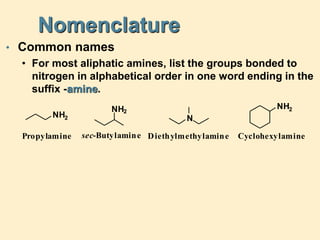
• Common names
• For most aliphatic amines, list the groups bonded to
nitrogen in alphabetical order in one word ending in the
suffix -amine.
Diethylmethylamine
sec-Butylamine
N
NH2
NH2
Cyclohexylamine
NH2
Propylamine
Nomenclature
• Amine salts
• When four atoms or groups of atoms are bonded to a
nitrogen atom, as for example CH3NH3
+, nitrogen bears
a positive charge and is associated with an anion as a
salt.
• Name the compound as a salt of the corresponding
amine.
• Replace the ending -amine (or aniline or pyridine or the
like) by -ammonium (or anilinium or pyridinium or the
like) and add the name of the anion.
( CH3 CH2 )3 NH+
Cl-
Triethylammonium chloride
Physical Properties
• Like ammonia, low-molecular-weight amines have
very sharp, penetrating odors.
• Trimethylamine, for example, is the pungent principle
in the smell of rotting fish.
• Two other particularly pungent amines are 1,4-
butanediamine (putrescine) and 1,5-pentanediamine
(cadaverine).
H2N NH2
1,5-Pentanediamine
(Cadaverine)
NH2
H2N
1,4-Butanediamine
(Putrescine)
Physical Properties
• Amines are polar compounds:
• Both 1° and 2° amines have N-H bonds, and can form
hydrogen bonds with one another.
• 3° amines have no N-H bond and cannot form hydrogen
bonds with one another.
Physical Properties
• An N-H---N hydrogen bond is weaker than an O-H---O
hydrogen bond, because the difference in
electronegativity between N and H (3.0 - 2.1 = 0.9) is
less than that between O and H (3.5 - 2.1 = 1.4).
• We see the effect of hydrogen bonding between
molecules of comparable molecular weight by
comparing the boiling points of ethane, methanamine,
and methanol.
CH3 OH
CH3 CH3 CH3 NH2
-6.3 65.0
32.0
31.1
MW (amu)
bp (°C)
30.1
-88.6
Physical Properties
• All classes of amines form hydrogen bonds with water
and are more soluble in water than are hydrocarbons of
comparable molecular weight.
• Most low-molecular-weight amines are completely
soluble in water.
• Higher-molecular-weight amines are only moderately
soluble in water or are insoluble.
Basicity of Amines
• Like ammonia, amines are weak bases, and
aqueous solutions of amines are basic.
• The acid-base reaction between an amine and water
involves transfer of a proton from water to the amine.
CH3-N
H
H
H-O-H CH3-N-H
H
H
O-H
Methylammonium
hydroxide
Methylamine
(a base)
+
+
-
: :
:
:
:
:
Basicity of Amines
• The base dissociation constant, Kb, for the
reaction of an amine with water has the following
form, illustrated for the reaction of methylamine
with water to give methylammonium hydroxide.
• pKb is defined as the negative logarithm of Kb
Kb = = 4.37 x 10⁻⁴
[ CH3 NH3
+
] [ OH
-
]
[ CH3 NH2 ]
pKb = - log 4.37 x 10 -4
= 3.36
Basicity of Amines
• Aliphatic amines have about the same base strength,
and are slightly stronger bases than NH3.
• Aromatic and heterocyclic aromatic amines are
considerably weaker bases than aliphatic amines.
• Note that while aliphatic amines are weak bases by
comparison with inorganic bases such as NaOH, they
are strong bases among organic compounds.
C6 H5 NH2
CH3 CH2 NH2
Aliphatic
Ammonia
Aromatic
3.0 - 4.0
4.74
8.5 - 9.5
Class pKb Example Name
Ethanamine
Aniline
Stronger base
Weaker base
Basicity of Amines
• Assume that the amine, RNH2, has a pKb of 3.50 and
that it is dissolved in blood, pH 7.40 (pOH 6.60).
• We first write the base dissociation constant for the
amine and then solve for the ratio of RNH3
+ to RNH2.
• substituting values for Kb and OH- gives:
RNH2 H2 O RNH3
+
OH-
+ +
[RNH3
+
] [OH-
]
[ RNH2 ]
Kb =
[RNH3
+
]
[RNH2 ]
[OH
-
]
Kb
=
[ RNH3
+
]
[ RNH2 ]
3.2 x 10⁻⁴
2.5 x 10-7 = = 1300
Basicity of Amines
• Given the basicities of amines, we can determine
which form of an amine exists in body fluids, say
blood.
• In a normal, healthy person, the pH of blood is
approximately 7.40, which is slightly basic.
• If an aliphatic amine is dissolved in blood, it is present
predominantly as its protonated (conjugated acid)
form.
HO
HO
NH2
Dopamine
HO
HO
NH3
+
Conjugate acid of dopamine
(the major form present
in blood plasma)
Reactions of Amines
• The most important chemical property of amines
is their basicity.
• Amines, whether soluble or insoluble in water, react
quantitatively with strong acids to form water-soluble
salts.
HO H
NH2
HO
HO
HCl
H2 O
HO
HO NH3
+
Cl
-
H
HO
(R)-Norepinephrine hydrochloride
(a water-soluble salt)
+
(R)-Norepinephrine
(only slightly soluble in water)
Reactions of Amines
• example: Complete each acid-base reaction and name
the salt formed.
( CH3 CH2 )2 NH HCl
N
CH3 COOH
+
(a)
(b) +
Reactions of Amines
• example: Complete each acid-base reaction and name
the salt formed.
• solution:
(CH3 CH2 ) 2 NH HCl
N
CH3 COOH
N
H
(CH3 CH2 ) 2 NH2
+
Cl
-
CH3 COO-
Diethylammonium
chloride
+
Pyridinium acetate
+
(a)
(b) +
End
Chapter 15
Amines