The document describes the bisection method, a root-finding algorithm that uses binary search to find roots (values that make a function equal to zero) of a continuous function. It works by repeatedly bisecting an interval known to contain a root and narrowing in on the root. The key steps are: (1) Start with an interval [a,b] where the function changes sign, ensuring a root exists in the interval. (2) Calculate the midpoint m of the interval. (3) Determine which subinterval [a,m] or [m,b] contains the root based on the sign change and update the interval accordingly. (4) Repeat until the interval size is small enough to approximate the root.


![A Mathematical Property
• Well-known Mathematical Property:
• If a function f(x) is continuous on the interval [a..b] and sign of f(a) ≠ sign of
f(b), then
• There is a value c ∈ [a..b] such that: f(c) = 0 I.e., there is
a root c in the interval [a..b]](/proxy?url=https%3A%2F%2Fimage.slidesharecdn.com%2Funit4-170125100310%2F85%2FUnit4-4-320.jpg)

![The Bisection Method
• The Bisection Method is a successive approximation method
that narrows down an interval that contains a root of the
function f(x)
• The Bisection Method is given an initial interval [a..b] that
contains a root (We can use the property sign of f(a) ≠ sign of
f(b) to find such an initial interval)
• The Bisection Method will cut the interval into 2 halves and
check which half interval contains a root of the function
• The Bisection Method will keep cut the interval in halves until
the resulting interval is extremely small
The root is then approximately equal to any value in the final
(very small) interval.](/proxy?url=https%3A%2F%2Fimage.slidesharecdn.com%2Funit4-170125100310%2F85%2FUnit4-6-320.jpg)
![The Bisection Method (cont.)
• Example:
• Suppose the interval [a..b] is as follows:](/proxy?url=https%3A%2F%2Fimage.slidesharecdn.com%2Funit4-170125100310%2F85%2FUnit4-7-320.jpg)
![The Bisection Method (cont.)
• We cut the interval [a..b] in the middle: m = (a+b)/2](/proxy?url=https%3A%2F%2Fimage.slidesharecdn.com%2Funit4-170125100310%2F85%2FUnit4-8-320.jpg)
![The Bisection Method (cont.)
• Because sign of f(m) ≠ sign of f(a) , we proceed with the
search in the new interval [a..b]:](/proxy?url=https%3A%2F%2Fimage.slidesharecdn.com%2Funit4-170125100310%2F85%2FUnit4-9-320.jpg)


![The Bisection Method (cont.)
• Here is an example where you have to change the end
point a:
• Initial interval [a..b]:](/proxy?url=https%3A%2F%2Fimage.slidesharecdn.com%2Funit4-170125100310%2F85%2FUnit4-12-320.jpg)

![The Bisection Method
• Rough description (pseudo code) of the Bisection Method:
Given: interval [a..b] such that: sign of f(a) ≠ sign of f(b)
repeat (until the interval [a..b] is "very small")
{
a+b
m = -----; // m = midpoint of interval [a..b]
2
if ( sign of f(m) ≠ sign of f(b) )
{
use interval [m..b] in the next iteration](/proxy?url=https%3A%2F%2Fimage.slidesharecdn.com%2Funit4-170125100310%2F85%2FUnit4-14-320.jpg)
![The Bisection Method
(i.e.: replace a with m)
}
else
{
use interval [a..m] in the next iteration
(i.e.: replace b with m)
}
}
Approximate root = (a+b)/2; (any point between [a..b] will do
because the interval [a..b] is very small)](/proxy?url=https%3A%2F%2Fimage.slidesharecdn.com%2Funit4-170125100310%2F85%2FUnit4-15-320.jpg)


![The Bisection Method (cont.)
• We will use the starting interval [0..4] since:
The interval [0..4] contains a root because: sign of f(0) ≠
sign of f(4)
• f(0) = 02 − 3 = −3
• f(4) = 42 − 3 = 13](/proxy?url=https%3A%2F%2Fimage.slidesharecdn.com%2Funit4-170125100310%2F85%2FUnit4-18-320.jpg)

![Regula-Falsi Method
Type of Algorithm (Equation Solver)
The Regula-Falsi Method (sometimes called the False Position Method) is a method used
to find a numerical estimate of an equation.
This method attempts to solve an equation of the form f(x)=0. (This is very common in
most numerical analysis applications.) Any equation can be written in this form.
Algorithm Requirements
This algorithm requires a function f(x) and two points a and b for which f(x) is positive for
one of the values and negative for the other. We can write this condition as f(a)f(b)<0.
If the function f(x) is continuous on the interval [a,b] with f(a)f(b)<0, the algorithm will
eventually converge to a solution.
This algorithm can not be implemented to find a tangential root. That is a root that is
tangent to the x-axis and either positive or negative on both side of the root. For example
f(x)=(x-3)2, has a tangential root at x=3.](/proxy?url=https%3A%2F%2Fimage.slidesharecdn.com%2Funit4-170125100310%2F85%2FUnit4-20-320.jpg)

![Example
Lets look for a solution to the equation x3-2x-3=0.
We consider the function f(x)=x3-2x-3
On the interval [0,2] the function is negative at 0 and positive at 2. This means that a=0
and b=2 (i.e. f(0)f(2)=(-3)(1)=-3<0, this means we can apply the algorithm).
2
3
4
6
31
)2(3
)0()2(
02)0(
0
ff
f
xrfp
8
21
2
3
)(
fxf rfp
This is negative and we will make the a =3/2 and
b is the same and apply the same thing to the
interval [3/2,2].
29
54
58
21
2
3
12
3
)2(
2
2
3
8
21
2
1
8
21
2
3
2
3
2
3
ff
f
xrfp
267785.0
29
54
)(
fxf rfp
This is negative and we will make the a =54/29 and
b is the same and apply the same thing to the
interval [54/29,2].](/proxy?url=https%3A%2F%2Fimage.slidesharecdn.com%2Funit4-170125100310%2F85%2FUnit4-22-320.jpg)


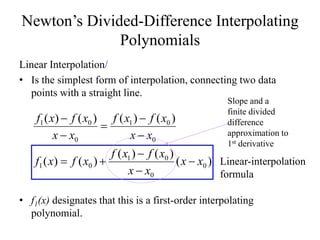


![General Form of Newton’s Interpolating Polynomials/
0
02111
011
011
0122
011
00
01110
012100100
],,,[],,,[
],,,,[
],[],[
],,[
)()(
],[
],,,,[
],,[
],[
)(
],,,[)())((
],,[))((],[)()()(
xx
xxxfxxxf
xxxxf
xx
xxfxxf
xxxf
xx
xfxf
xxf
xxxxfb
xxxfb
xxfb
xfb
xxxfxxxxxx
xxxfxxxxxxfxxxfxf
n
nnnn
nn
ki
kjji
kji
ji
ji
ji
nnn
nnn
n
Bracketed function
evaluations are finite
divided differences](/proxy?url=https%3A%2F%2Fimage.slidesharecdn.com%2Funit4-170125100310%2F85%2FUnit4-29-320.jpg)


![
)(
)()()(
)()()(
2
1202
10
1
2101
20
0
2010
21
2
1
01
0
0
10
1
1
xf
xxxx
xxxx
xf
xxxx
xxxx
xf
xxxx
xxxx
xf
xf
xx
xx
xf
xx
xx
xf
•As with Newton’s method, the Lagrange version has an
estimated error of:
n
i
innn xxxxxxfR
0
01 )(],,,,[ ](/proxy?url=https%3A%2F%2Fimage.slidesharecdn.com%2Funit4-170125100310%2F85%2FUnit4-32-320.jpg)




![CH-2_5 ROOTS_OF_NON_LINEAR_EQ [Compatibility Mode].pdf](/proxy?url=https%3A%2F%2Fcdn.slidesharecdn.com%2Fss_thumbnails%2Fch-25rootsofnonlineareqcompatibilitymode-260123171244-4215d39d-thumbnail.jpg%3Fwidth%3D640%26height%3D640%26fit%3Dbounds)


