STEM CELLS
PRESENTER: ZELEKE ENDALEW (MSc)
MODERATOR: Dr. Solomon Genet( PHD)
1
Objectives
 Define what stem cells are
 List the types of stem cells and their
properties
 List the methods of stem cell culture
 List the medical roles of stem cells
9/20/2022
Stem cells
2
Outline
 Definition
 Types of stem cells
 Stem cells and organogenesis
 Stem Cell Culture
 Medical roles of stem cells
 Summary
 References
9/20/2022
Stem cells
3
What are Stem Cells?
4
 A stem cell is a relatively unspecialized cell
that can reproduce itself indefinitely.
 able to differentiate into any cell of an organism
and have the ability of self-renewal.
 exist both in embryos and adult cells.
5
 They have two unique properties that enable
them to do this
 They can divide over and over again to produce
new cells.
 As they divide, they can change into the other
types of cells that make up the body.
6
What factors account for the stemness and
cell differentiation capability of ES cells?
 Expression of high levels of active telomerase.
 allows them to escape senescence.
 Expression of specific genes.
 A gene called Oct4, is exclusively expressed in
ES cells.
 Codes for a transcription regulator.
 A core set of transcription regulators defines and
maintains the ES cell state.
Types of Stem Cell
7
There are three main types of stem cell:
 Embryonic stem cells
 Supply new cells for an embryo as it grows and
develops into a baby.
 Are said to be pluripotent,
 they can change into any cell in the body.
8
https://pubmed.ncbi.nlm.nih.gov/16923385/
9
Adult stem cells
 Supply new cells as an organism grows and to
replace cells that get damaged.
 Are said to be multipotent
 they can only change into some cells in the body,
not any cell.
Adult stem cells…
10
 Blood (or 'haematopoietic') stem cells can only
replace the various types of cells in the blood.
 Skin (or 'epithelial') stem cells provide the
different types of cells that make up our skin
and hair.
11
Induced pluripotent stem cells (iPS cells)
 Stem cells that scientists make in the
laboratory
 Induced’ means that they are made in the lab
by taking normal adult cells, like skin or blood
cells, and reprogramming them to become
stem cells.
 Just like embryonic stem cells, they are
pluripotent so they can develop into any cell
type
Stem cell Types …
 Stem cells are of many types, specialized
for the genesis of different classes of
terminally differentiated cells—
 intestinal stem cells for intestinal epithelium,
 epidermal stem cells for epidermis,
 hematopoietic stem cells for blood
9/20/2022
Stem cells
12
 Tissue Renewal That Does Not Depend on
Stem Cells:
 Insulin Secreting Cells in the Pancreas and
 Hepatocytes in the Liver
 Some types of cells can divide even though
fully differentiated
 allowing for renewal and regeneration without the
use of stem cells.
9/20/2022
Stem cells
13
 insulin-secreting cells (β cells) of the
pancreas
 Sequestered in cell clusters called islets of
Langerhans
 contain no obvious subset of cells specialized
to act as stem cells
 yet fresh β cells are continually generated
within them
 Renewal occurs by simple duplication of the
existing insulin-expressing cells, not by
means of stem cells.
9/20/2022
Stem cells
14
Hepatocyte
 renew by simple duplication of fully differentiated
cells
 normally live for a year or more and renew
themselves through cell division at a very slow rate
 Within a day or so after either sort of damage, a
surge of cell division occurs among the surviving
hepatocytes, quickly replacing the lost tissue.
9/20/2022
Stem cells
15
 If two-thirds of a rat’s liver is removed, for
example, a liver of nearly normal size can
regenerate from the remainder by
hepatocyte proliferation within about two
weeks.
 Both the pancreas and the liver contain
small populations of stem cells that can be
called into play as a backup mechanism for
production of the differentiated cell types in
more extreme circumstances.
9/20/2022
Stem cells
16
 Some Tissues Lack Stem Cells and Are Not
Renewable
 the auditory epithelium and the retinal
epithelium lack stem cells, and their sensory
receptor cells—the sensory hair cells in the
ear, the photoreceptors in the retina—are
irreplaceable.
9/20/2022
Stem cells
17
Fibroblasts
 When a tissue is injured, the fibroblasts nearby
proliferate, migrate into the wound and
 produce large amounts of collagenous matrix that
helps to isolate and repair the damaged tissue.
 are the easiest of cells to grow in culture
 a feature that has made them a favorite subject for
cell biological studies.
9/20/2022
Stem cells
18
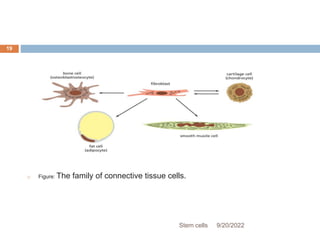
 Figure: The family of connective tissue cells.
9/20/2022
Stem cells
19
 Figure : Control of fibroblast differentiation by the physical properties of the extracellular matrix.
9/20/2022
Stem cells
20
Myoblasts
 Precursors of skeletal muscle fibers.
 after a period of proliferation, they stop dividing,
 expression of a muscle-specifc genes required for
terminal differentiation
 Fuse with one another to form multinucleate skeletal
muscle fibers
 Once differentiation and cell fusion have occurred,
the cells do not divide
 The nuclei never again replicate their DNA.
9/20/2022
Stem cells
21
 Some Myoblasts Persist as Quiescent Stem Cells in
the Adult
 able of serving as myoblasts are retained
 small, flattened, and inactive cells lying in close
contact with the mature muscle cell
 The process of muscle repair by means of satellite
cells is, however, limited.
 exhaustion of their regenerative capacity
9/20/2022
Stem cells
22
myoSatellite cells
 Are the stem cells of adult skeletal muscle
 held in reserve in a quiescent state
 available when needed as a self-renewing
source of terminally differentiated cells.
 If the muscle is damaged or stimulated to
grow, these cells are activated to proliferate
 their progeny can fuse to repair the damaged
muscle or to allow muscle growth.
9/20/2022
Stem cells
23
BLOOD CELLS
 Are all generated from a common stem cell, located
in the bone marrow.
 hematopoietic stem cell is thus multipotent
 giving rise to all the types of terminally
differentiated blood cells as well as some other
types of cells, such as the osteoclasts in bone
 have limited life-spans and are produced throughout
life.
9/20/2022
Stem cells
24
 Bone Marrow Contains Multipotent Hematopoietic
Stem Cells, Able to Give Rise to All Classes of Blood
Cells
 The developing blood cells and their precursors,
including the stem cells, are intermingled with one
another
 The stem cells constitutes a tiny fraction of the bone
marrow population
 about 1 cell in 50,000–100,000
9/20/2022
Stem cells
25
Figure: Depiction of hematopoiesis cell lines
9/20/2022
Stem cells
26
Neural Stem Cells
 Stem cells capable of generating new neurons are
hard to find.
 Were thought to be absent many years.
 Can be manipulated in culture and used to
repopulate the central nervous system.
 It is now discovered that neural stem cells that
generate both neurons and glial cells do persist in
certain parts of the adult human brain.
 There is continuing turnover of neurons in the
hippocampus.
9/20/2022
Stem cells
27
 Neural stem cells can be obtained from The
hippocampal region or fetal brains
 Grown in culture, and then grafted back into
other sites in the brain,
 generate neurons appropriate to the new
location.
9/20/2022
Stem cells
28
 Neural stem cells from pluripotent stem
cells can be grafted into an adult brain.
9/20/2022
Stem cells
29
 Embryonic Stem (ES) Cells Can Generate Any Part
of the Body.
 A fertilized egg, or an equivalent cell produced by
nuclear transplantation can generate a whole new
multicellular individual.
 can be taken from an early mouse embryo, at the
blastocyst stage.
 A class of stem cells called embryonic stem cells
through cell culture can be driven from it.
 Originate from the inner cell mass of the early
embryo.
9/20/2022
Stem cells
30
 Figure : Production and pluripotency of ES cells.
9/20/2022
Stem cells
31
 iPS cells also be derived from adult human
cells and from various other differentiated cell
types besides fibroblasts.
 ES and iPS cells can be guided to generate
specific adult cell types and even whole
organs.
9/20/2022
Stem cells
32
 Cells of one specialized type can be forced to
transdifferentiate directly into another.
 Fibroblasts can be made to transdifferentiate
directly into heart muscle cells.
 By forcing expression of combination of
factors: Gata4, Mef2c, and Tbx5
9/20/2022
Stem cells
33
34
 Reprogramming focuses on the expression of
oncogenes such as
 octamer-binding transcription factor-4 (Oct4),
 Kruppel-like factor-4 (Klf4)
 c-myelocytomatosis (c-Myc)
 enhanced by a downregulation of genes
promoting genome stability, such as p53.
Stem Cells and organogenesis
35
 After fertilization, the zygote usually divides
rapidly, or cleaves, to form many smaller cells.
 during this cleavage, the embryo does not
grow.
 a blastula—typically a solid or a hollow fluid-
filled ball of cells is then formed.
Stem Cells and
organogenesis…
36
 Complex cell rearrangements called
gastrulation
 transform the blastula into a multilayered
structure containing. a rudimentary internal gut.
 Some cells of the blastula remain external,
constituting the ectoderm, which will give rise
to the epidermis and the nervous system.
Stem Cells and
organogenesis…
37
 A blastocyst is formed after the fusion of sperm
and
ovum fertilization. Its inner wall is lined with
short- lived stem cells, namely, embryonic stem
cells.
 Blastocysts are composed of two distinct cell
types:
 The inner cell mass (ICM), develops into epiblasts
and induces the development of a foetus.
 the trophectoderm (TE).
38
 The trophectoderm continues to develop
 forms the extraembryonic support structures
needed for the successful origin of the embryo,
such as the placenta
 As the TE begins to form a specialized support
structure, the ICM cells remain
undifferentiated, fully pluripotent and
proliferative
 allows them to form any cell of the organism
39
 Human embryonic stem cells (hESCs) are
derived from the ICM.
 During the process of embryogenesis, cells
form aggregations called germ layers
 Each germ layers eventually give rise to
differentiated cells and tissues of the foetus
and, later on, the adult organism.
40
 After hESCs differentiate into one of the germ
layers, they become multipotent stem cells,
 potency limited to only the cells of the germ layer.
 Pluripotent stem cells will then be formed all
over the organism as undifferentiated cells
 Able to proliferate by the formation of the next
generation of stem cells
 differentiation into specialized cells under certain
physiological conditions.
41
 Although the derivation of ESCs without
separation from the TE is possible, such a
combination has growth limits.
 proliferating actions are limited, co-culture of
these is usually avoided.
Stem cell Culturing
42
 Cells are placed in a culture dish filled with
culture medium.
 Passage is inefficient but popular process of
sub-culturing cells to other dishes.
43
 Phenotypic pluripotency assays
 Recognizing undifferentiated cells is crucial in
successful stem cell therapy.
 Stem cells appear to have a distinct morphology
 a prominent nucleolus, high nucleus to cytoplasm
ratio
 Cells appear to be flat with defined borders, in
contrast to differentiating colonies.
 appear as loosely located cells with rough
borders.
44
 When stem cells differentiate, the methylation
process silences pluripotency genes
 reduces differentiation potential, although other
genes may undergo demethylation to become
expressed.
45
hESC derivation and media
 hESCs can be derived using a variety of
methods, from classic culturing to
microsurgery.
 hESC differentiation must be specified to avoid
teratoma formation.
 hESCs spontaneously differentiate into
embryonic
bodies (EBs).
46
 EBs can be studied instead of embryos or
animals to predict their effects on early human
development.
47
 The essential part of these culturing
procedures is a
separation of inner cell mass to culture future
hESCs.
 Particular attention must be taken in
controlling spontaneous differentiation.
 When the colony reaches the appropriate size,
cells must be separated.
48
 Cell passaging is used to form smaller clusters of
cells on a new culture surface.
There are four important passaging procedures.
Enzymatic dissociation
 is a cutting action of enzymes on proteins and
adhesion domains that bind the colony.
 It is crucial to not leave hESCs alone after
passaging.
 Solitary cells are more sensitive and can easily
undergo cell death
 collagenase type IV is an example.
49
Manual passage
 Focuses on using cell scratchers.
 The selection of certain cells is not necessary.
 This should be done in the early stages of cell
line derivation
50
Trypsin utilization
 allows a healthy, automated hESC passage.
 However, there is a risk of decreasing the
pluripotency and viability of stem cells.
51
Ethylene diamine tetraacetic acid (EDTA)
 indirectly suppresses cell-to-cell connections
by chelating divalent cations.
 Their suppression promotes cell dissociation.
 Prevent joining of cadherins (calcium dependent
adhesion) between cells
 Prevent clumping of cells
 Detaching adherent cells for passaging
Stem cell Culturing …
52
 Stem cells require a mixture of growth factors
and nutrients to differentiate and develop.
 The medium should be changed each day.
 Traditional culture methods used for hESCs
are
 mouse embryonic fibroblasts (MEFs) as a feeder
layer
 bovine serum as a medium.
53
 First feeder layer-free culture can be
supplemented with serum replacement,
combined with laminin .
 This causes stable karyotypes of stem cells
and pluripotency lasting for over a year.
 Initial culturing media can be
 serum (e.g. foetal calf serum (FCS)
 artificial replacement such as
 Synthetic serum substitute (SSS),
 Knockout Serum Replacement (KOSR), or
 StemPro.
54
 Turning point in stem cell therapy
John B. Gurdon in 1962
 Challenged the dogma that the specialized
cell is irreversibly committed to its fate.
 Successfully cloning frogs by transferring a
nucleus from a frog’s somatic cells into an
oocyte.
 demonstrated that it is possible for a somatic
cell to again acquire pluripotency.
55
56
Davis R.L. in 1987
 showed that reprogramming cells is possible,
and it can even be used to transform cells from
one lineage to another
 enforced expression of genes that were
originally found in myoblasts caused the
conversion of fibroblasts into myoblasts.
 myogenic differentiation 1 (Myod1)
57
Shinya Yamanaka and Kazutoshi Takahashi In
2006
 discovered that it is possible to reprogram
multipotent adult stem cells to the pluripotent
state.
 avoided endangering the foetus’ life in the
process.
58
 Four transcription factors (Oct-3/4, Sox2,
KLF4, and c-Myc).
 Are mainly expressed in embryonic stem cells
 could induce the fibroblasts to become pluripotent
 This new form of stem cells was named
iPSCs.
 One year later, the experiment also succeeded
with human cells.
Medical roles of Stem Cells
59
 play a large role in developing restorative
medicine.
 The difference between a stem cell and a
differentiated cell is reflected in the cells’ DNA.
Medical roles of Stem cells…
60
 Many serious medical conditions, such as birth
defects or cancer, are caused by improper
differentiation or cell division.
 Several stem cell therapies are possible,
among which are treatments for Heart failure,
retinal and macular degeneration, tendon
ruptures, and diabetes type 1
61
Hematopoietic stem cell transplantation
 the most popular stem cell therapy.
 the most tissue-specific stem cells
 experimentally studied for more than 50 years.
 HSCs are responsible for the generation of all
functional haematopoietic lineages in blood.
62
limitations
 There is a limited number of transplantable
cells
 an efficient way of gathering them has not yet
been found.
 problem with finding a fitting antigen-matched
donor for transplantation.
 Viral contamination or any immunoreactions
can cause a reduction in efficiency
63
Stem cells as a target for pharmacological testing
 Stem cells can be used in new drug tests.
 Each experiment on living tissue can be
performed safely on specific differentiated cells fro
pluripotent cells
 If any undesirable effect appears, drug formulas
can be changed until they reach a sufficient level
of effectiveness.
 Figure: Use of iPS cells for drug discovery and for analysis and treatment of genetic disease.
9/20/2022
Stem cells
64
65
 Stem cells as an alternative for arthroplasty.
Rejuvenation by cell programming.
 using cell reprogramming technology in elder
animals and humans to erase marks of ageing
without removing the epigenetic marks of cell
identity.
66
 Cells from aged individuals have
 different transcriptional signatures,
 high levels of oxidative stress,
 dysfunctional mitochondria, and
 shorter telomeres than in young cells
67
 There is a hypothesis that when human or
mouse adult somatic cells are reprogrammed
to iPSCs, their epigenetic age is virtually reset
to zero.
68
Cell-based therapies
 Stem cells can be induced to become a
specific cell type that is required to repair
damaged or destroyed tissues.
69
 It is possible to generate healthy heart muscle
cells and later transplant them to patients with
heart disease.
 it can be possible to induce stem cells to
differentiate into insulin-producing cells
70
71
Fertility diseases
 Scientists showed that it is possible to form
sperm from iPSCs
 Young adults at risk of losing their
spermatogonial stem cells (SSC), mostly
cancer patients can benefit from it
72
 Therapy for incurable neurodegenerative
diseases
 Parkinson’s disease, Alzheimer’s disease
(AD), and Huntington disease.
73
 Brain tissue from aborted fetuses was used on
patients with Parkinson’s disease
 showed that therapies with pure stem cells are an
important and achievable therapy.
74
Stem cell use in dentistry
 There are stem cells in the periodontal
ligament
 capable of differentiating into osteoblasts or
cementoblasts
 their functions were also assessed in neural cells
 Stem cells of the root apical areas are able to
recreate periodontal ligament.
Medical role…
75
 Adult stem cells are currently used to treat
some conditions, for example:
 Blood stem cells are used to provide a source of
healthy blood cells for people with some blood
conditions:
 Thalassaemia
 cancer patients who have lost their own blood stem
cells during treatment.
Medical roles…
76
 Age-related macular degeneration (AMD)
 a condition in which cells in the retina of the eye
called retinal pigment epithelium (RPE) cells stop
working.
 stem cells could be used as a new form of
treatment in the future:
 using iPSCs to produce new RPE cells in the lab
that can then be put into a patient’s eye to replace
the damaged cells.
77
An illustration showing how stem cells can be used to produce retinal pigment epithelium
(RPE) cells that can
be used to treat patients with age-related macular degeneration (AMD).
Image credit: Genome Research Limited
Medical roles
78
 Stem cells could be used to generate new organs
for use in transplants:
 damaged organs can be replaced by obtaining
healthy organs from a donor
 donated organs may be 'rejected' by the body as
the immune system sees it as something that is
foreign.
Summary
79
 A stem cell is a relatively unspecialized cell
that can reproduce itself indefinitely and act
as internal repair systems of the body.
 The three types of Stem cells are ESCs,
Adult stem cells and iPSC
 Stem cells can be isolated and be cultured
under appropriate conditions.
 Stem cells may be one way of generating
new cells that can then be transplanted into
the body to replace those that are damaged
or lost.
80
 Differentiated stem cells can be reprogrammed
to give undifferentiated cells capable of
differentiation into different lineage.
 Stem cells when specialized gives the genesis
of different classes of terminally differentiated
cell.
 Stem cells have immense medical role including
the cure for neurodegenerative diseases.
References
81
 Takahashi, K. and Yamanaka, S. (2006) ‘Induction of Pluripotent
Stem Cells from Mouse Embryonic and Adult Fibroblast Cultures by
Defined Factors’, Cell, 126(4), pp. 663–676. doi:
10.1016/j.cell.2006.07.024.
 Albert, B., Johnson, A. and Lewis, J., 2015. Molecular Biology of
The Cell. New York: Garland Science.
 Khan, F. A. et al. (2018) ‘Isolation, Culture, and Functional
Characterization of Human Embryonic Stem Cells: Current Trends
and Challenges’, Stem Cells International. Edited by V. Sorrenti,
2018, p. 1429351. doi: 10.1155/2018/1429351.
 Campbell’s molecular biology of the cell eleventh edition.
 Rahman, M. et al. (2016) ‘STEM CELL AND CANCER STEM CELL:
A Tale of Two Cells’, Progress in Stem Cell, 3(02), p. 97. doi:
10.15419/psc.v3i02.124.
 Li, Y., Xu, C. and Ma, T. (2014) ‘In vitro organogenesis from
pluripotent stem cells’, Organogenesis, 10(2), pp. 159–163. doi:
10.4161/org.28918.