SEGMENTATION
Segmentation
• It is often the key to developing a sustainable
competitive advantage. In a strategic context,
segmentation means the identification of
customer groups that respond differently from
other groups to competitive offerings.
• A segmentation strategy couples the
identified segments with a programme to
deliver an offering to those segments.
The development of a successful
segmentation strategy requires the
conceptualization, development, and
evaluation of a targeted competitive
offering.
Who are the biggest customers? The
most profitable? The most attractive
potential customers?
3 dimensions for Judging a
segmentation strategy
• Can a competitive offering be developed
and implemented that will be appealing to
the target segment ?
• Can the appeal of the offering and the
subsequent relationship with the target
segment be maintained over time despite
competitive responses ?
• Is the resulting business from the target
segment worthwhile given the investment
required to develop and market an offering
tailored to it ?
• The concept of a successful segmentation
strategy is that within a reduced market
space, it is possible to create a dominant
position that competitors will be unwilling
or unable to attack successfully.
Chapter 2 - External and
Customer Analysis
PPT 2-6
Examples of Approaches to Defining
Segments
Customer Characteristics
• Geographic
• Type of organization
• Size of firm
• Lifestyle
• Sex
• Age
• Occupation
Figure 2.3
Chapter 2 - External and
Customer Analysis
PPT 2-7
Examples of Approaches to Defining
Segments
Product-Related Approaches
• User type
• Usage
• Benefits sought
• Price sensitivity
• Competitor
• Application
• Brand loyalty
Figure 2.3
The first set of variables describes segments in terms of
general characteristics unrelated to the product
involved.
Eg
a consulting company may specialize in the hospitality
industry.
A fast food firm may focus on a particular fast growing
ethnic group.
A bakery may confine itself to geographically defined
segments eg . to a particular community or
neighbourhood.
• Demographics are particularly powerful for defining
segments largely because a person’s life stage affects
his or her activities, interests and brand loyalty. Another
reason is that demographic trends are predictable.
• Eg the US population over 65 is expected to grow to 50
million in 2020 when more than 5 million people will be
85 or older. Gold Violin recognizing this trend, has
established itself as a source of products designed for
the active elderly.
• Thus they have a talking watch, a bed- vibrating alarm
clock, a doorknob turner, a lighted hands- free magnifier
( all with attractive designs ) are just some of the Gold
Violin products that appeal to this long – ignored
demographic segment.
The second category of variables includes those
that are related to the product. One of the most
frequently used is usage.
A manufacturer of lawn equipment may design a
special line for a large consumer like Walmart, but
sell through distributors using another brand name
for other outlets.
A bakery may follow a very different strategy in
serving restaurants that rely very heavily on bakery
products than in serving those with fewer such
products.
Chapter 2 - External and
Customer Analysis
PPT 2-11
Segmentation
How should segments be defined?
– Benefit Segmentation
– Price Sensitivity
– Loyalty
– Applications
– Multiple Segments versus Focus Strategy
Benefits
• Benefits sought from products is a very useful
segmentation variable, as selection of benefits
can determine a total business strategy.
Eg. for gourmet frozen dinners/entrees we can segment
the market into those who are calorie- conscious, those
who focus on nutrition and health and those interested in
taste.
Each segment would require a very different marketing
strategy.
Price sensitivity
• In many product classes , there is a well - defined
breakdown between customers concerned first about
price and others who are willing to pay extra for higher
quality and features.
• Eg general merchandise stores form a well defined
hierarchy from the discounters to the prestige
department stores.
• Automobiles span the spectrum from Honda Civic to the
Lexus to the Rolls Royce.
• Airlines have first class, business class and economy.
• In each case the segment dictates the strategy
Loyalty
• Brand loyalty can be structured using a loyalty
matrix. Each cell represents a very different strategic
priority and can justify a very different programme.
• Generally. Loyal customers are taken for granted.
However, a study by Bain shows that a 5 %
increase in customer loyalty can nearly double the
lifetime profits generated by customers in several
industries including banking, insurance, automobile
service, publishing and credit cards.
• The key is often to reward the loyal customers by living
up to expectations consistently, providing an ongoing
relationship, and offering extras that surprise and delight.
• The loyalty matrix suggests that the brand fence sitters ,
including those of competitors, should also have high
priority.
• Using the matrix involves estimating the size of each of
the six cells, identifying the customers in each group and
designing programmes that will influence their brand
choice and loyalty level
Chapter 2 - External and
Customer Analysis
PPT 2-16
The Brand Loyalty Matrix: Priorities
Low
Loyalty
Moderate
Loyalty
Loyal
Customer
Non-customer
Medium
Low
to
Medium
High
Highest
Zero
High
Figure 3.4
Applications
• Some products and services, particularly
industrial products can best be segmented by
use or application. A portable computer may be
needed by some for use while travelling,
whereas others may need a computer at the
office that can be conveniently stored when not
in use. One segment may use a computer for
word processing .
• Some might use a 4 wheel drive for light
industrial hauling and others may be buying it
primarily for recreation.
• The athletic shoe industry segments into :
• A) Serious athletes ( small in number, but
influential)
• B) The Weekend warriors ( weekend
users)
• C) The casual wearers ( using them for
street wear)
• 80% of the market being composed of the
casual wearer segment and not really
needing performance, several shoe firms
have adopted a style focus strategy as an
alternative to the performance strategy
adopted by firms such as NIKe.
Multiple Segments vs Focus Strategy
Walmart, the largest US retailer started by
concentrating on cities with populations under
25,000 in eleven south central states, a hitherto
totally neglected segment by its competitors the
large discount chains.
This rural geographic focus gave it several
significant SCAs viz.
• an efficient and responsive warehouse supply
system,
• a low-cost motivated workforce
• relatively inexpensive retail space
• a lean and mean hands on management style.
Union Bank, California’s 8 eighth largest bank
makes no effort to serve individual customers.
Instead it provides a service operation tailored
to business accounts that is more committed
and comprehensive than those of its
competitors.
On the other hand….
Aggressive industries in many firms are moving towards
multiple segment strategies. Campbell Soup makes its nacho
cheese soup spicier for customers in Texas and California.
It offers a Creole Soup for Southern markets and a red- bean
soup for Hispanic markets.
In New York it links promotions with the New York Giants
football team and in S. Nevada mountains skiers are given
hot soup samples.
Developing multiple strategies is costly and needs to be
justified by an enhanced aggregate impact.
Market segmentation
• Companies recognize they cannot appeal to all buyers in
the marketplace, at least not to all buyers in the same
way. Buyers are too numerous, too widely scattered and
too varied in their needs and buying practices.
• Also, companies themselves vary greatly in their ability
to serve different segments. Thus a company must
identify the parts of the market it can serve best and
most profitably. It must design customer- driven
marketing strategies that build the right relationships with
the right customers.
Shotgun vs Rifle
• Hence , most companies have moved away from
mass marketing and towards target marketing.-
identifying market segments, selecting one or
more of them and developing products and
marketing programmes tailored to each.
• Instead of scattering their marketing efforts
( the shotgun approach) , firms are focusing on
the buyers who have greater interest in the
values they create best (the rifle approach)
Customer-Driven Marketing Strategy:
Creating Value for Target Customers
• Market Segmentation
• Market Targeting
• Differentiation and Positioning
The Process and Concepts
defined
• Market segmentation involves dividing the
market into smaller groups of buyers with
distinct needs, characteristics, or behaviours
that might require separate marketing
strategies or mixes.
• The company identifies different ways to
segment the market and develops profiles of
the resulting market segments.
Market Targeting
Consists of evaluating each ,market
segment’s attractiveness and selecting
one or more market segments to enter.
• Next, the company decides on a Value
Proposition – on how it will create value for
target customers
• Differentiation involves actually differentiating
the firm’s market offering to create superior
value
• Positioning consists of arranging for a market
offering to occupy a clear distinctive, desirable
place relative to competing products in the
minds of target consumers.
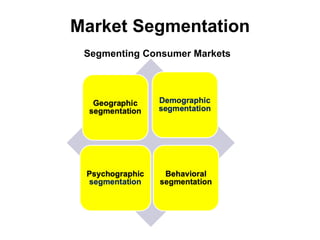
Market Segmentation
Market Segmentation
Segmenting Consumer Markets
Market Segmentation
• Geographic segmentation divides the market into
different geographical units such as nations,
regions, states, counties, or cities.
• Many companies today are localising their
products.eg Citibank offers different mixes of branch
banking services depending on neighbourhood
demographics. Baskin Robbins does “3 mile
marketing” emphasizing local events and
promotions close to its local store locations.
Segmenting Consumer Markets
• Many large companies are seeking to cultivate as
yet untapped geographic territory. Many large
companies are fleeing the competition of major cities
and suburbs to set up shop in rural and semi - urban
India eg smaller size retail formats which offer a
more intimate neighbourhood store setting.
Walmart has complemented its supercenters
by opening small super market style Market-side
grocery stores in markets where full size stores are
impractical.
Market Segmentation
Demographic segmentation divides the
market into groups based on variables
such as age, gender, family size, family
life cycle, income, occupation, education,
religion, race, generation, and nationality
Demographic segmentation
• Demographic factors are the most popular bases for
segmenting customer groups.
• The reasons for this :
• Consumer needs, wants and usage rates often vary closely with
demographic variables.
• Demographic variables are easier to measure than other
variables.
• Even when other segmentation bases are used marketers need
to know characteristics in order to assess the size of the target
market and to reach it efficiently
Demographic segmentation : Age and Life Cycle
segmentation
Age and life-cycle stage segmentation is the process of offering
different products or using different marketing approaches for
different age and life-cycle groups.eg Leo Toys offers different toys
for kids in different age groups.
HP targets adult buyers with The Computer Is Personal Again
campaign with ads featuring Price and Value.
But for teens it uses mostly online and viral media in its Society for
Parental Mind Control campaign “ fun ways to get a sweet computer
out of your parents.” HP believes kids are the arbiters of “cool”.
HDFC Standard Life Insurance has launched
pension plans for retired people so that they do not
have to depend on anyone for their financial needs.
Companies marketing to mature customers usually
employ positive images and appeals. Carnival
Cruise Lines targets people of all age groups
through it sad for its Fun Ships featuring an older
person and child riding waterslides stating, “ Fun
has no age limit”.
Demographic segmentation :
Gender segmentation
• Gender segmentation divides the market based on
sex (male or female).
• This has been used in clothing, cosmetics,
toiletries and magazines. Eg retail stores in India
offers clothing only for girls.
• More recently most women’s cosmetic makers
have started marketing men’s lines. Nivea markets
Nivea for men “an advanced line of enriching
skincare and soothing aftershave products
designed for the active men’s lifestyle” and offers
a 4 step guide to perfect men’s care.
• L’Oreal markets Hydra Energetic – moisturizer
for men to soften the signs of fatigue and stress.
• Neglected gender segments can offer new
opportunities in markets ranging from
motorcycles to guitars. 10 years ago 2 wheelers
were mainly targeted at men and looked as a
means of transportation.
• Today marketers like Bajaj and Hero Honda
are targeting brands like Kristal DTS-I
and Pleasure at young women. These two
wheelers are not bulky and powerful but light
and fun to ride for young and fashionable
women.
Pleasure
Why Should Boys Have All The Fun ?
Brand : Pleasure
Company: Hero Honda
Agency: FCB Ulka
November 2005 saw the launch of the scooter from Hero
Honda branded " Pleasure". The launch was a bold one
because of two reasons :
1. The scooter was going to compete with its technology
partner Honda.
2. Hero Honda was perceived as a bike manufacturer
Pleasure
• Pleasure is a 102 cc scooter targeting the young
ladies. The launch makes sense because the
scooter segment is now growing and is expected to
touch 1 million units. In the scooter segment , the
ungeared scooter segment is growing very fast.
• Hero Honda wants to have a pie of this segment. It
is a paradox in that in the 1990's Hero Honda
disrupted Scooters with its 4 stroke bikes and now it
is introducing a scooter.
• Pleasure is positioned as a Pleasure scooter.
The company is targeting Ladies and Ladies
only ( that is clearly and obviously cried out in
the baseline and in the ads).
• A sound strategy. If you are targeting ladies, why
should you expect men to ride that scooter. So
Hero Honda has decided that the brand will be
for ladies.
• Pleasure is going to be sold through "Just4her"
showrooms where the salesperson will be ladies
( Men are going to be pissed off by that)
• The product comes with 8 flashy colours and lot
of features for the fairer sex like broader seats,
electric start etc. So as far as the product
concept goes, Hero Honda have a winner at
hand.
• The communication executed by FCB Ulka
which is splashed all over the channels have an
international look and aimed at the ladies of age
group 18 - 35. The segmentation is based on the
current techno boom and the emerging
empowered ladies segment.
• Will it work in the real world?
Market situation
• There are some danger points in Pleasure's
paths. The product is pitted against Honda
Activa and Dio.
• Activa is a formidable player and its reputation
itself is an entry barrier for Pleasure. Since the
pricing of Pleasure is comparable with that of
Dio, Pleasure should have to make sure that it
creates a meaningful differentiation.
Demographic segmentation :
Income segmentation
Income segmentation divides the market into
affluent or low-income consumers.
Used for long by marketers of products and
services such as automobiles, clothing, cosmetics,
financial services, and travel
Many companies target affluent consumers with
luxury goods and convenience services.
Not all companies use income segmentation
targeting the affluent. Retailers such as Big Bazar
successfully target low and middle income groups.
“ Isse sasta kaun?”
Psychographic Segmentation
• Psychographic segmentation divides buyers
into different groups based on social class,
lifestyle, or personality traits.
There are two frameworks used for the purpose
of lifestyle analysis, viz, the AIO and the VALS
frameworks.
The AIO model frames long sets of
questions using the measures in the next
slide to find out major dimensions of
lifestyles of consumers
AIO framework
AIO framework
THE VALS MODEL
Behavioral segmentation
Behavioral segmentation divides
buyers into groups based on their
knowledge, attitudes, uses, or
responses to a product
• Occasions
• Benefits sought
• User status
• Usage rate
• Loyalty status
Segmenting Consumer Markets
Occasions
• Buyers can be grouped according to when they get the
idea to buy, actually make their purchase, or use the
purchased item.
• Eg Most consumers usually drink Orange Juice in the
morning, but orange growers have promoted orange
juice as a cool, healthful refresher , any time in the day
drink.
• Internationally, Coca Cola presents Diet Coke as n early
morning pick me up in its “ Good morning” campaigns. In
the Indian sub – continent ,,Coca Cola promotes its
brands as a family drink on occasions such as Diwali,
Christmas of family outings.
• Greeting card manufacturers create greeting
cards with appropriate messages for all
occasions such as Valentine’s Day, Christmas
day, Diwali, New Years and birthdays.
• In India you have a greeting card for every
occasion. Mother’s day, Father’s day,,
Wonderful son, great daughter, best niece,
blah,blah….
• Benefit segmentation requires finding the
major benefits people look for in the
product class, the kinds of people, who
look for each benefit , and the major
brands that deliver each benefit.
Benefits sought
Eg a company manufacturing athletic wear segments its
market according to benefits that different consumers seek
from their active wear
“Fit and Polish” customers seek a balance between function
and style.
“Serious Sports Competitors” seek performance and function.
“ Value seeking moms” have low sports interest and low
Active wear involvement , they buy for the family and seek
durability.
User status
Markets can be segmented into non –users, ex-
users, potential users, first – time users, and
regular users of a product.
Marketers want to reinforce and retain regular
users, attract targeted non – users, and
reinvigorate relationships with ex- users.
Usage rate
• Markets can be segmented into light, medium
and heavy product users. Heavy users are often
a small percentage of the market but account for
a high percentage of total consumption.
• eg Burger King has Super Fans (Ages 18 -34)
who make up 18 percent of the chain’s
customers but account for almost 50 % of all
consumer’s visits. Burger King’s ads are,
therefore, slanted towards these consumers
Loyalty status
• A market can be segmented by consumer
loyalty eg by :
• Brands ( Colgate)
• Stores ( Big Bazar/ Shoppers’s Stop)
• Companies (Toyota)
Buyers can be divided into groups according to
their degree of loyalty.
• eg Apple , Harley Davidson have an almost
fanatic following of loyal users. They buy only
these brands all the time.
• Other consumers are only somewhat loyal –
they are loyal to two or three brands.
• Still others show no loyalty while buying.
Implications
• By studying its loyalists a company can
pinpoint its target market and develop sharply
focused marketing appeals
• By studying its less loyal buyers the company
can detect which brands are competitive with
its own
• By studying consumers who are shifting
away from its brands a company can learn
about its marketing weaknesses.
Market Segmentation
Multiple segmentation is used to identify
smaller, better-defined target groups
Geodemographic segmentation is an
example of multivariable segmentation that
divides groups into consumer lifestyle
patterns
Using Multiple Segmentation Bases
Market Segmentation
PRIZM NE classifies every American
household into 66 unique segments
organized into 14 different social groups,
based on demographic, behavioural and
lifestyle factors
• These groups segment people and locations
into marketable groups of like-minded
consumers that exhibit unique characteristics
and buying behavior based on a host of
demographic factors
Using Multiple Segmentation Bases
• Consumer and Business Markets use many of
the same variables to segment their markets.
• In addition, some other variables are also used
to segment Business Markets such as :
• Operating characteristics
• Purchasing approaches
• Situational factors
• Personal characteristics
Market Segmentation :
Segmenting Business Markets
9.65
Business Markets Segmentation
• Demographic:
– Industry
– Company size
– Location
• Operating variables:
– Technology
– User/non-user status
– Customer capabilities
• Situational factors:
– Urgency
– Specific application
– Size of order
• Purchasing
approaches:
– Purchasing organization
– Power structure
– Existing relationships
– General policies
– Purchasing criteria
• Personal
characteristics:
– Buyer-seller similarity
– Attitude towards risk
– Loyalty
• By going after segments instead of the whole
market, companies can capture just the right
value proposition to each segment served and
capture more value in return.
• Almost all companies serve at least some
business markets. Eg ICICI Bank targets
merchants, corporations, and SMEs with specific
tailor -made services for all.
• Many marketers believe that Buying
behaviour and benefits provide the best
basis for segmenting business markets.
Market Segmentation
Segmenting International markets
• Geographic locations eg .Regions such as North
America, Western Europe, The Pacific Rim, the Middle
East, Asia or Africa.
• Economic factors eg. Population income levels or overall
level of economic development.
• Political and legal factors eg. Type and stability of
government, receptivity to foreign firms, monetary
regulations, amount of bureaucracy etc.
• Cultural factors eg. Common languages, religions,
values and attitudes, customs and behavioural patterns.
Market Segmentation
Segmenting on the basis of geographical,
economic, political, cultural and other
factors assumes segments should consist
of clusters of countries.
But with new communication technologies
connecting consumers around the world,
marketers can define and reach segments
irrespective of location.
Divides consumers into groups with similar needs and
buying behaviors even though they are located in
different countries.
eg. Lexus targets the world’s well – to – do. the global
elite segment irrespective of country
Swedish furniture giant IKEA targets the aspiring
global middle class. It sells good quality furniture that
ordinary people worldwide can afford.
Coca Cola creates special programmes to target teens
who are its core consumers of soft drinks the world over.
Intermarket segmentation or
Cross- market segmentation
Market Segmentation
• To be useful, market segments must be:
Requirements for Effective Segmentation
Market Targeting
• Target market consists of a set of
buyers who share common needs or
characteristics that the company
decides to serve
Selecting Target Market Segments
Principles of Marketing, Sixth
Canadian Edition
9.74
Target Marketing Strategies
• Three factors used to evaluate segments:
– Segment size and growth
– Structural attractiveness
• Competition, substitute products, power of
buyers/suppliers
– Company objectives and resources
Figure 9.2
Market Targeting
Undifferentiated marketing targets the
whole market with one offer
– Mass marketing
– Focuses on common needs rather than
what’s different
Target Marketing Strategies
Market Targeting
Differentiated marketing targets
several different market segments and
designs separate offers for each
• Goal is to achieve higher sales and
stronger position
• More expensive than undifferentiated
marketing
Target Marketing Strategies
Market Targeting
• Concentrated marketing targets a
small share of a large market
• Limited company resources
• Knowledge of the market
• More effective and efficient
• Eg Nirma started as a nicher,
selling only low priced detergents
to rural and semi rural customers.
Concentrated ( Niche Marketing )
Market Targeting
Micromarketing is the practice of
tailoring products and marketing
programs to suit the tastes of specific
individuals and locations
• Local marketing
• Individual marketing
Target Market Strategies
Market Targeting
Local marketing involves tailoring
brands and promotion to the needs and
wants of local customer groups
• Cities
• Neighborhoods
• Stores
Target Market Strategies
Market Targeting
Individual marketing involves tailoring
products and marketing programs to the
needs and preferences of individual
customers
• Also known as:
– One-to-one marketing
– Mass customization
– Markets-of-one marketing
Target Market Strategies
Market Targeting
Depends on:
• Company resources
• Product variability
• Product life-cycle stage
• Market variability
• Competitor’s marketing strategies
Choosing a Target Market
Market Targeting
• Benefits customers with
specific needs
• Concern for vulnerable
segments
• Children
– Alcohol
– Cigarettes
– Internet abuses
Socially Responsible Target Marketing
Differentiation and Positioning
Product position is the way the
product is defined by consumers on
important attributes—the place the
product occupies in consumers’
minds relative to competing
products
– Perceptions
– Impressions
– Feelings
Differentiation and Positioning
Positioning maps
show consumer
perceptions of their
brands versus
competing products
on important buying
dimensions.
Location of circle=
Where Consumers
position a brand
Size of circle =
Brand’s relative
market share .
Thus Land Cruiser is
a niche brand
perceived as
relatively affordable
and more
performance
oriented.
Differentiation and Positioning
• Identifying a set of possible competitive
advantages to build a position
• Choosing the right competitive
advantages
• Selecting an overall positioning strategy
• Developing a positioning statement
Choosing a Differentiation and Positioning Strategy
Differentiation and Positioning
Competitive advantage is an advantage
over competitors gained by offering
consumers greater value, either through
lower prices or by providing more benefits
that justify higher prices
Identifying Possible Value Differences
and Competitive Advantages
Differentiation and Positioning
Value
proposition is
the full mix of
benefits upon
which a brand is
positioned
Selecting an Overall Positioning Strategy
Differentiation and Positioning
Identifying a set of possible
competitive advantages to build a
position by providing superior value
from:
Choosing a Differentiation and Positioning Strategy
Differentiation and Positioning
Difference to promote should be:
Choosing the Right Competitive Advantage
Communication and Delivering the
Chosen Position
Choosing the positioning is often easier
than implementing the position.