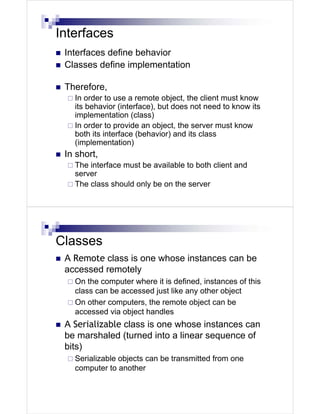
Remote Method Invocation (RMI) allows programmers to execute remote functions and calls using the same semantics as local function calls. RMI uses stubs and skeletons, where the stub acts as a proxy for the remote object on the client side and the skeleton receives the calls on the server side. To use RMI, an interface must be defined and implemented on the server, stub and skeleton classes are generated, the remote object is registered with an RMI registry, and then clients can look up and invoke methods on the remote object.




![3. Generating Stub & Skeleton Classes
The class that implements the remote
object should be compiled as usual
Then, it should be compiled with rmic:
Example:
rmic RMILightBulbImpl
creates the classes:
RMILightBulbImpl_Stub.class
Client stub
RMILightBulbImpl_Skeleton.class
Server skeleton
These classes do the actual communication
4. Creating RMI Server
Create an instance of the service implementation
Register with the RMI registry (binding)
import java.rmi.*;
import java.rmi.server.*;
public class LightBulbServer {
public static void main(String args[]) {
try {
RMILightBulbImpl bulbService = new RMILightBulbImpl();
RemoteRef location = bulbService.getRef();
System.out.println (location.remoteToString());
String registry = "localhost";
if (args.length >=1) {
registry = args[0];
}
String registration = "rmi://" + registry + "/RMILightBulb";
Naming.rebind( registration, bulbService );
} catch (Exception e) { System.err.println ("Error - " + e); } } }](/proxy?url=https%3A%2F%2Fimage.slidesharecdn.com%2Frmi-121001005256-phpapp02%2F85%2FRmi-9-320.jpg)
![5. Creating RMI Client
Obtain a reference to the remote interface
Invoke desired methods on the reference
import java.rmi.*;
public class LightBulbClient {
public static void main(String args[]) {
try { String registry = "localhost";
if (args.length >=1) { registry = args[0]; }
String registration = "rmi://" + registry + "/RMILightBulb";
Remote remoteService = Naming.lookup ( registration );
RMILightBulb bulbService = (RMILightBulb) remoteService;
bulbService.on();
System.out.println ("Bulb state : " + bulbService.isOn() );
System.out.println ("Invoking bulbservice.off()");
bulbService.off();
System.out.println ("Bulb state : " + bulbService.isOn() );
} catch (NotBoundException nbe) {
System.out.println ("No light bulb service available in registry!");
} catch (RemoteException re) { System.out.println ("RMI - " + re);
} catch (Exception e) { System.out.println ("Error - " + e); }
}
}
Steps of Running RMI
Make the classes available in the server host's,
registry host's, and client host's classpath
Copy, if necessary
Start the registry
rmiregistry
Start the server
java LightBulbServer reg-hostname
Start the client
java LightBulbClient reg-hostname](/proxy?url=https%3A%2F%2Fimage.slidesharecdn.com%2Frmi-121001005256-phpapp02%2F85%2FRmi-10-320.jpg)


