Predatory Journals
What Are Predatory Journals And Why Should We
Worry?
What is a predatory journal?
• A predatory journal is a publication that
actively asks researchers for manuscripts.
• They have no peer review system and no
true editorial board and are often found to
publish mediocre or even worthless papers.
• They also ask for huge publication charges.
What Is A Predatory Journal?
Predatory Journal
• Predatory journals is a phrase (now in wider
usage) coined by Jeffrey Beall, scholarly
communications librarian at the University of
Colorado at Denver, that refers to journals
(and journal publishers) whose main purpose
seems to be to exploit ("prey on") scholars
and academics and their need to publish the
results of their research.
Jeffrey Beall,
University of Colorado, Denver
Introduction
• In March 2008, Gunther Eysenbach,
publisher of an early open access journal, drew
attention to what he called,
• "black sheep among open access publishers
and journals”
Introduction
• In July 2008, Richard Poynder's interview series
brought attention to the practices of new
publishers who were "better able to exploit the
opportunities of the new environment."
• Doubts about honesty and scams in a subset of
open-access journals continued to be raised in
2009.
• Concerns for spamming practices ushered the
leading open access publishers to create the
• “Open Access Scholarly Publishers Association
in 2008”.
Richard Poynder
Introduction
• In another early precedent, in 2009 the Improbable
Research blog had found that Scientific Research
Publishing's journals duplicated papers already
published elsewhere; the case was subsequently
reported in Nature.
Introduction
• In 2010, Cornell University graduate
student Phil Davis (editor of the Scholarly
Kitchen blog) submitted a manuscript
consisting of computer-generated nonsense
(using SCIgen) which was accepted for a fee
(but withdrawn by the author).
CRAP Paper Accepted By Journal
Phil Davis is a publishing consultant
specializing in the statistical analysis of
citation, readership, publication and survey
data. He has a Ph.D. in science
communication from Cornell University
(2010), extensive experience as a science
librarian (1995-2006) and was trained as a
life scientist.
Introduction
• Predatory publishers have been reported to
hold submissions hostage, refusing to allow
them to be withdrawn and thereby
preventing submission in another journal.
Bohannon's experiment
"Who's Afraid of Peer Review?"
• In 2013, John Bohannon, a staff writer for the
journal Science and for popular science
publications, targeted the open access system by
submitting to a number of such journals a deeply
flawed paper and published the results in a paper
called, "Who's Afraid of Peer Review?".
• About 60% of those journals, including the Journal
of Natural Pharmaceuticals, accepted the faked
medical paper, and 40%, including the most
established one, PLOS ONE, rejected it.
Bohannon's experiment
"Who's Afraid of Peer Review?"
'Dr Fraud' experiment
• In 2015, four researchers created a fictitious sub-
par scientist named Anna O. Szust (oszust is
Polish for "fraud" [person]), and applied on her
behalf for an editor position to 360 scholarly
journals.
• Szust's qualifications were dismal for the role of
an editor; she had never published a single article
and had no editorial experience.
• The books and book chapters listed on her CV
were made-up, as were the publishing houses
that published the books.
'Dr Fraud' experiment
• One-third of the journals to which Szust applied
were sampled from Beall's List of 'predatory'
journals.
• Forty of these predatory journals accepted Szust as
editor without any background vetting and often
within days or even hours.
• By comparison, she received minimal to no
positive response from the "control" journals
which "must meet certain standards of quality,
including ethical publishing practices."
Anna O. Szust (oszust is Polish for
"fraud" [person]
'Dr Fraud' experiment
• Among journals sampled from the Directory of
Open Access Journals (DOAJ), 8 of 120
accepted Szust.
• The DOAJ has since removed some (but not all)
of the affected journals in a recent purge. None of
the 120 sampled journals listed in Journal
Citation Reports (JCR) offered Szust the position.
• The results of the experiment were published
in Nature in March 2017, and widely presented
in the press.
'Dr Fraud' experiment
SCIgen experiments
• SCIgen, a computer program that randomly
generates academic computer science
papers using context-free grammar, has
generated papers that have been accepted by a
number of predatory journals as well as
predatory conferences.
How three MIT students fooled the
world of scientific journals
How three MIT students fooled the
world of scientific journals
• Ten years ago, a few students at MIT’s Computer Science and
Artificial Intelligence Lab (CSAIL) had noticed such
unscrupulous practices, and set out to have some mischievous fun
with it. Jeremy Stribling, Dan Aguayo and Max Krohn PhD ’
spent a week or two between class projects to develop “SCIgen,” a
program that randomly generates nonsensical computer-science
papers, complete with realistic-looking graphs, figures, and
citations.
• The program was crude, but it did the trick: In April of 2005 the
team’s submission, “Rooter: A Methodology for the Typical
Unification of Access Points and Redundancy,” was accepted as a
non-reviewed paper to the World Multi-conference on Systemics,
Cybernetics and Informatics (WMSCI), a conference that Krohn
says is known for “being spammy and having loose standards.”
Why do academics publish in such
journals?
• In research environments, there is usually
more value for quantity over quality.
• Hiring and promotion of academics is based
largely on their number of publications.
Predatory journals has helped many
pseudo-researchers to prosper.
Why do academics publish in such
journals?
What is the harm caused by predatory
journals?
• Predatory and low-quality journals corrupt the
literature.
• Medical science has been particularly hit hard,
with journals now devoted to unscientific
medicine.
• “Peer review is at the heart of academic
evaluation.
• Publishing without peer review [while
pretending that peer review was done] gives
poor and mediocre academics a chance for jobs
and promotions which should go to better
qualified researchers,”
What is the harm caused by
predatory journals?
How does one find out if a given journal
is predatory or not?
• some people think any journal from an
unknown publisher, or a journal that
charges for publication, is necessarily
predatory.
• That is not necessarily correct. The important
thing is to dig deeper and find the quality of
submitted manuscripts and its standards,”
How does one find out if a given journal
is predatory or not?
Beall’s criteria for identification of
predatory journals
• Here is a curated list Beall’s criteria for
identification of predatory journals and
publishers
• No single individual is identified as specific
journal’s editor with no formal editorial/review
board or the same editorial board for more
than one journal.
• The editor and/or review board members do
not have academic expertise in the journal’s
field.
Beall’s criteria for identification of
predatory journals
Beall’s criteria for identification of
predatory journals
• Provides insufficient information or hides
information about author fees, offering to publish
an author’s paper and later sending an
unanticipated ‘surprise’ invoice.
• No proper indexing.
• The name of a journal is unrelated with the
journal’s mission.
• The name of a journal does not adequately reflect its
origin (e.g. a journal with the word ‘Canadian’ or
‘Swiss’ in its name when neither the publisher, editor,
nor any purported institutional affiliate relates
whatsoever to Canada or Switzerland).
Beall’s criteria for identification of
predatory journals
Checklist to Identify Fake Journal
• Do you or your colleagues know the journal?
• Can you easily identify and contact the publisher?
• Is the journal clear about the type of peer review
it uses?
• Are articles indexed in services that you use?
• Is it clear what fees will be charged?
• Do you recognise the editorial board?
• Is the publisher a member of a recognised
industry initiative (COPE,DOAJ,OASPA)?
Checklist to Identify Fake Journal
• The publisher has poorly maintained websites,
including dead links, prominent misspellings and
grammatical errors on the website.
• The publisher makes unauthorised use of
licensed images on their website, taken from
the open web, without permission or licensing
from the copyright owners.
• Re-publish papers already published in other
venues/outlets without providing appropriate
credits.
Checklist to Identify Fake Journal
• Use boastful language claiming to be a ‘leading publisher’ even
though the publisher may only be a start-up or a novice
organisation.
• Provide minimal or no copyediting or proofreading of
submissions.
• Publish papers that are not academic at all, e.g. essays by lay
people, polemical editorials, or pseudo-science.
• Have a ‘contact us’ page that only includes a web form or an
email address, and the publisher hides or does not reveal its
location.
• The publisher publishes journals that are excessively broad (e.g.
Journal of Education) or combine two or more fields not
normally treated together (e.g. International Journal of Business,
Humanities and Technology) in order to attract more articles and
gain more revenue from author fees.
Checklist to Identify Fake Journal
Characteristics of Predatory Journals
• Accepting articles quickly with little or no peer review or quality
control, including hoax and nonsensical papers.
• Notifying academics of article fees only after papers are
accepted.
• Aggressively campaigning for academics to submit articles or
serve on editorial boards.
• Listing academics as members of editorial boards without their
permission, and not allowing academics to resign from editorial
boards.
• Appointing fake academics to editorial boards.
• Mimicking the name or web site style of more established
journals.
• Making misleading claims about the publishing operation, such
as a false location.
• Using ISSNs improperly.
• Citing fake or non-existent impact factors.
Characteristics of Predatory
Journals
Predatory Open Access Publishing
• Predatory open-access publishing is an
exploitative open-access academic
publishing business model that involves
charging publication fees to authors without
providing the editorial and publishing
services associated with legitimate journals
(open access or not).
Predatory Open Access Publishing
Predatory open access publishing
• The idea that they are "predatory" is based
on the view that academics are tricked into
publishing with them, though some authors
may be aware that the journal is poor
quality or even fraudulent.
• New scholars from developing countries are
said to be especially at risk of being misled by
predatory practices.
Predatory open access publishing
Growth And Structure
• Predatory journals have rapidly increased their
publication volumes from 53,000 in 2010 to an estimated
420,000 articles in 2014, published by around 8,000
active journals.
• Early on, publishers with more than 100 journals
dominated the market, but since 2012 publishers in the
10–99 journal size category have captured the largest
market share.
• The regional distribution of both the publisher's country and
authorship is highly skewed, with three quarters of authors
hailing from Asia or Africa. Authors paid an average fee
of 178 USD per article for articles typically published
within 2 to 3 months of submission
Growth And Structure
Response
Beall's list
• University of Colorado Denver librarian and
researcher Jeffrey Beall, who coined the term
"predatory publishing", first published his list of
predatory publishers in 2010.
• Beall's list of potential, possible, or probable predatory
scholarly open-access publishers attempted to identify
scholarly open access publishers with questionable
practices.
• In 2013, Nature reported that Beall's list and web site
were "widely read by librarians, researchers, and open-
access advocates, many of whom applaud his efforts to
reveal shady publishing practices.”
Beall's list
Cabells' lists
• At the May 2017 meeting of the Society for
Scholarly Publishing, Cabell's International, a
company that offers scholarly publishing analytics
and other scholarly services, announced that it
intended to launch a blacklist of predatory
journals (not publishers) in June, The company
had started work on its blacklist criteria in early
2016.
• In July 2017, both a black list and a white list
were offered for subscription on their website.
Cabells' lists
Other Efforts
• More transparent peer review, such as open peer review
and post-publication peer review, has been advocated to
combat predatory journals.
• In an effort to "set apart legitimate journals and
publishers from non-legitimate ones", principles of
transparency and best practice have been identified and
issued collectively by the Committee on Publication Ethics,
the DOAJ, the, and the World Association of Medical
Editors.
• Open Access Scholarly Publishers journal review
websites (crowd-sourced or expert-run) have been
started, some focusing on the quality of the peer review
process and extending to non-OA publications. A group
of libraries and publishers launched an awareness campaign.
Other Efforts
Other Efforts
• A number of measures have been suggested to
further combat predatory journals.
• Others have called on research institutions to
improve the publication literacy notably
among junior researchers in developing
countries.
• Some organisations have also developed
criteria in which predatory publishers could be
spotted through providing tips that include
avoiding fast publishers
Other Efforts
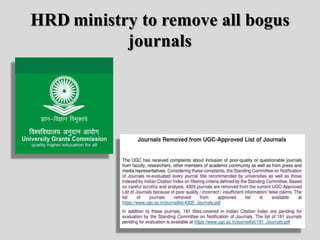
HRD ministry to remove all bogus
journals
• A requirement that scholars get at least two
research papers published in a University
Grants Commission-approved journal
before submitting their doctoral theses,
coupled with pressure on university teachers
to get their research published regularly in
academic periodicals, has produced an
unexpected side-effect: It has led to a
proliferation of dubious journals.
HRD ministry to remove all bogus
journals
HRD ministry to remove all bogus
journals
• For the study titled “A critical analysis of the
‘UGC-approved list of journals’, a team of six
researchers, in association with the human
resource development (HRD) ministry, analysed
1,336 academic periodicals randomly selected
from a list of 5,699 journals in the so-called
university-source component.
• Their conclusion: “Over 88% of non-indexed
journals in the university source component of
UGC-approved list could be of low quality.”
HRD ministry to remove all bogus
journals
• While the UGC website lists 32,659 journals,
university-source journals (5,699) are those
which are recommended by various
universities in the country, the paper notes.
• UGC has admitted that it received several
complaints about the inclusion of low-quality
journals soon after the release of its approved list
of journals on June 2, 2017. The UGC has
removed a few journals after an evaluation, the
paper said.
HRD ministry to remove all bogus
journals
HRD ministry to remove all bogus
journals
• The dubious publications were identified by
the team of researchers that included
Bhushan Patwardhan, a professor at the
Savitribai Phule Pune University (SPPU), a
special invitee member on the UGC Standing
Committee for Notification of Journals and
former vice-chancellor of Symbiosis
International University
Prof. Bhushan Patwardhan,
Savitribai Phule Pune University (SPPU)
HRD ministry to remove all bogus
journals
• Out of the 1,336 journals studied, 897 were
disqualified from the UGC- approved list of journals
by the human resource development ministry for
providing false information such as an incorrect
ISSN (International Standard Serial Number), making
false claims about the impact getting published in their
pages would have, indexing in dubious databases,
poor credentials of editors and non-availability of
information such as an address, website details and
names of editors. Papers published in the
disqualified journals will not be considered valid.
HRD ministry to remove all bogus
journals
HRD ministry to remove all bogus
journals
• “It is an alarming situation that such a huge
percentage of the journals are bogus.
Globally, it hampers the image of our
country,” Patwardan said.
• The HRD ministry has adopted a very
positive approach to dealing with the issue
“and has decided to remove all the bogus
journals from the UGC list shortly,”
Patwardhan said.
HRD ministry to remove all bogus
journals
Case Study: Dozens of Scientific Journals
Offered Her a Job. But She Didn't Exist
• If you received a resumé and cover letter from an
Anna O. Fraud, you might sense something fishy.
• If you got one from an Anna O. Szust, you’d
probably be less concerned — even though oszust
means “a fraud” in Polish.
• Either way, in a recent scientific sting operation
reported in Nature, plenty of potential employers
liked the fictitious Dr. Szust just fine — enough
that 48 of them offered her a job. And that’s a big
problem.
Case Study: Dozens of Scientific Journals Offered
Her a Job. But She Didn't Exist
Case Study: Dozens of Scientific Journals
Offered Her a Job. But She Didn't Exist
• The investigation was conducted by a team of
researchers led by Piotr Sorokowski, of the
University of Wroclaw in Poland, and described
in Nature by co-researcher Katarzyna Pisanski,
who is affiliated both with Wroclaw and with the
University of Sussex in the U.K.
• The goal of the sting was to expose so-called
predatory journals — science publications that
charge fees to publish science, accepting all
comers with all manner of papers provided
there’s money to be made.
Piotr Sorokowski,
University of Wroclaw
Case Study: Dozens of Scientific Journals Offered
Her a Job. But She Didn't Exist
• The “publish or perish” dictum is a very real thing
for researchers and academics whose hopes for
career advancement depend on doing work that
earns a spot in peer-reviewed journals.
• That has led to the rise of a staggering 10,000
predatory journals, which both charge fees to
publish unvetted work and recruit scientists to fill
editorial positions, lending a patina of credibility to
their generally shabby operations and offering a
prestigious sounding title to the scientists in return.
• By 2015, approximately half-a-million dubious
papers had been published this way.
Publish Or Perish
Case Study: Dozens of Scientific Journals
Offered Her a Job. But She Didn't Exist
• Pisanski and her colleagues selected 360
journals to approach in their study.
• Of these, 120 each came from two legitimate
directories of science publications: The Journal
Citation Reports (JCR) and the Directory of Open
Access Journals (DOAJ). The final 120 came
from a less formal directory known as “Beall’s
list,” a compendium of suspect journals compiled
by Jeffrey Beall, a librarian at the University of
Colorado.
Case Study: Dozens of Scientific Journals
Offered Her a Job. But She Didn't Exist
Case Study: Dozens of Scientific Journals
Offered Her a Job. But She Didn't Exist
• All 360 got a letter from “Dr. Szust” seeking a
position on their editorial board.
• Her resume consisted of a string of phony degrees
and invented book chapters pertinent to her wide-
ranging academic interests.
• A web presence was also created for Szust on
Academia.edu, Google+ and Twitter.
• Since the entire study was, in effect, an act of fraud —
even if it was designed to expose far more pernicious
fraud — the researchers were required to seek approval
from a university ethics review board, which they
received.
Case Study: Dozens of Scientific Journals
Offered Her a Job. But She Didn't Exist
Case Study: Dozens of Scientific Journals
Offered Her a Job. But She Didn't Exist
• The responses the investigators got from the three
groups of journals differed widely.
• None of the JCR publications offered a spot on the
masthead to the imaginary Szust. Only 40% of them sent
her any response at all. Of the journals listed on the DOAJ,
eight did make a job offer, though the responses from the
remaining 112 broke down more or less the same way they
did on the JCR.
• Some of the journals that rejected her also chided her
for her approaching them at all: “One does not become
an editor by sending in the CV; these positions are filled
because a person has a high research profile,” one wrote.
Case Study: Dozens of Scientific Journals
Offered Her a Job. But She Didn't Exist
Case Study: Dozens of Scientific Journals Offered
Her a Job. But She Didn't Exist
• The Beall’s list journals, on the other hand, couldn’t get enough
of the good Dr. Fraud.
• Forty of them offered her an editorial spot and some responses came
within hours.
• Four of them offered her the top slot — editor in chief. One of
them even specified that the job came “with no responsibilities.”
• And the journals did not do much to conceal their pecuniary
motivations either.
• Any money Szust generated by attracting scientists who would
pay to publish would be split 60-40, with the journal taking the
larger share and her keeping the remainder. Sometimes an upfront
fee was requested from Szust — a mandatory $750
“subscription” to the journal, for example.
Case Study: Dozens of Scientific Journals Offered
Her a Job. But She Didn't Exist
Case Study: Dozens of Scientific Journals
Offered Her a Job. But She Didn't Exist
• Spotting and avoiding predatory journals is not terribly
difficult.
• A catalog like Beall’s, for example, is effectively a
blacklist, and both DOAC and JDR serve as whitelists,
according to Pisanski and her colleagues. The bigger
problem, they say, is finding a way to scale back the
consuming role of publishing in determining academic
advancement — or at least reducing the constant stress the
process causes the academics themselves.
• Some of history’s best science has been done under extreme
pressure . But most research is slow, thoughtful and
iterative. Both the science and the scientists are at their best
when they’re allowed to take their time.
Terminology
Guest Or Gift Authors
• A guest author is somebody who did not
contribute in any way to the research and
writing, but is included in the author list
because they confer extra credibility on the
article.
• A gift author is one who may have a slight
relationship with the study or the article, but who
would not be considered an author according to
the International Committee of Medical Journal
Editors (ICMJE) guidelines.
Guest Or Gift Authors
• Guest/gift authorship is thought to be quite
common.
• A frequent example is the head of
department or the PhD supervisor being
named in all articles.
• In some regions of the world this is not only
expected but also required – so many authors
will not realise that it is considered
unethical to include these people.
Guest Authorship
Gift Authors
Ghost Authors
• A ghost author is a person who should be listed
as an author, but has been excluded.
• This term is most often used to identify authors
who are professional (medical
communications) writers.
• These are usually commissioned (and often
paid) by pharmaceutical companies to produce
a paper from raw data. The authors listed on the
article may have undertaken the research, created
and perhaps analysed the data, but not written the
article.
Ghost Authors
Ghost Authors
• Ghost authorship is more common in some
journals than others, and there are guidelines
for such articles developed by the European
Medical Writers Association.
• The guidelines require that the named authors
should have been involved with the article from
the start and should lead the writing, and that any
involvement of professional medical writers must
be acknowledged within the article (if they are not
named as an author).
Terminology
Lead Author
• The lead author, or first author, is the first named author
of a publication such as a research article
• Academic authorship standards vary widely across
disciplines. In many academic subjects, including the
natural sciences, computer science and electrical
engineering, the lead author of a research article is
typically the person who carried out the research, wrote
and edited the paper.
• The list of trailing co-authors reflects, typically, diminishing
contributions to the work reported in the manuscript.
Sometimes, journals require statements detailing each
author's contributions to be included in each publication.
Lead Author
Co-Author
• A co-author is someone who works with another
person to write something.
• According to the ICMJE guidelines, anyone who fulfils
all of the following criteria can be an author:
• Contributes significantly to the conception, design,
execution, and/or analysis and interpretation of data
• Participates in drafting and/or revising part of the
manuscript for intellectual content
• Approves of the version to be published
• Agrees to be accountable for all aspects of the work
Co-Author
Why research papers have so many
authors ?
• ONE thing that determines how quickly a
researcher climbs the academic ladder is his
publication record. The quality of this clearly
matters—but so does its quantity.
• There is another way to pad publication lists: co-
authoring. Say you write one paper a year. If you
team up with a colleague doing similar work and
write two half-papers instead, both parties end up
with their names on twice as many papers, but with
no increase in workload. Find a third researcher to
join in and you can get your name on three papers a
year. And so on.
Why research papers have so many
authors ?
Peer Review
• Scholarly peer review (also known as
refereeing) is the process of subjecting an
author's scholarly work, research, or ideas to
the scrutiny of others who are experts in the
same field, before a paper describing this
work is published in a journal, conference
proceedings or as a book.
Peer Review
Predatory Publishing
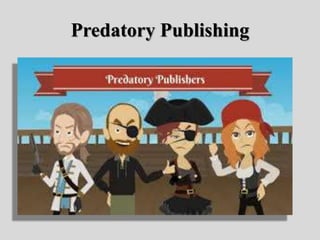
• Predatory open-access publishing is an
exploitative open-access academic publishing
business model that involves charging
publication fees to authors without providing
the editorial and publishing services
associated with legitimate journals (open
access or not).
Predatory Publishing
Beall's List Of Predatory Publishers
• Potential predatory scholarly open-access publishers
• https://beallslist.weebly.com/