OBESITY
Dr. RIYAZ
Assistant professor
Community medicine
0VER VIEW
1. DEFINITION
2. PREVALENCE OF OBESITY
3. PROBLEM STATEMENT
4. EPIDEMIOLOGICAL DETERMINANTS
5. ASSESSMENT OF OBESITY
6. COMPLICATIONS OF OBESITY
7. MANAGEMENT OF OBESITY
a) DIET
b) PHARMACOTHERAPY
c) EXERCISE
d) SURGERY
Definition
• Obesity may be defined as an abnormal
growth of the adipose tissue due to an
enlargement of fat cell size {hypertrophic
obesity}
• or an increase in fat cell number {hyperplastic
obesity}
• or a combination of both
Distribution of fat
Obesity Prevalence
• Over weight and obesity are the fifth leading risk of
global death
• Obesity has more than double since 1980
• Worldwide 1.5 billion adults are overweight or obese
(11% of men/ 14% of women obese)
– Overweight/obesity → 2.8 million deaths/yr
– U.S. has highest rates in world (36% vs. 32%
Mexico, 25% Canada, 4% Switzerland, 5% India)
Problem statement
• Key risk factor for natural diseases in other
chronic NCDs
• Hypertension, hyperlipidaemia, glucose
intolerance are first to appear in the transition
• CAD and renal failure at a later time (after few
decades)
Epidemiological determinants
Multiple causation:
1. Age: any age,
1/3rd were so since childhood,
obese infant (hyperplastic obesity)difficult
to manage with conventional methods
2. Sex: male: 28-35
Female: 45-49 menopausal age/ weight
increases with successive pregnancies
Epidemiological determinants
3. Genetic factors: Twin studies showed close
correlation between weights even when
reared in different environments
Also fat distribution has a genetic component
4.Physical inactivity: sedentary lifestyle
particularly sedentary occupation and inactive
recreation such as watching television, playing
video games promote it
Energy intake > energy output
Epidemiological determinants
5. socioeconomic status: Inverse relation
6.Eating habbits: e.g., eating in between meals,
preference to sweets, refined foods and fats,
composition, periodicity. Marketing of energy
dense micronutrient poor food
A child whose energy requirement is 2000
kcal/day and who consumes 100 kcal/day
extra will gain about 5 kg a year
Sugar substitutes:
May increase appetite for sweet foods and
promote overeating
Epidemiological determinants
7. Psychosocial factors: Overeating may be a
symptom of depression, anxiety, frustration,
loneliness.
• Excessively obese individuals are usually
withdrawn self conscious lonely and secret
eaters
8. Familial tendency: obese parents tend to have
obese children
Epidemiological determinants
9. Endocrine factors: Cushings syndrome,
growth hormone deficiency
10. Alcohol: relationship between alcohol and
obesity positive for men and negative for
women
11. Education: inverse relation
12.Drugs: steroids, Insulin, B adrenergic
blockers, contraceptives
INTRA-ABDOMINAL (CENTRAL) FAT ACCUMULATION
AND INCREASED RISK
• Abdominal obesity is important in the
development of insulin resistance and metabolic
syndrome (hyperinsulinaemia, Dyslipidaemia,
glucose intolerance, and hypertension) that Iink
obesity with CHD
• Premenopausal women have more lipoprotein
lipase (LPL) and higher LPL activity in the gluteal
and femoral subcutaneous regions, which contain
larger fat cells than those in men, but these
differences disappear after menopause.
Assessment of obesity
1. Body weight:
a. BMI (Quetelets index): wt(Kg)/ Ht (m2)
b. Ponderal index: Ht (cm)/cube root of body
weight in kgs
c. Brocca index: Ht (cm) – 100
Assessment of obesity
d) Lorentzs formula:
Ht (cm) - 150
Ht (cm) - 100 = 2 (women) or 4 (men)
e) Corpulence index: actual weight
desirable weight
(should not be < 1.2 for normal)
Assessment of obesity
• BMI and Brocas most commonly used
• BMI grading: internationally comparable
Classification BMI RISK of comorbidities
underweight <18.5 Low, but risk of other cinical problems
increased
Normal 18.5 – 24.99 Average
Overweight >_ 25
Pre - obese
Obese class I
Obese class II
Obese class III
25 - 29.9
30 – 34.9
35 - 39.9
>40
Increased
Moderate
Severe
Very severe
Assessment of obesity
2. Skin fold thickness: A large proportion of total
body fat is located just under the skin, it is
most accessible, rapid and "noninvasive"
• Harpenden skin callipers is used for the
purpose.
• The measurement may be taken at all the four
sites -
• mid-triceps, biceps, subscapular and suprailiac
regions.
Assessment of obesity
• The sum of the measurements should be less
than 40 mm in boys and 50 mm in girls
• Not standardised, difficult to measure in very
obese, not repeatable
Assessment of obesity
3. WAIST CIRCUMFERENCE AND WAIST : HIP RATIO (WHR)
Waist circumference: mid point between the lower border
of the rib cage and the iliac crest.
convenient and simple measurement i.e unrelated to
height.
an approximate index of intra - abdominal fat mass and
total body fat.
Increased risk of metabolic complications for men with a
waist circumference > 102 cm or 40 inches , and women
with a waist circumference > 88 cm or 35 inches ).
high WHR (> 0.90 in men and > 0.85 in women) indicates
abdominal fat accumulation.
COMPLICATIONS OF OBESITY
Complications associated with Obesity
Death
Cardiac failure
Pickwickian syndrome
Carcinomas
Cholelithiasis
Cardiovascular disease
DM
Venous insufficiency
Hyperuricemia
Hypertension
Hypertriglyceridemia
Management of
Obesity
WORK UP
Physical exam – Focus on possible complications
Investigations:
Blood sugar, lipid profile, liver function tests
Other tests based on clinical features
TSH, Sleep studies
Dexamethasone suppression test for Cushing’s
syndrome*
Treatment
Prevention
Diet
Increased physical activity
Behavior modification
Medicines
GUIDE TO TREATMENT OPTIONS
WEIGHT LOSS & WEIGHT MAINTENANCE
Integrated weight management
BEHAVIOUR MODIFICATION
Self monitoring of weight
Stress management
Social support
DIET
 The primary focus of diet therapy is to reduce overall
calorie consumption
Very low energy diets (e.g., 400 to 600kcal/d)
Low-calorie diets, >800 kcal/d
very low fat diets
very low carbohydrate diets
Guidelines recommend initiating treatment with a calorie
deficit of 500– 1000 kcal/d compared with the patient's
habitual diet.
Diet
The Dietary Reference Intakes for Macronutrients
released by the national Institute of nutrition
recommends
45–65% of calories from carbohydrates,
 20–35% from fat, and 10–35% from protein.
daily fiber intake of 38 g (men) and 25 g (women) for
persons over 50 years of age and 30 g (men) and 21 g
(women)for those under age 50.
Diet
Low-carbohydrate, high-protein diets appear to
be more effective in lowering BMI;
improving coronary heart disease risk factors,
including an increase in HDL cholesterol and a
decrease in triglyceride levels;
controlling satiety in the short term compared
with low-fat diets
Diet
Occasionally, very low calorie diets (VLCDs) are
prescribed as a form of aggressive dietary therapy.
The primary purpose of a VLCD is to promote a
rapid and significant (13–23 kg) short-term weight
loss over a 3- to 6-month period.
These propriety formulas typically supply 800 kcal,
50– 80 g protein, and 100% of the recommended
daily intake for vitamins and minerals.
EXERCISE
Increased energy expenditure is the most obvious
mechanism for an effect of exercise
Exercise appears to be a valuable means to sustain
diet therapy
Valuable in the obese individual for its effects on
cardiovascular tone and blood pressure
PHARMACOTHERAPY
Recommended if BMI >/= 27 with
comorbidities or BMI >/= 30
Facts:
Drugs alone cause modest weight loss
Diet with drugs improves efficacy
Effects maintained for duration of
treatment only
Long term safety data not available
Pharmacotherapy
Medications for obesity have traditionally
fallen into two major categories:
1. Appetite suppressants (anorexiants)
2. Gastrointestinal fat blockers
Pharmacotherapy
Centrally Acting Anorexiant Medication
Anorexiants increases satiety and decreases
hunger, these agents help patients reduce
caloric intake without a sense of
deprivation.
Targets the ventromedial and lateral
hypothalamus
Eg PHEN/TPM (Phenteramine and
Topiramate)  9.3% and 8.6% weight lost
in 2 large trials
Pharmacotherapy
Centrally Acting Anorexiant Medication
Lorcaserin is a selective 5-HT2C receptor agonist
thought to decrease food intake through the
propiomelanocortin system of neurons.
Pharmacotherapy
Peripherally Acting Medications
(Gastrointestinal fat blockers)
Orlistat is a synthetic hydrogenated
derivative of a naturally occurring
lipase inhibitor
Lipostatin Acts in the lumen of the
stomach and small intestine
Blocks the digestion and absorption of
~30% of dietary fat
Weight loss of ~9–10%
Pharmacotherapy
In development
Bupropion and naltrexone
Liraglutide
Surgery
Indications
BMI > 35 with an associated comorbidity or a BMI
> 40 (irrespective)
Repeated failures of other therapeutic approaches
Capability of tolerating surgery
Surgery
Weight loss surgeries have traditionally been
classified into 3 categories on the basis of
anatomic changes:
Restrictive
Restrictive-malabsorptive
Malabsorptive
Clinical benefits of bariatric surgery in achieving weight
loss and alleviating metabolic comorbidities have been
attributed largely to changes in the physiologic
responses of gut hormones and in adipose tissue
metabolism.
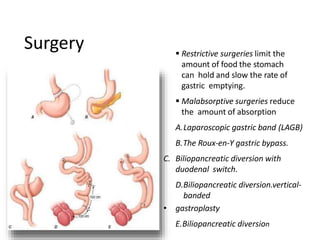
Surgery  Restrictive surgeries limit the
amount of food the stomach
can hold and slow the rate of
gastric emptying.
 Malabsorptive surgeries reduce
the amount of absorption
A.Laparoscopic gastric band (LAGB)
B.The Roux-en-Y gastric bypass.
C. Biliopancreatic diversion with
duodenal switch.
D.Biliopancreatic diversion.vertical-
banded
• gastroplasty
E.Biliopancreatic diversion
Surgery
These procedures generally produce a 30–35% average total body
weight loss that is maintained in nearly 60% of patients at 5 years.
Significant improvement in multiple obesity-related comorbid
conditions, including type 2 diabetes, hypertension, dyslipidemia,
obstructive sleep apnea, quality of life and long-term cardiovascular
events.
The most common surgical complications include stomal
stenosis or marginal ulcers
The restrictive-malabsorptive procedures carry an increased
risk for micronutrient deficiencies of vitamin B12, iron, folate,
calcium, and vitamin D.
Patients with restrictive-malabsorptive procedures require lifelong
supplementation with these micronutrients.
Prevention and control
• Dietary changes
• Increased physical activity
• Others: appetite suppressing drugs, gastric
bypass, gastroplasty, jaw wiring.. Not effective
• Health education is the most common
effective measure
Thank you