CHAPTER 4


    LISTS

   All the programs in this file are selected from
            Ellis Horowitz, Sartaj Sahni, and Susan Anderson-Freed
            “Fundamentals of Data Structures in C”,
            Computer Science Press, 1992.


               CHAPTER 4                       1
Introduction
 Array
  successive items locate a fixed distance
 disadvantage
  • data movements during insertion and deletion
  • waste space in storing n ordered lists of varying
    size
 possible solution
  • linked list
                  CHAPTER 4            2
Pointer Review (1)
      Pointer Can Be Dangerous
int i, *pi;
        1000                  2000
    i        ?           pi          ?

pi = &i;
    i 1000                  2000
  *pi      ?             pi   1000

i = 10 or *pi = 10
    i 1000                  2000
   *pi      10           pi   1000

                 CHAPTER 4               3
Pointer Review (2)
typedef struct list_node *list_pointer;
typedef struct list_node {
                int data;
                list_pointer link;
              }
list_pointer ptr = NULL;
          1000
 ptr     NULL                      ptr->data(*ptr).data
ptr = malloc(sizeof(list_node));
         1000              2000      *ptr
ptr      2000
                            data     link
               CHAPTER 4                     4
4.1.2 Using Dynamically Allocated Storage


int i, *pi;
float f, *pf;
pi = (int *) malloc(sizeof(int));
                                       request memory
pf = (float *) malloc (sizeof(float));
*pi =1024;
*pf =3.14;
printf(”an integer = %d, a float = %fn”, *pi, *pf);
free(pi);
                      return memory
free(pf);
*Program4.1:Allocation and deallocation of pointers (p.138)
                CHAPTER 4                      5
4.2 SINGLY LINKED LISTS


     bat           cat            sat          vat   NULL


*Figure 4.1: Usual way to draw a linked list (p.139)


                CHAPTER 4                     6
Insertion

     bat            cat            sat           vat   NULL


                               mat    


*Figure 4.2: Insert mat after cat (p.140)


                 CHAPTER 4                      7
bat          cat        mat       sat      vat   NULL

                                dangling
                                reference

*Figure 4.3: Delete mat from list (p.140)


                    CHAPTER 4                     8
Example 4.1: create a linked list of words
Declaration
typedef struct list_node, *list_pointer;
typedef struct list_node {
          char data [4];
          list_pointer link;
          };
Creation
list_pointer ptr =NULL;
Testing
#define IS_EMPTY(ptr) (!(ptr))
Allocation
ptr=(list_pointer) malloc (sizeof(list_node));
                CHAPTER 4                   9
e -> name  (*e).name
 strcpy(ptr -> data, “bat”);
 ptr -> link = NULL;
   address of                      ptr   data     ptr link
   first node

                              b     a   t   0   NULL
      ptr

*Figure 4.4:Referencing the fields of a node(p.142)


                 CHAPTER 4                        10
Example: create a two-node list
        ptr


              10           20 NULL
typedef struct list_node *list_pointer;
typedef struct list_node {
         int data;
         list_pointer link;
         };
list_pointer ptr =NULL

Example 4.2: (p.142)
              CHAPTER 4                   11
list_pointer create2( )
{
/* create a linked list with two nodes */
    list_pointer first, second;
    first = (list_pointer) malloc(sizeof(list_node));
    second = ( list_pointer) malloc(sizeof(list_node));
    second -> link = NULL;
    second -> data = 20;
                               ptr
    first -> data = 10;
    first ->link = second;
    return first;                    10            20 NULL
}                            *Program 4.2:Create a tow-node list
(p.143)
                   CHAPTER 4                    12
List Insertion:

          Insert a node after a specific node

void insert(list_pointer *ptr, list_pointer node)
{
/* insert a new node with data = 50 into the list ptr after node */
   list_pointer temp;
   temp = (list_pointer) malloc(sizeof(list_node));
   if (IS_FULL(temp)){
      fprintf(stderr, “The memory is fulln”);
      exit (1);
   }


                     CHAPTER 4                        13
temp->data = 50;
     if (*ptr) { noempty list
         temp->link =node ->link;
         node->link = temp;
                               ptr
    }
    else { empty list                      10                 20 NULL
        temp->link = NULL; node
        *ptr =temp;
     }                                             50      
}
                                          temp
*Program 4.3:Simple insert into front of list (p.144)

                    CHAPTER 4                         14
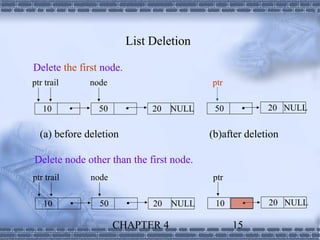
List Deletion

Delete the first node.
ptr trail       node                      ptr

   10            50         20   NULL    50          20 NULL


  (a) before deletion                     (b)after deletion

Delete node other than the first node.
ptr trail       node                      ptr

   10            50         20   NULL    10          20 NULL

                       CHAPTER 4                15
void delete(list_pointer *ptr, list_pointer trail, list_pointer
 node)
{
/* delete node from the list, trail is the preceding node
   ptr is the head of the list */
                                            trail   node
    if (trail)
       trail->link = node->link; 10                50             20   NULL
    else
       *ptr = (*ptr) ->link;     10                20 NULL
     free(node);
}
        ptr         node                              ptr
       10             50           20   NULL       50             20 NULL
                            CHAPTER 4                       16
Print out a list (traverse a list)
void print_list(list_pointer ptr)
{
   printf(“The list ocntains: “);
   for ( ; ptr; ptr = ptr->link)
     printf(“%4d”, ptr->data);
   printf(“n”);
 }


*Program 4.5: Printing a list (p.146)


                   CHAPTER 4                 17
4.3 DYNAMICALLY LINKED STACKS AND QUEUES


   top
                     element link
                                                      NULL
  (a) Linked Stack

    front                                           rear
                      element link
                                                      NULL
   (b) Linked queue

*Figure 4.10: Linked Stack and queue (p.147)


                      CHAPTER 4                18
Represent n stacks
#define MAX_STACKS 10 /* maximum number of
stacks */
typedef struct {
         int key;
         /* other fields */
        } element;
typedef struct stack *stack_pointer;
typedef struct stack {
         element item;
         stack_pointer link;
         };
stack_pointer top[MAX_STACKS];

              CHAPTER 4            19
Represent n queues
#define MAX_QUEUES 10 /* maximum number of
queues */
typedef struct queue *queue_pointer;
typedef struct queue {
        element item;
        queue_pointer link;
        };
queue_pointer front[MAX_QUEUE],
rear[MAX_QUEUES];


             CHAPTER 4            20
Push in the linked stack
void add(stack_pointer *top, element item)
{
  /* add an element to the top of the stack */
  stack_pointer temp =
                   (stack_pointer) malloc (sizeof (stack));
  if (IS_FULL(temp)) {
     fprintf(stderr, “ The memory is fulln”);
     exit(1);
     }
     temp->item = item;
     temp->link = *top;
     *top= temp;            * Program 4.6:Add to a linked stack
(p.149)
}                 CHAPTER 4                    21
pop from the linked stack
element delete(stack_pointer *top) {
/* delete an element from the stack */
    stack_pointer temp = *top;
    element item;
    if (IS_EMPTY(temp)) {
       fprintf(stderr, “The stack is emptyn”);
       exit(1);
    }
    item = temp->item;
    *top = temp->link;
     free(temp);
     return item;
}
*Program 4.7: Delete from a linked stack (p.149)
                   CHAPTER 4                       22
enqueue in the linked queue
void addq(queue_pointer *front, queue_pointer *rear, element item)
{ /* add an element to the rear of the queue */
  queue_pointer temp =
                  (queue_pointer) malloc(sizeof (queue));
  if (IS_FULL(temp)) {
     fprintf(stderr, “ The memory is fulln”);
     exit(1);
     }
     temp->item = item;
     temp->link = NULL;
     if (*front) (*rear) -> link = temp;
     else *front = temp;
     *rear = temp; } CHAPTER 4                    23
dequeue from the linked queue (similar to push)
   element deleteq(queue_pointer *front) {
   /* delete an element from the queue */
       queue_pointer temp = *front;
       element item;
       if (IS_EMPTY(*front)) {
          fprintf(stderr, “The queue is emptyn”);
          exit(1);
       }
       item = temp->item;
       *front = temp->link;
        free(temp);
        return item;
   }
                    CHAPTER 4                   24
Polynomials
  A( x ) =a m − x e
               1
                         m−1
                               + m− x e
                                a 2       m−2
                                                + + 0xe
                                                 ... a    0


  Representation
typedef struct poly_node *poly_pointer;
typedef struct poly_node {
   int coef;
   int expon;
   poly_pointer link;
};
poly_pointer a, b, c;


           coef           expon            link

                  CHAPTER 4                25
Examples


a = 3x + 2 x +1
         14       8


a
    3   14            2   8      1        0   null


b = 8 x 14 − 3x 10 +10 x 6
b
    8   14            -3 10      10       6   null


              CHAPTER 4              26
Adding Polynomials

3 14       2   8           1    0
     a
8 14       -3 10           10   6
      b
11 14              a->expon == b->expon
      d
3   14     2   8           1    0
                   a
8   14     -3 10          10    6
                b
11 14      -3 10           a->expon < b->expon
                 d
          CHAPTER 4                 27
Adding Polynomials (Continued)


3   14       2   8        1   0
                     a
8   14       -3 10       10   6
                                   b
11 14        -3 10        2   8
                                  d
a->expon > b->expon


         CHAPTER 4            28
Alogrithm for Adding Polynomials
poly_pointer padd(poly_pointer a, poly_pointer b)
{
    poly_pointer front, rear, temp;
    int sum;
    rear =(poly_pointer)malloc(sizeof(poly_node));
    if (IS_FULL(rear)) {
        fprintf(stderr, “The memory is fulln”);
        exit(1);
    }
    front = rear;
    while (a && b) {
        switch (COMPARE(a->expon, b->expon)) {


                CHAPTER 4             29
case -1: /* a->expon < b->expon */
               attach(b->coef, b->expon, &rear);
               b= b->link;
               break;
           case 0: /* a->expon == b->expon */
               sum = a->coef + b->coef;
               if (sum) attach(sum,a->expon,&rear);
               a = a->link;    b = b->link;
               break;
           case 1: /* a->expon > b->expon */
               attach(a->coef, a->expon, &rear);
               a = a->link;
       }
    }
    for (; a; a = a->link)
        attach(a->coef, a->expon, &rear);
    for (; b; b=b->link)
        attach(b->coef, b->expon, &rear);
    rear->link = NULL;
    temp = front; front = front->link; free(temp);
    return front;
}
                      Delete extra initial node.


               CHAPTER 4                      30
Analysis
(1)   coefficient additions
      0 ≤ additions ≤ min(m, n)
      where m (n) denotes the number of terms in A (B).
(2)   exponent comparisons
      extreme case
      em-1 > fm-1 > em-2 > fm-2 > … > e0 > f0
      m+n-1 comparisons
(3)   creation of new nodes
      extreme case
      m + n new nodes
      summary           O(m+n)

               CHAPTER 4                  31
Attach a Term
void attach(float coefficient, int exponent,
            poly_pointer *ptr)
{
/* create a new node attaching to the node pointed to
   by ptr. ptr is updated to point to this new node. */
    poly_pointer temp;
    temp = (poly_pointer) malloc(sizeof(poly_node));
    if (IS_FULL(temp)) {
        fprintf(stderr, “The memory is fulln”);
        exit(1);
    }
    temp->coef = coefficient;
    temp->expon = exponent;
    (*ptr)->link = temp;
    *ptr = temp;
}


               CHAPTER 4                32
A Suite for Polynomials
e(x) = a(x) * b(x) + d(x)
poly_pointer a, b, d, e; read_poly()
...
a = read_poly();          print_poly()
b = read_poly();          padd()
d = read_poly();
temp = pmult(a, b);       psub()
e = padd(temp, d);        pmult()
print_poly(e);

                  temp is used to hold a partial result.
                  By returning the nodes of temp, we
                  may use it to hold other polynomials

           CHAPTER 4                   33
Erase Polynomials
void earse(poly_pointer *ptr)
{
/* erase the polynomial pointed to by ptr */
    poly_pointer temp;
    while (*ptr) {
        temp = *ptr;
        *ptr = (*ptr)->link;
        free(temp);
    }
}


             O(n)
           CHAPTER 4           34
Circular Linked Lists
        circular list vs. chain
ptr
         3   14              2 8                 1   0

                                   avail
ptr

                                   temp


avail
                                           ...

                      CHAPTER 4                      35
Maintain an Available List
poly_pointer get_node(void)
{
  poly_pointer node;
  if (avail) {
      node = avail;
      avail = avail->link:
  }
  else {
      node = (poly_pointer)malloc(sizeof(poly_node));
      if (IS_FULL(node)) {
          printf(stderr, “The memory is fulln”);
          exit(1);
      }
  }
  return node;
}


             CHAPTER 4              36
Maintain an Available List                         (Continued)


 Insert ptr to the front of this list

void ret_node(poly_pointer ptr)
{
  ptr->link = avail;
    avail = ptr;
}                    Erase a circular list (see next page)
void cerase(poly_pointer *ptr)
{
    poly_pointer temp;
    if (*ptr) {
        temp = (*ptr)->link;
        (*ptr)->link = avail;                 (1)
        avail = temp;         (2)
        *ptr = NULL;
    }
}

    Independent of # of nodes in a list O(1) constant time
               CHAPTER 4                      37
4.4.4 Representing Polynomials As Circularly Linked Lists

                         avail
                                 (2)

                                                                 
ptr
           (1)            temp


                                                               NULL

avail

*Figure 4.14: Returning a circular list to the avail list (p.159)

                     CHAPTER 4                          38
Head Node

    Represent polynomial as circular list.
    (1) zero

                      a            -1
                          Zero polynomial
    (2) others
a
          -1           3 14             2       8        1   0


                   a = 3x + 2 x +1
                              14            8


                     CHAPTER 4                      39
Another Padd

poly_pointer cpadd(poly_pointer a, poly_pointer b)
{
  poly_pointer starta, d, lastd;
  int sum, done = FALSE;
  starta = a;
  a = a->link;          Set expon field of head node to -1.
  b = b->link;
  d = get_node();
  d->expon = -1;     lastd = d;
  do {
    switch (COMPARE(a->expon, b->expon)) {
       case -1: attach(b->coef, b->expon, &lastd);
                b = b->link;
                break;


                CHAPTER 4                 40
Another Padd (Continued)

        case 0: if (starta == a) done = TRUE;
                else {
                  sum = a->coef + b->coef;
                  if (sum) attach(sum,a->expon,&lastd);
                  a = a->link;   b = b->link;
                }
                break;
        case 1: attach(a->coef,a->expon,&lastd);
                a = a->link;
      }
    } while (!done);
    lastd->link = d;
    return d;          Link last node to
}                      first


                  CHAPTER 4                41
Additional List Operations

typedef struct list_node *list_pointer;
typedef struct list_node {
    char data;
    list_pointer link;
};

Invert single linked lists
Concatenate two linked lists


               CHAPTER 4           42
Invert Single Linked Lists

    Use two extra pointers: middle and trail.

list_pointer invert(list_pointer lead)
{
    list_pointer middle, trail;
    middle = NULL;
    while (lead) {
        trail = middle;
        middle = lead;
        lead = lead->link;
        middle->link = trail;
    }
    return middle;
}
                   0: null
                   1: lead                      ...
                   ≥2: lead
             CHAPTER 4                   43
Concatenate Two Lists

list_pointer concatenate(list_pointer
             ptr1, list_pointer ptr2)
{
  list_pointer temp;
  if (IS_EMPTY(ptr1)) return ptr2;
  else {
    if (!IS_EMPTY(ptr2)) {
      for (temp=ptr1;temp->link;temp=temp->link);
      temp->link = ptr2;
    }
    return ptr1;
  }
}
     O(m) where m is # of elements in the first list
              CHAPTER 4                    44
4.5.2 Operations For Circularly Linked List


    What happens when we insert a node to the front of a circular
    linked list?


          X1                X2               X3        
a

 Problem: move down the whole list.
 *Figure 4.16: Example circular list (p.165)


                     CHAPTER 4                      45
A possible solution:


       X1                  X2                  X3         
                                                                     a
Note a pointer points to the last node.

*Figure 4.17: Pointing to the last node of a circular list (p.165)


                     CHAPTER 4                         46
Operations for Circular Linked Lists
void insert_front (list_pointer *ptr, list_pointer
node)
{
    if (IS_EMPTY(*ptr)) {
        *ptr= node;
        node->link = node;
    }
    else {
         node->link = (*ptr)->link; (1)
         (*ptr)->link = node;       (2)
      }
}


       X1            X2         X3           ptr
(2)
                   (1)
                 CHAPTER 4             47
Length of Linked List


int length(list_pointer ptr)
{
    list_pointer temp;
    int count = 0;
    if (ptr) {
        temp = ptr;
        do {
             count++;
             temp = temp->link;
        } while (temp!=ptr);
    }
    return count;
}


            CHAPTER 4                  48
Equivalence Relations

A relation over a set, S, is said to be an equivalence relation over S
iff it is symmertric( 对称 ), reflexive( 自反 ), and transitive( 传递 )
over S.
     reflexive, x=x
     symmetric, if x=y, then y=x
     transitive, if x=y and y=z, then x=z


                    CHAPTER 4                    49
Examples

0=4, 3=1, 6=10, 8=9, 7=4,
6=8, 3=5, 2=11, 11=1

three equivalent classes
{0,2,4,7,11}; {1,3,5}; {6,8,9,10}


                 CHAPTER 4          50
A Rough Algorithm to
          Find Equivalence Classes
void equivalenec()
{
    initialize;
    while (there are more pairs) {
Phase 1


        read the next pair <i,j>;
        process this pair;
    }
    initialize the output;
    do {
        output a new equivalence class;
Phase 2


    } while (not done);
}


          What kinds of data structures are adopted?
                 CHAPTER 4                   51
First Refinement
#include <stdio.h>
#include <alloc.h>
#define MAX_SIZE 24
#define IS_FULL(ptr) (!(ptr))
#define FALSE 0
#define TRUE    1
void equivalence()
{
    initialize seq to NULL and out to TRUE
    while (there are more pairs) {
        read the next pair, <i,j>;
        put j on the seq[i] list;
        put i on the seq[j] list;
    }
    for (i=0; i<n; i++)
        if (out[i]) {                  direct equivalence
             out[i]= FALSE;
             output this equivalence class;
        }
}                           Compute indirect equivalence
                            using transitivity


              CHAPTER 4                  52
Lists After Pairs are input
             [0]    [1]    [2] [3] [4] [5]             [6] [7] [8]          [9] [10] [11]
0≡4
       seq
3≡1
6 ≡ 10
8≡9          11 3          11 5           7      3      8      4      6      8      6     0
7≡4                 NULL   NULL                 NULL          NULL          NULL   NULL
6≡8
3≡5
2 ≡ 11        4                    1      0            10             9                    2
11 ≡ 0       NULL                 NULL   NULL          NULL          NULL                 NULL


             typedef struct node *node_pointer ;
             typedef struct node {
                 int data;
                 node_pointer link;
             }; CHAPTER 4              53
Final Version for
       Finding Equivalence Classes
void main(void)
{
  short int out[MAX_SIZE];
  node_pointer seq[MAX_SIZE];
  node_pointer x, y, top;
  int i, j, n;
  printf(“Enter the size (<= %d) “, MAX_SIZE);
  scanf(“%d”, &n);
  for (i=0; i<n; i++) {
      out[i]= TRUE;             seq[i]= NULL;
  }
  printf(“Enter a pair of numbers (-1 -1 to quit): “);
  scanf(“%d%d”, &i, &j);
      Phase 1: input the equivalence pairs:


               CHAPTER 4              54
while (i>=0) {
    x = (node_pointer) malloc(sizeof(node));
    if (IS_FULL(x))
      fprintf(stderr, “memory is fulln”);
        exit(1);
    } Insert x to the top of lists seq[i]
    x->data= j; x->link= seq[i]; seq[i]= x;
    if (IS_FULL(x))
      fprintf(stderr, “memory is fulln”);
        exit(1);
    } Insert x to the top of lists seq[j]
    x->data= i; x->link= seq[j]; seq[j]= x;
    printf(“Enter a pair of numbers (-1 -1 to 
          quit): “);
    scanf(“%d%d”, &i, &j);
}


             CHAPTER 4              55
Phase 2: output the equivalence classes
for (i=0; i<n; i++) {
    if (out[i]) {
        printf(“nNew class: %5d”, i);
        out[i]= FALSE;
        x = seq[i];     top = NULL;
        for (;;) {
            while (x) {
                j = x->data;
                if (out[j]) {
                    printf(“%5d”, j);  push
                    out[j] = FALSE;
                    y = x->link; x->link = top;
                    top = x; x = y;
                }
                else x = x->link;
            }
            if (!top) break;           pop
            x = seq[top->data]; top = top->link;
        }
    }
}


                CHAPTER 4                 56
4.7 Sparse Matrices


                  0  0 11 0 
                  12 0 0  0 
                             
                  0 −4 0  0 
                             
                   0 0 0 − 15
inadequates of sequential schemes
(1) # of nonzero terms will vary after some matrix computation
(2) matrix just represents intermediate results

new scheme
Each column (row): a circular linked list with a head node
                 CHAPTER 4                   57
Revisit Sparse Matrices
# of head nodes = max{# of rows, # of columns}
            連   down      head           right     連同一列元素
head node
            同
                          next
            一
            行   down entry row col               right
entry node
            元
                               value
            素

                       entry         i    j
    aij
                               aij
                CHAPTER 4                         58
Linked Representation for Matrix


4 4

                              0 2
                              11

          1 0          1 1
          12            5
                       2 1
                       -4
                                         3 3
                                         -15
      CircularCHAPTER 4
               linked list      59
#define MAX_SIZE 50 /* size of largest matrix */
typedef enum {head, entry} tagfield;
typedef struct matrix_node *matrix_pointer;
typedef struct entry_node {
        int row;
        int col;
        int value;
        };
typedef struct matrix_node {
        matrix_pointer down;
        matrix_pointer right;
        tagfield tag;
                 CHAPTER 4                   60
union {
             matrix_pointer next;
             entry_node entry;
             } u;
        };
matrix_pointer hdnode[MAX_SIZE];


               CHAPTER 4            61
[0] [1] [2]
               [0]    4      4   4
               [1]    0      2 11
               [2]    1      0 12
               [3]    2      1 -4
               [4]    3      3 -15
*Figure 4.22: Sample input for sparse matrix (p.174)


               CHAPTER 4                 62
Read in a Matrix

matrix_pointer mread(void)
{
/* read in a matrix and set up its linked
  list. An global array hdnode is used */
   int num_rows, num_cols, num_terms;
   int num_heads, i;
   int row, col, value, current_row;
   matrix_pointer temp, last, node;
  printf(“Enter the number of rows, columns
        and number of nonzero terms: “);


            CHAPTER 4          63
scanf(“%d%d%d”, &num_rows, &num_cols,
      &num_terms);
 num_heads =
 (num_cols>num_rows)? num_cols : num_rows;
 /* set up head node for the list of head
    nodes */
 node = new_node();    node->tag = entry;
 node->u.entry.row = num_rows;
 node->u.entry.col = num_cols;
 if (!num_heads) node->right =   node;
 else { /* initialize the head   nodes */
   for (i=0; i<num_heads; i++)   {
     term= new_node();
     hdnode[i] = temp;
     hdnode[i]->tag = head;      O(max(n,m))
     hdnode[i]->right = temp;
     hdnode[i]->u.next = temp;
   }
            CHAPTER 4            64
current_row= 0;       last= hdnode[0];
for (i=0; i<num_terms; i++) {
  printf(“Enter row, column and value:”);
  scanf(“%d%d%d”, &row, &col, &value);
  if (row>current_row) {
    last->right= hdnode[current_row];
    current_row= row; last=hdnode[row];
  }                        ...
  temp = new_node();
  temp->tag=entry; temp->u.entry.row=row;
  temp->u.entry.col = col;
  temp->u.entry.value = value;
  last->right = temp;/*link to row list */
  last= temp;
  /* link to column list */
  hdnode[col]->u.next->down = temp;
  hdnode[col]=>u.next = temp;
}
  利用 next field 存放 column 的 last node
          CHAPTER 4          65
/*close last row */
     last->right = hdnode[current_row];
     /* close all column lists */
     for (i=0; i<num_cols; i++)
       hdnode[i]->u.next->down = hdnode[i];
     /* link all head nodes together */
     for (i=0; i<num_heads-1; i++)
       hdnode[i]->u.next = hdnode[i+1];
     hdnode[num_heads-1]->u.next= node;
     node->right = hdnode[0];
    }
    return node;
}

            O(max{#_rows, #_cols}+#_terms)


                CHAPTER 4               66
Write out a Matrix


void mwrite(matrix_pointer node)
{ /* print out the matrix in row major form */
  int i;
  matrix_pointer temp, head = node->right;
  printf(“n num_rows = %d, num_cols= %dn”,
         node->u.entry.row,node->u.entry.col);
  printf(“The matrix by row, column, and
         value:nn”);    O(#_rows+#_terms)
  for (i=0; i<node->u.entry.row; i++) {
    for (temp=head->right;temp!=head;temp=temp->right)
      printf(“%5d%5d%5dn”, temp->u.entry.row,
           temp->u.entry.col, temp->u.entry.value);
    head= head->u.next; /* next row */
  }
}

              CHAPTER 4              67
Free the entry and head nodes by row.
                   Erase a Matrix
void merase(matrix_pointer *node)
{
  int i, num_heads;
  matrix_pointer x, y, head = (*node)->right;
  for (i=0; i<(*node)->u.entry.row; i++) {
    y=head->right;
    while (y!=head) {
      x = y; y = y->right; free(x);
    }
    x= head; head= head->u.next; free(x);
  }
  y = head;
  while (y!=*node) {
    x = y; y = y->u.next; free(x);
  }
  free(*node); *node = NULL;
}
  O(#_rows+#_cols+#_terms)
Alternative: 利用 Fig 4.14 的技巧,把一列資料 erase (constant time)
                  CHAPTER 4                   68
4.8 Doubly Linked List
Move in forward and backward direction.

Singly linked list (in one direction only)
How to get the preceding node during deletion or insertion?
Using 2 pointers

Node in doubly linked list consists of:
1. left link field (llink)
2. data field (item)
3. right link field (rlink)


               CHAPTER 4                  69
Doubly Linked Lists

typedef struct node *node_pointer;
typedef struct node {
    node_pointer llink;        ptr
    element item;            = ptr->rlink->llink
    node_pointer rlink;      = ptr->llink->rlink
}
              head node


   llink item rlink
                      CHAPTER 4             70
ptr


*Figure 4.24:Empty doubly linked circular list with head node (p.180)


                  CHAPTER 4                        71
node                                    node


                                                         

                newnode

*Figure 4.25: Insertion into an empty doubly linked circular list (p.181)


                     CHAPTER 4                          72
Insert


void dinsert(node_pointer node, node_pointer newnode)
{
    (1) newnode->llink = node;
    (2) newnode->rlink = node->rlink;
    (3) node->rlink->llink = newnode;
    (4) node->rlink = newnode;
}
              head node


   llink item rlink
                      (1)   (3)      (2)
             (4)

                   CHAPTER 4               73
Delete

void ddelete(node_pointer node, node_pointer
deleted)
{
    if (node==deleted) printf(“Deletion of head node
                              not permitted.n”);
    else {
         (1) deleted->llink->rlink= deleted->rlink;
         (2) deleted->rlink->llink= deleted->llink;
             free(deleted);
    }
}

              head node


                               (1)
   llink item rlink
                               (2)
                      CHAPTER 4       74