Indian Cuisine
Introduction
 The cuisine of India is one of the world's most
diverse cuisines, characterized by its
sophisticated and subtle use of the many
spices, vegetables, grains and fruits grown
across India.
 The cuisine of each geographical region
includes a wide assortment of dishes and
cooking techniques reflecting the varied
demographics of the ethnically diverse Indian
subcontinent.
 India's religious beliefs and culture have
played an influential role in the evolution of
its cuisine.
 Vegetarianism is widely practiced in many
Hindu, Buddhist and Jain communities.
 India’s unique blend of cuisines evolved
through large-scale cultural interactions with
neighboring Persia, ancient Greece,
Mongols and West Asia
 New World foods such as chili peppers,
tomatoes, potatoes and squash, introduced
by Arab and Portuguese traders during the
sixteenth century,
 Indian cuisine has also influenced cuisines
across the world, especially those of South
East Asia.
 Popular cuisines across the globe, enjoyed
not only among the large Indian Diaspora but
also by the general population in North
America, Europe, Australia and parts of
Africa.
Element of Indian Cuisine
 The staples of Indian cuisine are:
 rice
 atta (whole wheat flour),
 and a variety of pulses, the most important of
which are masoor (most often red lentil), chana
(bengal gram), toor (pigeon pea or yellow
gram), urad (black gram) and mung (green
gram).
 Pulses may be used whole, dehusked, for
example dhuli moong or dhuli urad, or split.
 Pulses are used extensively in the form of dal
(split).
 Some of the pulses like “chana” and "Mung"
 Most Indian curries are fried in vegetable oil.
 In North and West India, groundnut oil has
traditionally been most popular for frying,
 Eastern India, mustard oil is more commonly
used.
 In South India, coconut oil and sesame
(gingelly) oil are common.
 In recent decades, sunflower oil and
soybean oil have gained popularity all over
India.
 Hydrogenated vegetable oil, known as
Vanaspati ghee, is also a popular cooking
medium that replaces Desi ghee (clarified
 Most important & frequently used spices in
Indian cuisine are chilli pepper, black mustard
seed cumin ,turmeric ,fenugreek asafoetida
ginger and garlic
 Popular spice mixes are garam masala which is
usually a powder of five or more dried spices,
 commonly comprised:
 Black and white peppercorns
 Cloves
 Cinnamon or cassia bark
 Nutmeg
 Mace
 Black and green cardamom pods
 Bay leaf
 But every region has its own blend of Garam
Masala.
 Goda Masala is a popular spice mix in
Maharashtra. (Some leaves like tej pat (cassia
leaf), coriander leaf, fenugreek leaf and mint
leaf are commonly used. )
 The use of curry leaves is typical of all South
Indian cuisine.
 In sweet dishes, cardamom, nutmeg,
saffron, and rose petal essence are used.
 The term "curry" is usually understood to
mean "gravy" in India, rather than "spices."
Philosophy of Indian food
 Ayurveda influence
 Ayurveda classified Indian food into six taste.
1. Sweet
2. Salty
3. Pungent ( Help in digestion include Onion,
garlic, shallots etc)
4. Bitter
5. Astringent (unripe banana, cranberries,
pomegranate,basil and spices like saffron and
turmeric.)
 “Cook what is in the season, with love and
respect and share the food with people and
enjoy life to the fullest”
 At most of the hotel menu, a section called
“Ghar ka khana” which means home style food
can be seen.
Regional Indian
Cuisine
North Indian Cuisine
 North Indian cuisine is distinguished by the
proportionally high use of dairy products;
milk, paneer, ghee (clarified butter), and yoghurt
(yogurt, yoghourt) are all common ingredients.
 Gravies are typically dairy-based. Other
common ingredients include chilies, saffron,
and nuts.
 North Indian cooking features the use of the
"tawa" (griddle) for baking flat breads like roti
and paratha, and "tandoor" for baking breads
such as naan, and kulcha; main courses like
tandoori chicken are also cooked in the
"tandoor“.
 Other breads like puri and bhatoora, which are
deep fried in oil, are also common.
 Goat and lamb meats are favored ingredients of
many northern Indian recipes.
 The samosa is a popular North Indian snack,
and now commonly found across the country.
 A common variety is filled with boiled, fried, or
mashed potato. Other fillings include minced
meat, cheese (paneer), mushroom (khumbi),
and chick pea.
 The staple food of most of North India is a
variety of lentils, vegetables, and roti.
 The varieties used and the method of
 Popular snacks, side-dishes and drinks include
mirchi bada,, bhujiya, chaat, kachori, several
types of pickles (known as achar), murabba,
sharbat, aam panna and aam papad.
 Popular sweets are known as mithai (meetha
means sweet in Hindi), such as gulab jamun,
jalebi, peda, rabri, kulfi,, ras malai, gulkand, and
several varieties of laddu, barfi and halwa.
 Some common North Indian foods such as
the various kebabs and most of the meat dishes
originated with Muslims’ incursions into the
country.
 Pakistani cuisine and north Indian cuisine are
CUISINE OF KASHMIR
 The cuisine of Jammu and Kashmir differs
from the rest.
 Kashmiri dishes are mild to medium, with
highly fragrant, creamy and velvety sauces.
 Breads like Kulcha and Shirmal (more of
Middle Eastern) and a spice mix called “Ver”
is used extensively.
 Used in Abundance: Cinnamon, clove, fennel,
cardamom, asafetida, mace, nutmeg, saffron,
and chili along with cream, garlic, tomatoes, and
capsicums
 The cooking is meat based: Goats meat or
chicken, and the Kashmiri chili imparts rich red
color to the food.
 Kashmiri meal is followed by generous serving
of fresh fruits such as, strawberries, cherries,
plums, and apples.
PUNJABI CUISINE
 The Punjab is the home of Tandoor oven and
breads (as wheat is their staple crop).
 Mutton Rogan Josh is a specialty.
 With dairy products, vegetables, lentils and
poultry, it is a rich well balanced cuisine that
complements the hard-working life of Punjabis.
 The Punjabis have added their own touch to
Mughlai dishes, including fragrant spices such
as nutmeg, yogurt, fruit, cream, and butter.
 Mouth watering tandoori chicken, kebabs,
koftas, dals, sabzis and parathas are part of this
cuisine.
 A typical meal consists of rotis, yogurt, curried
vegetables, and a lentils dish.
RAJASTHANI CUISINE
 Rajasthan is a “land of the great Maharajas”
& one of the most colorful and vibrant states
in India.
 The food varies from mild to medium in
heat/hot.
 Sauces are mainly sweet and creamy in flavor
and texture.
 Coriander, cardamom, turmeric, chili, cumin,
tamarind are widely used.
 Milk, buttermilk, yogurt, onions, ginger, garlic,
green chilies, cashew nuts, mint and jaggery
(gur) are also used in abundance.
 Steaming or Dumpukht (Slow oven baking)
Eastern Cuisine
 East Indian cuisine is famous for its desserts,
especially sweets such as rasagolla,
chumchum, sandesh, rasabali, chhena poda,
and kheeri.
 Many of the sweet dishes now popular in
Northern India initially originated in the Bengal
and Orissa regions.
 Apart from sweets, East India cuisine offers
delights made of posta (poppy seeds).
 Traditional Bengali cuisine is not too spicy, and
not too faint.
 General ingredients used in Bengali curries are
mustard seeds, cumin seeds, black cumin,
green chillies and cumin paste.
 Mustard paste, curd, nuts, poppy seed paste
and cashew paste are preferably cooked in
mustard oil.
 Curries are classified into bata (paste), bhaja
(fries), chochchoree (less spicy vaporized
curries) and jhol (thin spicy curries).
 These are eaten with plain boiled rice or ghonto
(spiced rice).

 Fish is commonly consumed in the eastern part
of India, most especially in Bengal.
 Rice is the staple grain in Eastern India, just as
it is in South India.
 A regular meal consists of many side dishes
made of vegetables.
 The popular vegetable dishes of Orissa are
Dalma and Santula (Potato, brinjal, pumpkin,
ladyfinger etc boiled and fried).
 The most popular vegetable dish of Bengal is
Sukto.
 Deep-fried, shallow-fried and mashed
vegetables are also very popular.
 Fish is frequently featured in a regular meal.
Cuisine of Assam
 In Assam, as in the West Bengal, Fish-Fried,
curried with vegetables or marinated in mustard
oil and then lightly spiced are integral part.
 Also Bamboo shoots are used in abundance,
 Lemon and lime play a large part in seasoning.
Orissa
 Compared to other regional Indian cuisines,
Odisa cuisine uses relatively less oil and is
less spicy, but very flavorful.
 Rice is the staple food of this region.
 Mustard oil is used in several dishes as the
cooking medium, but ghee is preferred in
temples.
 In old times Food was traditionally served
on disposable plates made of sal leaves.
 Long coastline with bay of Bangal, use more
Rice & Fish.
Bihar & Jharkhand
 People in Bihar and Jharkhand love their
platter with all the colors of seasonal
vegetables which grow in abundance and Rice
is staple food here.
 Influence of Buddhism is apparent here as
majority of the population practice
vegetarianism.
 The state came under the influence of Mughal
once and naturally the famous Mughal cuisine
left its mark here too.
Southern Cuisine
 South Indian cuisine is distinguished by a
greater emphasis on rice as the staple grain,
the ubiquity of sambar (also called saaru, a
vegetable stew) and rasam (also called rasa, a
soup prepared with tamarind juice or tomato,
pepper and other spices), a variety of pickles,
and the liberal use of coconut and particularly
coconut oil and curry leaves.
 The dosa, poori, idli, vada, bonda etc are
typical South Indian favorites and are generally
consumed as breakfast.
 Hyderabadi biryani, a popular type of biryani,
reflects the diversity of south Indian cuisine.
 Andhra, Tamil, Hyderabadi, Mangalorean, and
Kerala cuisines each have distinct tastes and
methods of cooking.
 Each south Indian place has different way of
Sambar preperation.
 Some popular dishes include the biryani, ghee,
rice with meat curry, seafood.
 Tamil cuisine generally classifies food into six
 Traditional Tamil cuisine recommends that all
of these six tastes be included in each main
meal to provide complete nutrition, minimize
cravings and balance the appetite and
digestion.
 A typical meal, served on a banana leaf,
includes steamed rice along with a variety of
vegetable dishes like sambar, dry curry, rasam.
 Meals are often accompanied by crisp
appalams (Papad).
 After a final round of rice and curds or
buttermilk,a meal is concluded with a small
banana and a few betel leaves and nuts.
HYDERABAD
 Home to Unique non-vegetarian cuisine similar
to Mughlai.
 Ghee is used
 Spices are added to cream and butter
 Dishes are garnished with Almonds, Pistachio,
Cashew nuts and Raisins.
 Popular: Meat cooked with rice known as
Biryanis
 Simple dish: Kitchdi
 Complex dish: Lukmi (deep fried pastry dough
squares stuffed with minced meat)
Lukmi
CUISINE OF KERALA
 Land of coconut palms Spices such as
cardamom, cinnamon, ginger, pepper, and
turmeric.
 Essential Ingredients for hot and sour flavors:
Chilies, Fresh curry leaves, mustard seeds,
tamarind and asafetida.
 It has well developed Vegetarian Cuisine but
also boasts plenty of meat, poultry and seafood
dishes.
 Typical Kerala feast is referred to as a “SADYA”
 Some Dishes:
 PUTTU : Rice flour dough layered with grated
coconut, steamed in hollow bamboo
Tamil Nadu Cuisine
 Meats and seafood are flavored with red chilies,
black peppercorn and fresh curry leaves to give
a strong and vibrant curry aroma
 Most food consists of grains, lentils, vegetables.
 Pongol: dish served during the festival Pongol
i.e. mixture of rice and lentils boiled together
and seasoned with clarified butter, cashew nuts,
pepper and cumin.
 Some dishes: Dosa, Utthapams, Idlies, along
with sambhar.
 Also famous for filter coffee.
Western Indian Cuisine
 Western India has three major food groups:
Gujarati, Maharashtrian and Goan.
 There are two main types of Maharashtrian
cuisine, defined by geographical circumstances.
 The coastal regions, geographically similar
to Goa, consume more rice, coconut, and fish.
 In the hilly regions of the Western Ghats and
Deccan plateau, groundnut is used in place of
coconut and the staples are jowar (sorghum)
and bajra (millet) as staples.
 Saraswat cuisine forms an important part of
coastal Konkani Indian cuisine.
 Gujarati cuisine is predominantly vegetarian.
 Many Gujarati dishes have a hint of sweetness
due to use of sugar or brown sugar.
 The typical Gujarati meal consists of Roti, daal
or kadhi, rice, and sabzi/shaak (a dish made up
of different combinations of vegetables and
spices, which may be stir fried, spicy or sweet).
 Staples include homemade pickles, Khichdi
(rice and lentil or rice and mung bean daal), and
chhaas (buttermilk).
 Main dishes are based on steamed vegetables
and daals that are added to a vaghaar, which is
a mixture of spices sterilized in hot oil that
 Salt, sugar, lemon, lime, and tomato are used
frequently to prevent dehydration in an area
where temperatures reach 50C (120F) in the
shade.
 The cuisine of Goa is influenced by its Hindu
origins, Portuguese colonialism, and modern
techniques.
 The staple food of Goans is rice and fish and
the cuisine is mostly seafood-based.
 Kingfish (Vison or Visvan) is the most common
delicacy; others include pomfret, shark, tuna
and mackerel.
 Popular shellfish include crabs, prawns, tiger
 Goan Hindu cuisine is less spicy, uses little or
no onion or garlic, and incorporates a variety of
vegetables, lentils, pumpkins, gourds, bamboo
shoots, and roots.
 Goan Christian cuisine includes beef dishes and
the well-known Vindaloo, first introduced by the
Portuguese as "vinha d'alhos."
MAHARASHTRA
 Light, sweet and sour flavors drawn from
Mango, tamarind, coconut, jaggery (unrefined
sugar)
 Dishes tend to be hot and spicy, made with
chilies, fennel, fenugreek, turmeric, asafoetida,
curry leaves and green coriander.
 Mumbai (once Capital) has influence of
Parsees, Sindhis, Punjabis, Goans and Muslims
as well
 Popular street foods: Dosa’s, Hamburgers,
Pulaos, Biryani
 Most Popular: Vada Pav (gram flour cakes
stuffed in between bread), Paan Culture.
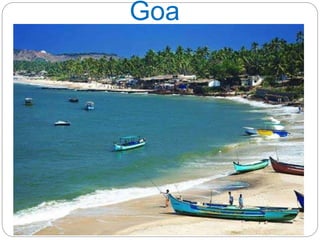
Goa
 Known as “ pearl of Orient”
 Beaches filled with coconut palm
 Portuguese made biggest impact on food.
 Staple food: fish. Christian eat beef & pork
 Cuisine is hot, sweet and sharp, due to use of
spices such as cinnamon, cloves, black
peppercorn and curry pastes made with
coconut, red chillies and vinegar.
 Most famous Vindaloo is from Portugal
 Sorpotel (Pork offal including, liver, heart and
kidneys diced and cooked with chillies and
Tamarind.
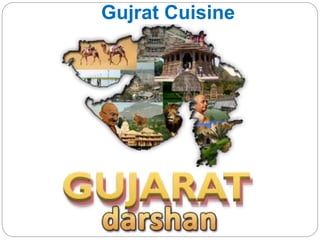
Gujrat Cuisine
 Home to some of India’s finest vegetarian
dishes.
 Gujarat is renowned for its sophisticated light
vegetarian meals.
 Food is mainly mild.
 Pulses and vegetables accompanied by breads
are popular.
 Dairy based products such as buttermilk are
favoured.
 Spice pastes are made using root ginger +
Green Chillies .
Influence in Indian Cuisine
 Indian cuisine is a varied as its people and
culture.
 Each ethnic group has its own blends of
spices and special cooking equipment and
spices to produce the most delectable gourmet
fare.
 India was invaded by many conquerors and
rulers.
 Indian heritage, culture, and arts were the
major attraction to the rulers.
 India was invaded by Arabs, Central Asians,
Mughals, and also the Greeks.
 Some travelers from China also left a huge
Influence of Greeks
 Greece is very famous for its fresh herbs
such as oregano, mint, coriander, and essential
oils such as olive etc.
 With the conquest of India by Alexander the
Great in 350 BC, the Greeks brought their
profound herbs and spices.
 Greek cuisine itself is a blend of cuisines of the
Roman Empire and Turkey.
 During the time of Alexander, trade
flourished between India, Rome, and other
Mediterranean countries and this brought
the usage of saffron and many herbs and
spices to Indian cooking.
 Greek cuisine till date is very famous for its
fruits, cheese, nuts, grains, and oils.
 Greece contributed Indian vegetables such as
egg plant and Zucchini.
 A pan fried Kalhari (Cheese) found in Jammu,
India, is similar in taste to the Greek cheese
called Kasseri.
 Spice such as fenugreek and fennel were the
influence of Greeks and these two are the most
commonly used spices in Indian cooking.
 Greek influence gave elegance to Indian food,
along with lots of flavors and nutrition.
Influence of Mughals
 The Muslims from western Asia brought the rich
heritage of Mughlai cuisine.
 Mughals invaded Indian (12th century) and
covered a large area of the country.
 Mugal enjoyed wining and dining and their large
and elaborated buffet fares influenced Indian
tradition to a large extent.
 On special occasions, such as marriage, it was
common to see a range of minimum 50 dishes.
 A variety of food on the table described one’s
royalty and richness.
 The Mughals brought them the usage of
aromatic spices such as cardamom, mace,
nutmeg, and variety of nuts such as almonds
and pistachios.
 The cooking style too changed with the advent
of spit fire roasts and this gives birth to Kababs
and Tandoori items.
 The spices were quite exquisite and can be
referred to as exotic spices.
 The usage of milk and cream along with nuts
and dried fruits gave rise to biryanis and pilafs
that are still an integral part of Indian culture.
 Meats were the preferred choice of
 Meats started to be included in the meals of
Indian society.
 Each Mughal ruler added his own preferred food
items to the Indian cuisine.
 It is believed that when Babur invaded India,
he brought with him the tradition of grilled meats
and dried fruit.
 His son Humayun continued the traditions and
introduced a range of pilafs and biryanis.
 Certain Mughal rulers married Rajput
princesses and this added a new dimension to
the Mughlai cuisine.
Chinese
 The parts of India closer to the borders of
China and Mongolia, such as the states of
Mizoram, Arunachal Pradesh, Nagaland, and
Manipur have more influence of Mongolian
and Chinese cooking.
 The Mongolians introduced cooking styles of
hot pots and stews and also introduced new
ingredients into cooking.
 Traditional Mongolian cooking uses lots of meat
and dairy products along with rice and this can
be seen in eastern India, where rice is the most
preferred staple food.
 The style of hot pots, where the mince meat is
 Mongolians also introduced simplicity into Indian
cooking.
 It can be seem that in these states, the food is
simple and not very elaborate.
 The cooking methods employed are steaming
and frying and this is again the influence of
Mongolia.
 Mustard oil is the influence of Mongolia and so
is the usage of sugar.
 Chinese also gave methods of cooking to Indian
cooking.
 Stir-fries used in Indian cooking are the result
of Chinese influence.
Influence of Portuguese
 When Vasco da Gama came to India, Indian
food went through a sea change.
 The advent of spices and the most common
ingredient chilly was brought in by Vasco da
Gama in the year 1498.
 The influence of the Portuguese food can be
seen in Goa cuisine, where the names of dishes
are very Portuguese.
 The dishes of Goa cuisine are tangy, spicy and
immensely flavored.
 The introduction to seafood such as prawns and
meats, such as pork and beef, has been the
influence of the Portuguese.
 Portuguese brought in fruits, such as cashew
Influence of British
 During the reign of the British in India, many
elaborated techniques were introduced to the
Indian Kitchen.
 Flexibility and the diversity were introduced in
Indian cooking and people started to use many
of the European cooking styles in the menu.
 The concept of grilling on the cast iron pans and
roasting has been given to use by British
people.
 The English brought whisky and tea to India.
 The concept of curries with rice are a concept
that started during British time.
 Many preparations such as Murgh Makhani
are said to be invented by the British.
 Many dishes made during British time are
classified as Raj cuisine, which most comprises
of Anglo-Indian cuisine.
 There was no concept of soups in Indian
cuisine, but all the various types of shorbas are
the influence of the British.
 Soups such as Mulligatawny is also concepts
given by the British people.
Cuisine
 Religious practices vary widely in India.
 In the olden time when cast system was
prevalent, many sects classified food
accordingly and also posted prohibition and
restrictions on certain castes, for examples,
Brahmins could not eat meats, etc.
 India has always been secular state with people
practicing different religions and faiths.
 Indian foods are much more influenced by
ayurveda principle, which believes that food
provides purity of mind, body and spirit.
 Thus many religions have demarcated food
accordingly so that the people eat healthy food
and lead a simple and pure life.
 Natural variations are also common; further
individual adherence to a religious diet is often
based on personal degree of orthodoxy.
 Today the growing awareness towards
animal right and health consciousness has
given birth to vegetarianism.
 It is easy to digest and build strong immune
system.
Techniques Employed In Indian
Cooking
Dum (Sealed steaming)
 Dum means cooking an item with its own steam.
 This is caried out in an enclosed container,
where the steam is not allowed to escape out.
 The heat is applied from top and bottom.
 This is done by putting the utensil on top of
smouldering charcoals and some burning
charcoal is also put on top of the lid to allow the
heat from all the sides.
 The meat or vegetable is partially cooked and
the lid is sealed with the help of dough and
placed to cook on dum.
 Dum cooking is usually done for dishes that
have aromatic and flavorful spices and this
Use:
 It is usually used for cooking biryani.
 Some vegetarian curries such as dum aloo from
Kashmir are also cooked by this method.
 The dishes cooked by this technique might have
its name associated with the technique such as
gosht dum masala, dum ki batak, dum ka
karela, and so on.
Bhunao ( Sauté/ Stir fry):
 This is the combination of sauté, stir frying and
stewing.
 This is the process of cooking where heat is
regulated from medium to high, adding liquid
such as water, yoghurt or as required by the
dish.
 This continuous stirring or bhunana is done to
prevent dish from sticking to the bottom of the
utensil.
 Bhunao is not a complete process of cooking,
but is the part of the entire process that is used
for preparing a dish.
 Sometimes when the dish is made using only
 Used:
 It is used for preparing most of the Indian
dishes, where the ingredients are sautéed, prior
to finishing them into curries and dry
preparations.
 Bhunna murgh, bhuneey dum key bateyr, etc
are the dishes that are made using this
technique.
Baghar (Tempering):
 It is also known as tadka in North, chonkna in
central India, Baghar in west.
 Tempering is done using hot oil, as hot oil has
properties of extracting flavor and color of
spices.
 This process can be done in the beginning of
the dish or in the end. Sometimes a dish is also
tempered in the beginning and finished with
tempering in the end.
 For example, Kadhi from north or salan from
Hyderbad.
Use:
 The major use of tempering is to flavor a dish
with aromatic spices.
 Some time tempering is also done to get rid of
strong smell of mustard oil or ghee.
 In Lucknow, people remove the smell of ghee
by tempering it with aromatic spices such as
green cardamom and mace and the procedure
is known as ghee durust dena.
Talna (Frying)
 This is term used for frying in Indian cuisine.
 Usually done in kadhai as the shape of the
kadhai facilitates the fry of large quantities in
less amount of oil.
Use:
 It is used for frying of snacks or even main
course and desserts.
Dhungar (smoking):
 Dhungar or smoking means to impart the
Smokey flavor to the dish.
 Unlike Western smoking, which involves burning
of wood such as oak, chicory etc.
 Indian dhungar used oil or ghee poured over
smouldering charcoals.
 Sometimes spices such as cloves are used to
impart a flavor, which mainly goes well with
meat dish.
 The item to be smoked is put in a handi and
small piece of coal is placed in a bowl and
placed in the handi among the food to be
smoked.
 Use:
 It has many uses. The Rajasthani specialities,
such as maans key sooley, laal maans, etc are
smoked with cloves.
 Kebab mixes such as galouti kebab from
lucknow is also smoked with cloves.
Sekna:
 Sekna means baking or roasting. One could use this
method for Indian breads such as chappati, phulka
paratha, etc. over tawa, or even breads, meats, and
vegetables in tandoor. Central parts of India use cow dung
as a medium of fuel for sekna.
 Use: It is used for Indian bread made on tawa. It is used
for Kebabs, breads made on sigri or tandoor.
Bhapa ( Steaming) :
 Bhapa refers to cooking with steam. It is used mostly in all
parts of India, with exception to north. Steaming is carried
out in simple pot or sometimes things are steamed in
bamboo tubes. Things can be steamed in banana leaves
also.
 Used: It finds its uses in breakfast to main meal and even
desserts. Idli from south, macher paturi from Bengal, and
modak, a dessert form Maharashtra, are few examples of
steamed dishes.
Paste and gravies used in Indian
Cuisine