Download as PDF, PPTX
- 1 / 12

- 2 / 12
 Most read
 - 3 / 12
- 4 / 12
 Most read
 - 5 / 12
- 6 / 12

- 7 / 12
- 8 / 12

- 9 / 12

- 10 / 12

- 11 / 12

- 12 / 12
 Most read

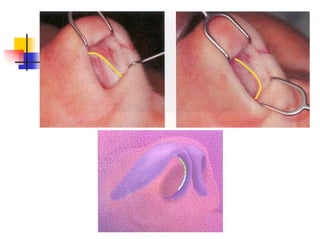
This document discusses different incision techniques for rhinoplasty surgery. There are three main incision types: 1) Transcartilaginous incisions are made within the nasal cartilage. 2) Intercartilaginous incisions are made between the upper and lower nasal cartilages. 3) Marginal incisions are made along the outer edge of the nasal cartilage. The document also describes four surgical approaches - delivery, cartilage splitting, retrograde, and open - and provides details on transfixion, intercartilaginous, intracartilaginous, and transcolumellar incision techniques.


