FAMILY NURSING
AND
HOME NURSING
PAUL EBENEZER
MSC 1ST YEAR
CON, CMC
family ?
family is a group of persons united with ties
of marriage ,blood or adopation consist of
single household ,intracting and
intercommunicating with others in their
respective social roles of husband and wife,
mother and father, son and daughter, brother
and sister creating a common culture
-(burgess and Locke)
• Family is a word that conjures up different images for every
individual and groups, and the word has evolved in its meaning
over time.
• Legal: Relationships through blood ties, adoption,
guardianship, or marriage
• Biological: Genetic biological network among people
• Sociological: Groups of people living together
• Psychological: Groups with strong emotional ties.
INTRODUCTION
• Families are the foundation of society.
• Family is where life begins and love never ends.
• The health of a community is directly related to the health of
its families.
• District nursing concept by Nightingale.
• Families have greatest potential for raising Individual.
• Family as a client
• The specialty has its roots in community health nursing, maternal
child nursing, nurse midwifery, public health nursing and mental
health nursing.
• Although it does overlaps other specialties, family health nursing is a
distinct specialty.
• As a distinct speciality it is relatively young, yet there is strong
evidence that family nursing is a growing , dynamic speciality area of
focus in practice, education and research.
Definition of Family:-
• Influenced by personal involvement with his or her
own family with clinical experiences.
• A family care giving unit might consist of couple, a
mother, father and children a single parent and child,
grandparent and grandchildren, a sibling group on
circle of family.
Definition of Family health
•Family Health is defined as a dynamic changing state
of well being which includes the biological,
psychological, spiritual, sociological and cultural
factors of individual members and the whole family
system. (Hanson 2005)
General SystemTheory
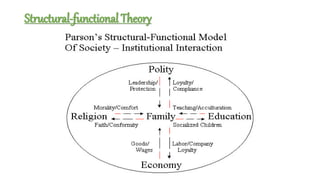
Structural-functional Theory
Developmental theory
Marriage
Child bearing
families
Preschool
children
Launching
Adults
Teens
School
Children
Middle aged
parents
Aging family
members
Characteristics of a Healthy Family
•The healthy family tends to communicate well and listen
to all members.
•The family members affirms and supports all its
members.
•Teaching respect for others is valued by the family.
•The family members have a sense of trust.
•The family members play together, and humour is
present.
Characteristics of a healthy family contd…
•All members interact with each other, and a balance in
the interaction is noted among the members
•The family members shares leisure time together
•The family members has a shared sense of
responsibilities
•The privacy of the members is honored by the family
•The family opens its boundaries to admit and seek
help with problems.
Types of Family
1. Nuclear Family
2. Extended Family
3. Single-parent Family
4. Foster Family
5. Blended Family
6. Integrational Family
7. Cohabiting Family
8. Gay and Lesbian Family
9. Single Adults Living alone
Approaches to Family Nursing
• Central to the practice of family nursing is conceptualizing
and approaching the family from four perspectives
1. Family as context
2. Family as Client
3. Family as a system
4. Family as a component of society
1. Family as context
• The family has a traditional focus that
places the individual first and the family
second.
• The family as a context serves as a
strength or a stressor to individual
health and illness issues.
• The nurse is more interested in the
individual and realizes that the family
influences the health of the individual.
2. Family as Client
• The family is the primary focus
and individuals are secondary.
• The focus is concentrated on how
the family as a whole is reacting to
the event when a family member
experience a health issue.
3. Family as a system
• The focus is on the family as
client.
• This approach focuses on
individual members and the
family as a whole at the same
time.
• The interaction among family
members become the target for
nursing intervention.
4.Family as a component of society
• The family is seen as one of
many institutions in society
along with health, education,
religious and financial
institutions.
• The family is a basic or
primary unit of society, as are
all the other units, and they
are all part of the larger
system of the society
•Family Nursing goals
•The framework of Levels of Prevention
explains the goal of family nursing.
1. Primary prevention:
a)
Health attitudes, behaviours and values are
learned in the family
• Health promotion and primary prevention of acute and chronic
health problems pose the greatest health challenge to our society.
• Perhaps our most important goal should be to assist people
(individual and families) to learn how to be healthy in a natural way,
rather than just focussing on assisting clients about how not to get
sick, or worse yet, assisting clients only when they are sick.
•Specific preventive measures
•Risk appraisal/ risk reduction.
2. Secondary prevention
a) Early Diagnosis: Identifying high risk behaviours,
screening and detection of family pathology or
dysfunction.
b) Prompt treatment: Encouraging to go to the
appropriate facilities for care, family therapy,
reporting of suspected abuse etc.
3. Tertiary prevention
: The family unit maybe
changed in composition, recovery and
maintenance of chronically ill people etc.
Theories Used in Family Nursing
• Family Nursing Theories
• Family system Theories
• Family development and life cycle Theory
• Bio Ecological System Theory
• NURSING THEORIES
• Newman Concept of Family
• Roy’s Concept of Family
• Kings Concept of Family
• Roger’s Concept of the Family
Family Nursing Theories
1. Family Nursing Theory
Is an evolving synthesis from 3 different tradition
theory:
Family social science,
Family therapy and
Nursing
Family social
science
theories
Family therapy
theories
Nursing
models/
theories Family
nursing
theories
Family system Theories
Family life cycle
Basic Model of nuclear family life cycle
Phases of Family Life
Cycle
Events Characterizing
Description Beginning End
I. Formation
II. Extension
III.Complete Extension
IV.Contraction
V. Complete contraction
VI.Dissolution
Marriage
Birth of First Child
Birth of Last Child
1st child leaves home
Last child has left home
parents
Birth of 1st Child
Birth of a Last Child
1st child leaves home
Last child leaves
home parents
1st spouse dies
Death of Surviour
Bio Ecological System Theory
•Developed by Urie Bron Fenbrenner
(1972,1979,1997)
•Describes how environments and systems
outside the family influence the
development of a child over time.
•Very useful to help identify the stresses and
potential resources that can affect family
adaptation.
Newman Concept of Family
•Newman defines the family as a system within
society
•The goal is for the family system to maintain itself is
an optimal state of health.
•Nursing role is to intervene to reduce stressor
related to the family’s health status.
Roy’s Concept of Family
• Family as an adaptive system. Stimuli from individual family members
needs and from the external environment have an impact on family
system
• The family system internally process input through ,supporting ,
nurturing and socializing
• The goal is to promote family system adaptation towards ‘survival,
continuity, and growth.
• Nurse Role is to Participate with the family in processing and adapting
to stimuli affecting the family system
Kings Concept of Family
• Defines as family as a social system and an interpersonal system of
interacting Individuals
• The goal for the family is to influence in Individuals in growth and
development, and in processing from dependence in childhood to
independence in adulthood
• Nurse’s Role is to assist families through nurse-family intraction that
clarifies and provide information necessary for goal settings and
problem solving resolution related to family health.
Roger’s Concept of the Family
•Defines the family as an energy field in continuous
process with energy fields. She views the family as
an irreducible whole that cannot understood
solely by knowledge about individual family
members.
•The Goal of family is maintenance and promotion
of family’s wellbeing through restructuring family
and environment field.
Family Nursing Process
Family Assessment
• Sources of family assessment data:
• a) Client interviews relative to past or present events.
• Questioning and listening
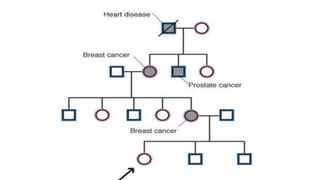
• Genogram
• Ecomap
• b) Objective data
• Observations of the house
• Observations of family interactions.
• c) Subjective data
•d) Reported experiences of the family members
• Reported observations of significant others
• Assessment instruments completed by family
members.
•e) Written and oral information from referral
• Reports from agencies working with the family.
• Reports from other health team members.
Assessment tools
1. Genogram:
A way to diagram the family.
Usually three generations of the family member are included.
2. Ecomap
Is a visual diagram of the family unit in relation to other units or
subsystem in the community.
3. Family Health tree
Recording the family’s medical and health histories based on the
genogram.
Used for planning positive familial influences on risk factors such as
diet, exercise, coping with stress or pressure to have a physical
examination.
NANDA Diagnosis relevant to Family Nursing
• Anticipatory grieving
• Care Giver Role strain
• Chronic Sorrow
• Compromised Family Coping
• Decisional Conflict
• Deficient Knowledge
• Disabled family Coping
• Dysfunctional Family Processes: Alcoholism
• Dysfunctional Grieving
• Health-seeking Behaviour
• Imbalanced Nutrition: Less than Body requirement
• Imbalanced Nutrition: More than Body requirement
• Impaired adjustment
• Impaired Home Maintenance
• Impaired parenting
• Impaired social interaction
• Ineffective Role Performance
• Ineffective Family Therapeutic Regimen Management
• Interrupted Family Processes
• Noncompliance
• Parental Role Conflict
• Post-trauma syndrome.
• Powerlessness
• Readiness for Enhanced Family Coping
• Readiness for Enhanced Spiritual Well-being
• Risk for Caregiver Role Strain
• Risk for Imbalanced Nutrition.
• Risk for Impaired Parenting
• Risk for loneliness
• Risk for other Directed Violence
• Risk for powerlessness
• Sexual Dysfunction
• Social Isolation
• Spiritual Distress
Family Nursing Intervention
• Behaviour Modification
• Case management , including coordinating and
advocacy
• Collaboration
• Consultation
• Counselling, including support, cognitive reappraisal,
crisis intervention and group work
• Empowerment strategies
• Environmental Modification
•Family advocacy
•Lifestyle modification
•Networking, including use of self-groups and
social support
•Referring
•Role modelling
•Role supplementation
•Teaching strategies
•Values clarification
Role of the family health nurse (WHO, 2000)
• Help the individuals and families to cope with illness
and chronic disability, or during time of stress by
spending a large part of their time working in patient’s
home and with their families.
• Give advice on lifestyle and Health risks factors as well
as assisting families with matters concerning health.
•Through prompt decision, they can ensure that
the health problems of families are treated at an
early stage.
•Identify the effects of socio economic factors in a
family‘s health and refer them to the appropriate
agency.
•Can facilitate the early discharge of people from
the hospital by providing nursing care at home,
and act as the lynchpin between the family and
the family health physician.
Barriers to implementing family intervention
• 1. Family-related Barriers:
• Apathy And Indecision
• Apathy: It is manifested when the family responds to the
nursing actions with an apparent “so what” attitude and
gives no sign of action or concern.
• Does the family really not care?
• Usually, they do care
•Indecision where the family members have
difficulty making decisions.
•In both the situations it is important that the nurse
probe into what is happening within the family and
to be curious about the root of the problem so that
it can be identified and addressed.
•2. Nurse related barriers:
•Imposing Ideas
•Negative labelling
•Overlooking strengths
•Neglecting cultural and gender implications.
Challenges for family Nursing
• Delegation in the management of nursing care activities is a challenge
in family nursing:
• Often nurses try to enhance on family health buy delegating duties to
family members of the health care team.
• Discharge planning with a family involves an accurate assessment of
what will be needed for care at the time of discharge along with any
short coming in the home settings
• Cultural sensitivity in family nursing
Home Nursing
Introduction
• Home nursing is nursing care which is provided in a home
environment, rather than in a medical facility.
• Many circumstances in which people require home care : Temporary
to long term care
• Employment in this field is quite varied : As Agencies, Freelancers
• The level of care involved in home nursing is tailored to the needs of
the patient.
• Some nurses simply visit the home one or more times
a day to perform nursing tasks which cannot be done
by other caregivers, or to check on the patient's well
being if no other caregivers are being used.
• In other cases, home nursing is a live-in position,
because the patient requires constant monitoring and
care.
Definition
•Home Nursing is “a specialized area of Nursing
practice, rooted in community health nursing,
that delivers care in the residence of the client”
ANA, 2007
•Home Health Nurses includes generalist nurse,
Public Health Nurse, Clinical Nurse Specialist
and Nurse Practitioner.
•Home Health Care is that component of a
continuum of comprehensive health care
whereby health services are provided to
individuals and families in their place of
residence, for the purpose of promoting,
maintaining or restoring health, or maximizing
the level of independence, while minimizing
the effects of disability and illness, including
terminal illness.
U.S DHHS,1990
Purpose of Home Health Services
•The primary purpose of home
health services is to allow
individuals to remain at home and
receive health care services that
would otherwise be offered in a
health care institution such as
hospital or nursing home settings.
Types of Home Health Agencies
• Official agencies (Local or State Govts)
• Non Profit Agencies
• Proprietary Agencies (For-profit agencies)
• Chains
• Hospital Agencies
Nursing standards and educational
preparation of Home Health.
• ANA 2008
• Generalist home care nurse : Baccalaureate level
• Advance Practice Home Health Nurse: Masters or doctoral degree in
nursing.
HOME VISIT
• Providing services to families in their homes.
• Purpose : Home visit as compared to clinical visits, gives
a more accurate assessment of the family structure, the
natural or home environment and behavior in that
environment
• Long term effects of home visits are positive and are
shown to be cost effective for society.
Application of nursing process
• Assessment
• Diagnosis
• Planning and Implementation
• Evaluating and documenting
ADVANTAGES
• The home settings is intimate; this intimate fosters
familiarity, sharing, connections, and caring between
clients , families and their nurse.
• Behaviour are more natural, cultural beliefs and practices
are more visible and multigenerational interaction tend to
be displayed.
DISADVANTAGES
• More than any other care providers, these nurses have firsthand
knowledge and experience about burden of care.
• In the interest of cutting health care cost, policy makers, third party
payer ,and medical providers are placing increasingly complex
responsibility on clients families and significant others.
• Care giving demands may go on for months and years, placing the
care giver themselves at risk for physiological and psychological
problem.
• Additionally, nurses enter homes where the living condition and
support system may be inadequate.
Conclusion:
• Health and illness behaviours are learned within the
context of family.
• Health care effectiveness is improved when emphasis is
placed on the family.
• Promotion, maintenance and restoration of the health
of families is important to the survival of society.
• Advanced practice nurses in primary care are in the best
position to foster family health given the fact that a
major aspect of primary care is health promotion
Thank you