EXCEPTION HANDLING
Pranali P Chaudhari
Contents
 Errors and Exception
 Exception Handling Mechanism
 Try, Throw and Catch
 Re-throwing an Exception
 Specifying Exceptions
Quiz 1
 What is an error?
 An error is a term used to describe any issue that arises
unexpectedly and results in incorrect output.
 What are the different types of errors?
 Logical error:
 Occur due to poor understanding of problem or solution
procedure.
 Syntactic error:
 Arise due to poor understanding of the language itself.
 What is an exception?
 Exceptions are run time anomalies or unusual conditions
that a program may encounter while executing.
Exception Handling
 Exceptions are of two types:
 Synchronous exceptions
 The exceptions which occur during the program
execution due to some fault in the input data are known
as synchronous exceptions.
 For example: errors such as out of range, overflow,
underflow.
 Asynchronous exceptions.
 The exceptions caused by events or faults unrelated
(external) to the program and beyond the control of the
program are called asynchronous exceptions.
 For example: errors such as keyboard interrupts,
hardware malfunctions, disk failure.
Exception Handling Mechanism
 Exception handling mechanism provides a
means to detect and report an exception
circumstances.
 Find the problem (Hit the exception)
 Inform that an error has occurred (Throw the
exception)
 Receive the error information (Catch the
exception)
 Take corrective actions (Handle the
exception)
 The error handling consists of two segments
Exception Handling Mechanism
 The exception handling mechanism is built
upon three keywords:
 Try
 Is used to preface a block of statements which may
generate exceptions.
 Throw
 When an exception is detected, it is thrown using a
throw statement in the try block.
 Catch
 A catch block defined by the keyword catch catches
the exception thrown by the throw statement in the try
block and handles it appropriately.
Exception Handling Mechanism
 When the try block throws
an exception the program
control leaves the try block
and enters the catch
statement of the catch
block.
 If the type of object thrown
matches the arg type in the
catch statment the catch
block is executed.
 Otherwise the program is
terminated with the help of
abort( ) function.
Try block throwing an exception
int main()
{
int a,b;
cout<<“enter the values of a
and b :”;
cin>>a;
cin>>b;
int x = a-b;
try
{
if(x != 0)
{
cout<<“Result (a/x) =“
<< a/x;
}
else
{
throw(x);
}
}
catch(int i)
{
cout<<“Exception Caught
: x = “ << x << “n”;
}
return 0;
}
Exceptions thrown by functions
 Mostly
exceptions are
thrown by
functions that
are invoked from
within the try
blocks.
 The point at
which the throw
is executed is
called the throw
point.
Exceptions thrown by functions
void divide(int x, int y, int z)
{
if((x-y) != 0)
{
int R = z/(x-y);
cout << “Result = “ << R << “n”;
}
else
{
throw (x-y);
}
}
Exceptions thrown by functions
int main()
{
try
{
divide(10,20,30);
divide(10,10,20);
}
catch(int i)
{
cout << “n Exception caught” ;
}
return 0;
}
Throwing Mechanism
 When an exception is desired to be handled is
detected, it is thrown using the throw statement.
 Throw statement has one of the following forms:
 throw(exception);
 throw exception;
 throw;
 The operand object exception may be of any type,
including constants.
Catching Mechanism
 A catch block looks like a function definition:
catch(type arg)
{
// statements for managing exceptions.
}
 The type indicates the type of exception that catch block
handles.
 The catch statement catches an exception whose type
matches with the type of catch argument.
Multiple Catch Statements
 Multiple catch statements can be associated with a
try block.
 When an exception is thrown, the exception
handlers are searched for an appropriate match.
 The first handler that yields the match is executed.
 After executing the handler, the controls goes to the
first statement after the last catch block for that try.
Multiple Catch Statements
void test(int x)
{
try
{
if (x==1) throw x;
else
if(x==0) throw ‘x’;
else
if(x== -1) throw 1.0;
cout<<“nEnd of try-block”;
}
}
catch(char c) // catch 1
{
cout<<“nCaught a character”;
}
catch(int m) // catch 2
{
cout<<“nCaught an integer”;
}
catch(double d) // catch 3
{
cout<<“nCaught a double”;
}
cout<<“n End of try-catch block”;
Multiple Catch Statements
int main( )
{
cout<<“n x = =1”;
test(1);
cout<<“n x = = 0”;
test(0);
cout<<“n x = = -1”;
test(-1);
cout<<“n x = =2”;
test(2);
return 0;
}
x == 1
Caught an integer
End of try-catch system
x == 0
Caught a character
End of try-catch system
x == -1
Caught a double
End of try-catch system
x == 2
End of try-block
End of try-catch system
Catch all Exceptions
 Sometimes it is not possible to anticipate all
possible types of exceptions and therefore not able
to design independent catch handlers to catch
them.
 A catch statement can also force to catch all
exceptions instead of a certain type alone.
 Syntax:
catch (…)
{
// statements for processing all exceptions.
}
Catch all Exceptions
void test(int x)
{
try
{
if (x==1) throw x;
else
if(x==0) throw ‘x’;
else
if(x== -1) throw 1.0;
cout<<“nEnd of try-
block”;
}
}
catch(…)
{
cout<<“n Caught an
exception”;
int main( )
{
cout<<“nTesting generic
catch”;
test(1);
test(0);
test(-1);
test(2);
return 0;
}
Re-throwing an Exception
 A handler can re-throw the exception caught without
processing it.
 This can be done using throw without any arguments.
 Here the current exception is thrown to the next enclosing
try/catch block.
 Every time when an exception is re-thrown it will not be
caught by the same catch statements rather it will be
caught by the catch statements outside the try catch block.
Re-throwing an Exception
void divide(double x, double y)
{
cout<<“Inside Function”;
try
{
if(y = =0.0)
throw y;
else
cout<<“Division = “ <<x/y<<“n”;
}
catch(double)
{
cout<<“nCaught double inside function”;
throw;
}
cout<<“n End of function”;
}
int main()
{
cout<<“n Inside main”;
try
{
divide(10.5, 2.0);
divide(20.0, 0.0);
}
catch(double)
{
cout<<“n Caught double inside
main”;
}
cout<<“n End of main”;
return 0;
}
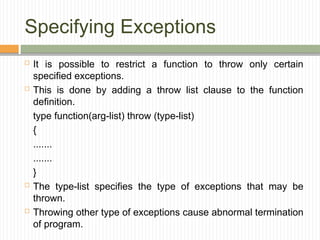
Specifying Exceptions
 It is possible to restrict a function to throw only certain
specified exceptions.
 This is done by adding a throw list clause to the function
definition.
type function(arg-list) throw (type-list)
{
.......
.......
}
 The type-list specifies the type of exceptions that may be
thrown.
 Throwing other type of exceptions cause abnormal termination
of program.
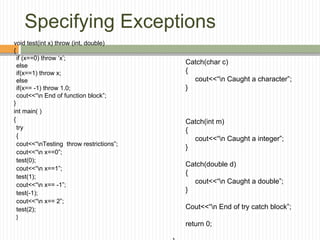
Specifying Exceptions
void test(int x) throw (int, double)
{
if (x==0) throw ‘x’;
else
if(x==1) throw x;
else
if(x== -1) throw 1.0;
cout<<“n End of function block”;
}
int main( )
{
try
{
cout<<“nTesting throw restrictions”;
cout<<“n x==0”;
test(0);
cout<<“n x==1”;
test(1);
cout<<“n x== -1”;
test(-1);
cout<<“n x== 2”;
test(2);
}
Catch(char c)
{
cout<<“n Caught a character”;
}
Catch(int m)
{
cout<<“n Caught a integer”;
}
Catch(double d)
{
cout<<“n Caught a double”;
}
Cout<<“n End of try catch block”;
return 0;
Summary
 ______ are peculiar problems that a program may encounter at run
time.
 Exceptions are of two types _____ and ______.
 An exception is caused by a faulty statement in ____ block, which is
caught by _____ block.
 We can place two or more catch blocks to catch and handle multiple
types of exceptions. (True/ False).
 It is also possible to make a catch statement to catch all types of
exception. (True/ False)
 We cannot restrict a function to throw a specified exceptions. (True /
Short Answer Questions
 What is an exception?
 Exceptions are run time anomalies or unusual conditions
that a program may encounter while executing.
 How is exception handled in C++?
 In C++ the exception is handled using the three
keywords try, throw and catch. Or try-catch mechanism.
 What are the advantages of using exception
handling mechanism in a program?
 The purpose of exception handling mechanism is to
provide a means to detect and report an exceptional
circumstances so that appropriate action can be taken
and prevent abnormal termination of program.
Short Answer Questions
 When should a program throw an exception?
 There are some situation when a program come across
unexpected errors and cause abnormal termination of
program. To handle such errors and prevent program
from termination exceptions are thrown and handled.
 What should be placed inside the try block?
 The statement that may generate an exception are
placed in the try block.
 When do we use multiple catch handlers?
 Multiple catch handlers are used in a situation where a
program has more than one condition to throw and
exception.
Short Answer Questions
 Explain under what circumstances the
following statements would be used:
 throw;
 Re-throwing an exception.
 void fun1(float x) throw()
 Prevent a function from throwing any exception.
 catch( ... )
 Used to catch all types of exceptions.
References
 Object Oriented Programming with C++ by E.
Balagurusamy.
END OF UNIT ....