Key Issue #3
   Locations near markets or
    break-of-bulk points have
    become more important than
    locations near raw materials
    for firms in developed
    countries.
   However, situation factors do
    not explain the growing
    importance of Japanese and
    other Asian manufacturers.
   The cost of conducting
    business varies among
    locations, depending on the
    cost of three production
    factors: land, labor, and
    capital.
 Land for one-story            Aluminum plants have
  factories available in rural   been built near sources
  locations.                     inexpensive hydroelectric
 Attracted to land              power, including the TN
  accessible to energy           Valley and the Pacific NW.
  sources.                      Industry may also be
 Industries with a              attracted to a particular
  particularly high demand       location because of
  for energy may select a        amenities at the site.
  location with lower
  electrical rates.
 The aluminum industry
  requires a large amount of
  electricity.
 A labor-intensive
  industry is one in
  which labor cost is a
  high percentage of
  expense.
 Some labor intensive
  industries require
  highly skilled labor to
  maximize profit,
  whereas others need
  less skilled, inexpensive
  labor.
   Examples of labor intensive
    industries
     Generally require less skilled,
      low-cost workers.
 The global distributions of
  spinning, weaving, and sewing
  plants are not the same,
  because the steps are not
  equally labor-intensive.
 (Some) natural fiber
  manufacturing is concentrated
  where the principal input
  (cotton) is grown.
Fig. 11-15: Production of cotton yarn from fiber is clustered in major cotton
             growing countries, including the U.S., China, India, Pakistan, and
             Russia.
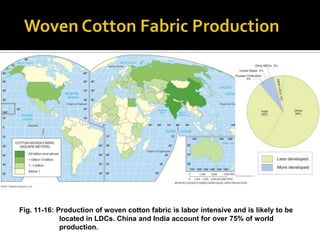
Fig. 11-16: Production of woven cotton fabric is labor intensive and is likely to be
             located in LDCs. China and India account for over 75% of world
             production.
Fig. 11-17: Sewing cotton fabric into men’s and boys’ shirts is more likely to be
             located near customers in MDCs, but much production now occurs in
             LDCs.
   U.S. textile weavers and clothing
    manufacturers have changed
    locations to be near sources of
    low-cost employees.
   U.S. textile and clothing firms
    were concentrated in the
    Northeast during the nineteenth
    century (employing) European
    immigrants.
   Workers began to demand better
    working conditions and higher
    wages around 1900.
   Their claim was bolstered by tragic
    events, such as the 1911 Triangle
    Shirtwaist Company fire in NYC
Fig. 11-18: Hosiery manufacturers usually locate near a low-cost labor
             force, such as found in the southeastern U.S.
Fig. 11-19: Knit outerwear requires more skilled workers, and much
             manufacturing is still clustered in or near New York City.
 Companies may become
  more successful by paying
  higher wages for skilled labor
  than by producing an inferior
  product made by lower-paid,
  less skilled workers.
 Computer manufacturers
  have concentrated in the
  highest-wage regions in the
  United States.
 These regions have a large
  concentration of skilled
  workers because of proximity
  to major university centers.
Fig. 11-20: Computer and parts manufacturing requires highly skilled workers and capital. It
             is clustered in the Northeast and the West Coast.
   Financial institutions in many
    LDCs are short of funds, so
    new industries must seek
    loans from banks in MDCs.
   Local and national
    governments increasingly
    attempt to influence the
    location of industry by
    providing financial incentives.
   These include grants, low-
    cost loans, and tax breaks.
   principle whereby places and regions
    specialize in activities for which they have the
    greatest advantage in productivity relative to
    other regions – or for which they have the
    least disadvantage

   principle that an area produces the items for
    which it has the greatest ratio of advantage
    or the least ratio of disadvantage in
    comparison to other areas.
   Create an advertisement for your city to
    encourage business to locate there. Be sure
    to highlight the desirable site & situation
    characteristics of your city

   Target your ad toward certain industries that
    you know are looking for the site and
    situation characteristics of your city. Choose
    industries we have discussed in this chapter.
Requirements                  Points
         Name of the City                 5
        Site Characteristics             15
     Situation Characteristics           15
Targeted toward specific industries       5
    Creative, Colorful, Pictures         10
  (Looks like an advertisement)
                                      TOTAL: 50
   The location that a firm chooses
    cannot always be explained by
    situation and site factors.
   Many industries have become
    “footloose,” meaning they can
    locate in a wide variety of
    places.
   An industry may be especially
    footloose if it uses replica
    machines, electronic mail, the
    Internet, and other
    communications systems to
    move inputs and products.