Chapter 7: Carbohydrates
2
Chapter 7: Carbohydrates and Glycobiology
keystone concepts:
• All carbohydrates are made up of C, H, and O
• The three elements that make up all carbohydrates are arranged as
alcohols, aldehydes, or ketones
• Monosaccharides are the monomeric subunits of di-, oligo-, and
polysaccharides
• Polysaccharides vary in composition, type of glycosidic bond, chain
length, degree of branching, and biological function
• Glycoconjugates including proteoglycans, glycoproteins, and
glycolipids and are hybrid carbohydrate molecules with protein and
lipid components
• Carbohydrates function in energy storage, structural support, and
intercellular signaling
3
Monosaccharide classification
• Monosaccharides have the general formula CnH2nOn, where n varies from
3 to 8.
• Aldose: a monosaccharide containing an aldehyde group.
• Ketose: a monosaccharide containing a ketone group.
• all monosaccharides (except dihydroxyacetone) contain 1+ chiral
carbon atom
– occur in optically active isomeric forms
• enantiomers = two different optical isomers that are mirror images
• in general, a molecule with n chiral centers can have 2n
stereoisomers
Monosaccharides have chiral carbons
• are used to represent three-dimensional sugar structures on paper
• bonds drawn horizontally indicate bonds that project out of the
plane of the paper
• bonds drawn vertically project behind the plane of the paper
• The carbon chain is written vertically with the most oxidized carbon
at the top.
• Carbohydrates can have multiple chiral carbons; the
configuration of groups around each carbon atom determines
how the compound interacts with other biomolecules.
Fischer Projections
• The assignment of D or L is made according to the orientation of the
asymmetric carbon furthest from the carbonyl group
• in a standard Fischer projection if the hydroxyl group is on the right the
molecule is a D sugar (dextro), otherwise it is an L sugar (levo).
• Assignment is compared to glyceraldehyde
D Isomers and L Isomers
What Makes Sugar Sweet?
• TAS1R2 and TAS1R3
encode sweet-taste
receptors
• binding of a compatible
molecule generates a
“sweet” electrical signal
in the brain
– requires a steric
match
D-Aldoses
D-Ketoses
Epimers
• epimers = two sugars that differ only in the
configuration around one carbon atom
Galactose is in many plant gums and pectins
• component of the disaccharide lactose
Fructose is the sweetest of all the naturally occurring
sugars
• honey, fruits
• component of the disaccharide sucrose
Monosaccharides
Other monosaccarides
-components of
DNA and RNA
• in aqueous solution, all
monosaccharides with 5 or more
backbone carbons occur as cyclic
structures
• The carbonyl group of a straight-
chain monosaccharide will react
reversibly with a hydroxyl group
on a different carbon atom
• To form a hemiacetal or hemiketal,
forming a heterocyclic ring with an
oxygen bridge between two
carbon atoms.
• Rings with five and six atoms are
called furanose and pyranose
respectively.
13
The Common Monosaccharides Have
Cyclic Structures
Hemiacetals and Hemiketals
• hemiacetals or hemiketals are the derivatives formed by a
general reaction between alcohols and aldehydes or ketones
• acetal or ketal = product of the second alcohol molecule addition
– forms a glycosidic bond
α versus β
• The carbon atom containing the
carbonyl oxygen is called the
anomeric carbon
• The oxygen atom may take a
position either above or below
the plane of the ring.
• The resulting possible pair of
stereoisomers are called
anomers. In the α anomer, the -
OH substituent on the anomeric
carbon rests on the opposite side
(trans) of the ring from the
CH2OH side branch.
Pyranoses and Furanoses
• pyranoses = six-membered
ring compounds
– form when the hydroxyl
group at C-5 reacts with
the keto group at C-1
• furanoses = five-membered
ring compounds
– form when the hydroxyl
group at C-5 reacts with
the keto group at C-2
Organisms Contain a Variety of Hexose
Derivatives
Symbols and Abbreviations for
Monosaccharides and Derivatives
Haworth Perspective Formulas
• Haworth perspective
formulas = more accurate
representation of cyclic sugar
structure than Fischer
projections
– six-membered ring is tilted
to make its plane almost
perpendicular to that of the
paper
– bonds closest to the
reader are drawn thicker
than those farther away
Sugars That Are, or Can Form, Aldehydes Are
Reducing Sugars
• reducing sugars = undergo a characteristic redox reaction
where free aldehyde groups react with Cu2+ under alkaline
condition
– reduction of Cu2+ to Cu+ forms a brick-red precipitate
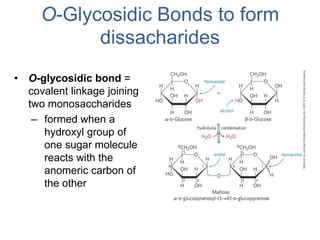
O-Glycosidic Bonds to form
dissacharides
• O-glycosidic bond =
covalent linkage joining
two monosaccharides
– formed when a
hydroxyl group of
one sugar molecule
reacts with the
anomeric carbon of
the other
The Reducing End
• formation of a
glycosidic bond
renders a sugar
nonreducing
• reducing end =
the end of a
disaccharide or
polysaccharide
chain with a free
anomeric carbon
Free anomeric carbon
Naming Reducing Oligosaccharides
• step 1: with the nonreducing end on the left, give the
configuration (α or β) at the anomeric carbon joining the
first unit to the second
• step 2: name the nonreducing residue using “furano” or
“pyrano”
• step 3: indicate in parentheses the two carbon atoms
joined by the glycosidic bond, with an arrow connecting
the two numbers
• step 4: name the second residue and repeat for
additional residues
Three Common Disaccharides
• lactose is a reducing
disaccharide
• sucrose and trehalose
are nonreducing sugars
Polysaccharides
- a carbohydrate consisting of large numbers of
monosaccharide units joined by glycosidic bonds.
Starch
-2/3 of the human diet
-Potatoes, rice, wheat, cereal grains
-mixture of amylose and amylopectin
Glycogen
-only storage for glucose in the body
-liver and muscle
-similar in structure to amylopectin but, more
branched
26
polysaccharides (glycans)
Differ by:
• Monosaccharide
identity
• Length
• Glycosidic bond type
• Branching
- a carbohydrate consisting of large numbers of monosaccharide units joined
by glycosidic bonds.
- most carbohydrates in nature occur as polysaccharides (Mr > 20,000)
heteropolysaccharides =
contain 2+ kinds of
monomers
– provide extracellular
support
homopolysaccharides =
contain only a single
monomeric sugar species
- serve as storage forms
and structural elements
Storage: Starch and Glycogen
• starch = contains two types of glucose polymer, amylose and amylopectin
– amylose = long, unbranched chains of D-glucose residues connected by
(α1→4) linkages
– amylopectin = larger than amylose with (α1→4) linkages between glucose
residues and highly branched due to (α1→6) linkages
• glycogen = polymer of (α1→4)-linked glucose subunits, with (α1→6)-linked
branches
– more extensively branched
– more compact than starch
Starch
• Starch: a polymer of D-glucose.
– Starch can be separated into amylose and
amylopectin.
– Amylose is composed of unbranched chains of
up to 4000 glucose units joined by a-1,4-
glycosidic bonds.
– Amylopectin contains chains up to 10,000 D-
glucose units also joined by a-1,4-glycosidic
bonds; at branch points, new chains of 24 to 30
units are started by a-1,6-glycosidic bonds.
Polysaccharides
• Amylopectin.
30
amylose and amylopectin
Amylose
Amylopectin
Glucose
removed
from this
end
Glycogen
• Glycogen is the energy-reserve carbohydrate for
animals.
– Glycogen is a branched polysaccharide of
approximately 106 glucose units joined by a-1,4- and a-
1,6-glycosidic bonds.
– The total amount of glycogen in the body of a well-
nourished adult human is about 350 g, divided almost
equally between liver and muscle.
32
Glycogen
• Especially abundant in liver and
muscle
• Why is it essential that glycogen
be highly branched?
• Glucose removal from
nonreducing ends is more rapid
• Why not store glucose in
monomeric form?
• Osmolarity
• Hydration
33
Cellulose
• Linear, unbranched homopolysaccharide of glucose that is found in
plants (stalks, stems, trunks)
• Fibrous, tough, water insoluble
Interchain and intrachain hydrogen bonds
produce a supramolecular fiber with great
tensile strength
Cellulose
• Cellulose is a linear polysaccharide of D-glucose
units joined by b-1,4-glycosidic bonds.
– It has an average molecular weight of 400,000 g/mol,
corresponding to approximately 2200 glucose units per
molecule.
– Cellulose molecules act like stiff rods and align themselves side
by side into well-organized water-insoluble fibers in which the
OH groups form numerous intermolecular hydrogen bonds.
– This arrangement of parallel chains in bundles gives cellulose
fibers their high mechanical strength.
– It is also the reason why cellulose is insoluble in water.
Cellulose
• Cellulose (cont’d)
– Humans and other animals cannot use cellulose as food because
our digestive systems do not contain b-glucosidases (a cellulase),
enzymes that catalyze hydrolysis of b-glucosidic bonds.
– Instead, we have only a-glucosidases; hence, the polysaccharides
we use as sources of glucose are starch and glycogen.
– Many bacteria and microorganisms have b-glucosidases and can
digest cellulose.
– Termites have such bacteria in their intestines and can use wood
as their principal food.
– Ruminants (cud-chewing animals) and horses can also digest
grasses and hay.
Starch And Cellulose
37
Chitin
• Linear homopolysaccharide of N-acetylglucosamine in b linkage
• C-2 hydroxyl is replaced with an acetylated amino group
• Not digestible
• Exoskeletons of arthropods, lobsters etc.
• Second most abundant polysaccharide in nature (cellulose is #1)
38
Bacterial cell wall: Peptidoglycans
• Heteropolysaccharide of N-
acetylglucosamine (NAG) and
N-acetylmuramic (NAM) acid
in b1→4 linkage
• Linear polymers lie side by
side and are crosslinked by
small peptides
• Strong sheath prevents
swelling and lysis
• Lysozyme breaks the b1→4
glycosidic bond
• Penicillin prevents synthesis
of the peptide crosslinks
39
Extracellular matrix: glycosaminoglycans
• Extracellular matrix is a
porous substance in
animal and bacteria that
holds cells together while
allowing diffusion of small
molecules
• Composed of repeating
disaccharides with fibrous
proteins (collagen, elastin,
fibronectin and laminin)
• One of the
monosaccharides is either
NAG or NAM
• Hydroxyls sometimes
esterified with sulfate
Joints,
vitreus humor
in eye
Cartilage,
tendons,
ligaments
Cartilage,
cornea,
horns
40
Summary of Polysaccharides
41
Glycoconjugates: Proteoglycans
• Glycogonjugates are informational
carbohydrates that are covalently
linked to proteins or lipids
• Macromolecules of the cell surface or
extracellular matrix or secreted
• One or more sulfated
glycosaminoglycan covalently
attached to a core protein
Proteoglycans can aggregate
(ex: aggrecan of the extracellular
matrix). Interact with collagen  gives
strength
42
Interactions between cells and the
extracellular matrix
• Cellular and extracellular
interactions:
– Anchor cells to the extra-
cellular matrix
– Direct cell migration
– Signal transduction
43
Lipids may contain covalently
bound oligosaccharides
• Gangliosides
– membrane lipid
- cell recognition (blood
typing)
• Lipopolysaccharides
– Prominent feature ing
outer membrane of
gram negative bacteria
– Antibody recognition
Lipopolysaccharide of Salmonella
44
Lectins bind carbohydrates
• Proteins that bind
carbohydrates with varying
specificity
• Serve in cell recognition,
signaling and adhesion
• Useful to detect and separate
glycoproteins
Selectins: type of lectin in the plasma
membrane
Lectins also
mediate bacterial
adhesion to host
cells as in the case
of H. pylori
45
Oligosaccharides: recognition and
adhesion at the cell surface
• Oligosaccharides, as part of
glycoproteins and glycolipids,
interact with lectins in the
extracellular space
• Viruses, bacterial toxins, and some
bacteria bind to glycoproteins to
begin the infection/disease
process
• Lectins in the plasma membrane
mediate cell-cell interactions
• Lysosomal enzymes are directed
into the lysosome through
oligosaccharide recognition