Surgical techniques and role of
lymphadenectomy in ca vulva
Priyanka Malekar
DNB first yr resident (surgical oncology)
24/2/2018
1
• Lymphatic drainage
• Labia majora, labia minora, clitoris → superficial and deep inguinal
nodes → secondarily to pelvic nodes
• Clitoris - to external iliac nodes
to obturator node via dorsal vein of clitoris
Lymphatic drainage of perineum, clitoris and anterior labia minora are
bilateral
2
3
4
Nodal mets
• Single most important factor predicting outcome
• 5 yr OS for pts with negative nodes – 83-100%
• 5 yr OS for pts with positive nodes – 38-61%
5
Prognostic factors in lymph node
involvement
• Whether unilateral or bilateral
• Depth of tumor
• Number of positive nodes
• Volume of tumour metastases
• Level of metastatic nodal disease
6
7
8
9
10
Stage 1/ T1 (early vulvar cancer)
(no. of inguino-femoral mets. by infiltration depth)
11
T1a lesion (2cm in largest diameter)
• T1 tumours with a <1mm depth of infiltration(stage1a)
can be safely treated by wide local excision (1-2cms tumour free margin)
without LND
• If final pathology reveals invasion >1mm, ipsilateral groin dissection to be
done
• (the risk of local recurrence was 50% when the tumor-free margin was less
than 8mm heaps et all)
Heaps et al. Surgicopathologic variables predictive of local recurrence in SCC vulva.Gynecol Oncol 1990;38:309-315
12
Local recurrence…
13
Clinical T1b & T2 cancers without suspicious groin
nodes
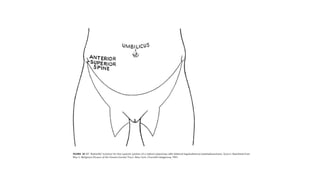
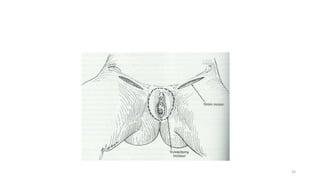
• Modified radical surgery (triple incision)
• Nodal involvement > 8%
• Radical wide local excision + Inguinal LND
• Midline lesions - bilateral inguinal dissection
14
15
16
• If clinically positive groin nodes are found in an ipsilateral dissection
for a small primary lesion, dissection of the contralateral groin is
advocated. – for lesions that are:
1. Unilateral
2. Unifocal
3. Not located in the anterior portion of the labia minora
4. No palpable lymphadenopathy in either groin
5. No lymph node metastases found at time of unilateral LND
17
• In non midline T1 tumors no patient had lymph node mets to the
contralateral groin
• DeSimone CP et al. The treatment of lateral T1 and T2 squamous cell carcinoma of the vulva
confined to the labium majus or minus. Gynecol Oncol 2007;104:390–395.
• Contralateral groin dissection unnecessary for patients with
nonmidline lesions < 2 cm size and /or with negative ipsilateral nodes
• Gonzalez et al. Patterns of inguinal groin metastases in squamous cell carcinoma of the vulva.
Gynecol Oncol 2007;105:742–746.
18
Stage II
• Radical local excision + bilateral inguinal node dissection
• Large tumors may require modified radical vulvectomy
19
Stage III
• Modified radical vulvectomy with bilateral inguinal node dissection
• Adjuvant radiation therapy to the pelvis and groin
20
21
Stage IV
• Pelvic exenteration OR
• Preoperative neoadjuvant chemoradiation which improve operability
or decrease the extent of surgery required
SURGERY
• Pioneering works by Taussig and Way
• En bloc radical vulvectomy and bilateral dissection of groin and pelvic
nodes introduced in 1940s
• Became standard for operable vulvar cancer
• Excellent survival and local control in 90% patients
Radical vulvectomy
• Removal of entire vulva
• To the level of deep fascia of thigh
• Periosteum of pubis
• Inferior fascia of urogenital diaphragm
Disadvantages
• Altered appearance and sexual function
• Wound breakdown
• Lymph cyst, lymphangitis
• Lower limb oedema
• Significant psychosexual consequences
Radical local excision
• Depth of dissection same
• Similar rates of local recurrence (7.2% vs 6.3%)
• Less morbidity
• Three incision technique
27
28
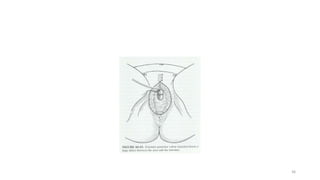
Surgical technique for ca vulva
30
31
32
33
34
35
36
38
39
40
41
42
43
44
Role of RT in vulvar cancer
• Post op RT to primary tumour and nodal beds based on pathologic
poor prognostic features
• Pre op RT with concurrent chemotherapy in loco regionally advanced
disease with extension to midline structures. This is followed by
function preserving surgery and inguinal dissection
ADJUVANT RT to tumour
• Adjuvant RT for primary tumour given
1. large tumours > 4 cms
2. positive or close surgical margins(< 8mm)
3. LVSI
4. Depth of stromal invasion > 5mm
ADJUVANT RT to nodal regions
• Adjuvant RT for nodal regions given for
1. 2 or more microscopically positive nodes
2. 1 or more macroscopically positive nodes gross extracapsular
extension
3. Residual nodal disease
4. If only a small number of nodes sampled
• Groin dissection versus primary groin radiation in carcinoma of the vulva: a Gynecologic Oncology Group study.
Stehman et al. 1992
• GOG 88
• RCT, N = 58
• Patients with squamous carcinoma of the vulva and nonsuspicious (N0-1) inguinal nodes
randomised to receive either groin dissection or groin radiation after radical vulvectomy.
• Closed prematurely - interim monitoring revealed an excessive number of groin relapses
on the groin radiation regimen
ROLE OF ADJUVANT POST OP RT
• Kunos et al. Pelvic Radiation therapy compared with pelvic node resection for node positive
vulvar cancer. Obstet Gynecol. 114:537-546.2009
• GOG 37
• RCT , N= 114 surgically treated patients (after radical local excision and bilateral
inguinal lymphadenectomy)with positive groin nodes
• Randomised to ipsilateral pelvic node dissection vs RT to bilateral pelvis and
groins
• Overall Survival - 51% VS 41%
• Cancer specific survival – 51% after RT
29% after LND
• Benefit of RT significant in pts with gross nodal mets, 2 or more nodes,
extracapsular spread
• RT significantly reduced groin failures (5% vs 24%)
GOG 145
• Ongoing trial
• To evaluate the role of adjuvant RT to the nodal regions in patients
with negative nodes but high risk features ( tr > 4 cms, positive
margins, LVSI)
• Results awaited
Post treatment surveillance
• Low risk disease (early stage, treated with surgery alone)
6 monthly x 2yrs
then annually
• High risk disease (advanced stage, treated with
neoadjuvant/adjuvant therapy)
3 monthly x 2 yrs
6 monthly x 3 yrs
then annually
Recurrence
• Local / inguinal / distant
• Local recurrence – Re excision, good prognosis
• Groin recurrence – worse prognosis
• RT along with surgery or chemotherapy
• 5 yr survival by site of recurrence
Perineal – 60%
Inguinal and pelvic – 27%
Distant – 15%
GOG risk categories
• Minimal – lesion < 2 cms
negative groin nodes
• Low - 1 positive groin node with lesion < 2 cms
- negative nodes with >2 cms but < 8cms
• Intermediate – negative groin nodes with lesion > 8 cms
1 positive groin node with lesion >2cms
2 unilaterally positive nodes, lesion< 8 cms
• High – 3 or more positive nodes
2 bilaterally positive nodes
5 yr survival by GOG categories
Category 5 yr survival
Minimal 98%
Low 87%
Intermediate 75%
High 29%
Summary
• Stage IA – Radical local excision
• Stage IB – Radical local excision + Ipsilateral Inguinal LND
• Stage II – Radical local excision + Bilateral inguinal LND
• Stage III – Modified radical vulvectomy + Bilateral
inguinal LND
• Stage IVA – Preoperative chemoradiotherapy + Limited
resection
• Stage IVB – Palliative chemotherapy
• Adjuvant RT to tumour and nodes for high risk pathologic factors
• Sentinel node biopsy is a safe alternative to inguinal LND
59