ANIRIDIA
AND
LOW VISION
Presented by :Rashad Ibn Muhammed
M.optom 1st sem
OBJECTIVES
 To know about Aniridia, as its signs and symptoms
 To aware about the management of low vision
patients with Aniridia
DEFINITION
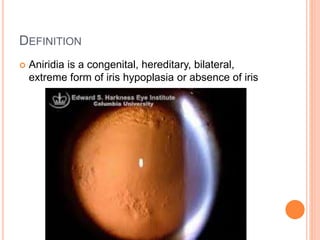
 Aniridia is a congenital, hereditary, bilateral,
extreme form of iris hypoplasia or absence of iris
Aniridia is not just an defect in iris development but is
a panocular disorder with
 Macular hypoplasia,
 Optic nerve hypoplasia,
 Cataract
 Corneal changes
 Nystagmus.
 How ever, a small stump of iris tissue exists at iris
root
TYPES
Aniridia Type 1 (AN-1)
 Is inherited through the autosomal dominant
inheritance (AD) pattern
 Only affects the eye not the rest of the body.
 Caused by mutation in the PAX6 gene on
chromosome 11p13
Aniridia Type 2 (AN-2)
 Is sporadic, that means it is not inherited from either
parent
 Children who have sporadic congenital Aniridia may
only have Aniridia or they may also have a chance
of having problems with other parts of their bodies.
 Children with (AN)-2 are at risk of developing one of
two associated conditions, Miller Syndrome or
WAGR Syndrome
Aniridia Type 3 (AN-3)
 Can be associated with Gillespie Syndrome
 (AN)-3 follows the autosomal recessive (AR)
inheritance pattern.
PATHOGENESIS
1. Some researchers consider Aniridia a subtype of
coloboma
2. In the ectodermal theory Aniridia is caused by
failure in the optic vesicle rim development
between the 12th and 14th weeks of gestation
 Supporting this theory is the association of aniridia with
other ectodermal defects: anomalies in the retina,
absence of the fovea, and absence of iris musculature.
SIGNS
 Photophobia
 Nystagmus (Pendular)
 Strabismus (Esotropia)
CORNEA
 Corneal vascularisation
 Epithelial ulcers
 Aniridic keratopathy
 Arcus juvenilis
 Microcornea
IRIS
 Complete absence of iris on oblique illumination
 Hypoplasia with irregular pupillary margins (atypical
coloboma of pupil)
 Root of the iris visible on gonioscopy
 Angle of the anterior chamber
Trabecular meshwork may be partially or completely
covered by the iris stump.
CRYSTALLINE LENS
 Transparent or opaque
 Ectopia lentis
 Subluxated or Dislocated lens
FUNDUS
 Foveal hypoplasia
 Optic nerve hypoplasia
 Macular hypopigmentation
 Macular reflex dull
 Glaucomatous cupping
ASSOCIATED SYNDROMES
1. Miller syndrome
2. WAGR Syndrome
3. Gillespie Syndrome
MILLER SYNDROME
 It is a condition that is also known as the Genee-
Wiedemann syndrome, Wildervanck-Smith
syndrome or postaxial acrofacial dystosis
(POADS)
 It causes problems with the development of the
face and the arms and legs such as cleft palate and
small jaw.
WAGR SYNDROME
 W: Wilms’ Tumour
 A: Aniridia
 G: Genitourinary problems
 R: (Mental) Retardation
W: WILMS’ TUMOUR
 Also called as nephroblastoma
 A childhood tumour of the kidney. Children with AN-
2 have a 30% risk of developing Wilms’ tumour
before the age of 5 years old.
 If detected early Wilms’ tumour can be treated
successfully.
GILLESPIE SYNDROME
 This is a rare, genetic condition which can cause
Aniridia and cerebella ataxia.
 Cerebella ataxia affects the parts of the brain
responsible for co-ordination, balance and muscle
tone.
 Cerebella ataxia can cause problems with walking
unaided, writing and clear speech.
TREATMENT
 Correction of refractive errors and treatment of
amblyopia are simple and essential measures.
 Optical low vision aids for those with significant
visual impairment and help with schooling and
social support should be provided.
 Tinted or photo chromic lenses can be used to
reduce light sensitivity associated with the large
papillary aperture.
 Medical treatment
 Surgical treatment
TREATMENT OF AMBLYOPIA AND STRABISMUS
 Usually the potential visual acuity in both eyes
should be symmetrical.
 When the vision is unequal without structural
difference, vigorous amblyopia exercises should be
performed in the worst eye.
 Binocularity can be achieved if macular hypoplasia
is not severe.
 Strabismus surgery is indicated at an early age.
MEDICAL TREATMENT
 Prophylaxis for the prevention of glaucoma
 Miotics
 Beta-blockers
 Sympathomimetics
 Carbonic anhydrase inhibitors
 Prostaglandin analogues
SURGICAL TREATMENT
 Penetrating keratoplasty (PK)
 Cataract extraction
 Trabeculectomy
 Goniotomy
LOW VISION MANAGEMENT
 Visual acuity
Measure VA by using
1. TAC (Teller acuity chart) (1m to 3yr)
2. Lea symbols (1-3 yrs)
3. Bailey and Lovie charts
MANAGEMENT
 Provide magnification for distance visual tasks
 Provide magnification for near visual tasks
 Provide light filtration
 Provide contrast enhancement
1.HAND HELD TELESCOPES
2.SPECTACLE MOUNTED
TELESCOPES
3.MAXTV OR SEETV SPECTACLE
BINOCULARS
4.BIOPTIC TELESCOPE
FOR NEAR
1.HAND MAGNIFIRS
2.STAND MAGNIFIERS
3. SPECTACLE MAGNIFIERS
6.CLOSED CIRCUIT TELEVISION
READING SYSTEMS (CCTV)
7.PORTABLE CCTV
ABSORPTIVE LENSES
“SUNLENSES”
REDUCED APERTURE CONTACT
LENSES
NON OPTICAL DEVICES
READING STANDS
REFERENCES
 Essentials of low vision:Richard L Brilliant
 Low vision rehabilitation of children with
Aniridia By Sarah Appel, O.D. (William Feinbloom
Vision Rehabilitation Center)
 http://emedicine.medscape.com/article/1208379
 http://eyewiki.aao.org/Aniridia
 https://www.rnib.org.uk/eye-health-eye-conditions-
z-eye-conditions/aniridia
Aniridia and low vision