PRACTICAL
CLASS-2
TYPES OF MEDIA &
MEDIA
PREPARATION
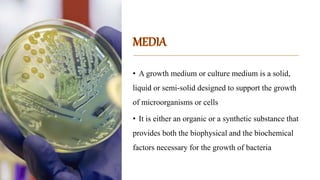
• A growth medium or culture medium is a solid,
liquid or semi-solid designed to support the growth
of microorganisms or cells
• It is either an organic or a synthetic substance that
provides both the biophysical and the biochemical
factors necessary for the growth of bacteria
• Microorganisms need nutrients, a
source of energy and certain
environmental conditions in order
to grow and reproduce.
• In the environment, microbes
have adapted to the habitats most
suitable for their needs, whereas in
laboratory, these requirements
must be met by a culture medium.
• This is basically an aqueous
solution to which all the necessary
nutrients have been added
Based on chemical
composition
• Synthetic
media
• Non synthetic
media
Based on
consistency
• Solid medium
• Liquid medium
• Semi solid
medium
Based on utility or
purpose
• Basal medium
• Enriched medium
• Differential
medium
• Selective medium
• Assay medium
• Maintenance
medium
• Fermentation
medium
The percent elemental composition of all the chemicals in the media is clearly
known
Also known as Chemically defined media
Both autotropic and heterotropic organisms can grow
Useful in studying the nutritional requirements of bacteria and also for
microbiological assay of vitamins, amino acids
Ex: Peptone water: 1 % peptone + 0.5 % NaCl, Czapek dox medium
Complex type and contain various ingredients of unknown percent
elemental composition such as animal plant and microbial extracts.
Also known as un-defined media
Used for cultivation of wide range of microorganisms
Ex: yeast extract, beef extract, potato dextrose agar
Agar powder is added to the nutrient broth it becomes nutrient agar-
solid media
Used for making nutrient agar plates, slants and stabs
ADVANTAGES:
 COLONY MORPHOLOGY
CAN BE STUDIED
 PURE CULTURES CAN BE
OBTAINED
 ENUMERATION CAN BE
DONE
DISADVANTAGES:
HIGH POPULATIONS CAN
NOT BE OBTAINED
No agar is added or used while preparing the media
ADVANTAGES:
 HIGH POPULATION SCAN BE
OBTAINED
 ENUMERATION BY
TURBIDOMETER
DISADVANTAGES:
 COLONY MORPHOLOGY CANNOT
BE STUDIED
 PURE CULTURES CANNOT BE
OBTAINED
Contains agar at 0.5%
Soft curd like consistency
Studying bacterial motility
Cultivation of microaerophilic bacteria
Ex: Nitrogen free malic acid BTB agar
 Differential or indicator media distinguish one microorganism type from
another growing on the same medium.
 This type of media uses the biochemical characteristics of a microorganism
growing in the presence of specific nutrients or indicators (such as neutral red,
phenol red, eosin y, or methylene blue) added to the medium to visibly indicate
the defining characteristics of a microorganism.
 These media are used for the detection of microorganisms and by molecular
biologists to detect recombinant strains of bacteria.
For example, if a mixture of bacteria is inoculated into a blood
containing agar medium (blood agar), some of the bacteria may
hemolyze (destroy) the red blood cells, others do not thus one can
distinguish between hemolytic and non-hemolytic bacteria on the
same medium. e.g., Congored yeast extract mannitol agar
Transport media should fulfill these criteria:
 Temporary storage of specimens being transported to the laboratory for cultivation
 Maintain the viability of all organisms in the specimen without altering their
concentration
 Contain only buffers and salt
 Lack of carbon, nitrogen, and organic growth factors so as to prevent microbial
multiplication
 Transport media used in the isolation of anaerobes must be free of molecular oxygen.
Examples of transport media include:
 Thioglycolate broth is for strict anaerobes.
 Stuart transport medium is a non-nutrient soft agar gel containing a reducing
agent to prevent oxidation, and charcoal to neutralize.
 Certain bacterial inhibitors are used for gonococci, and buffered glycerol
saline for enteric bacilli.
 Venkataraman Ramakrishna (VR) medium is used for V. cholerae
 Enriched media contain the nutrients required to support the growth of a wide
variety of organisms, including some of the more fastidious ones.
 They are commonly used to harvest as many different types of microbes as are
present in the specimen.
 Addition of extra nutrients in the form of blood, serum, egg yolk, etc, to basal
medium makes enriched media.
 Enriched media are used to grow nutritionally exacting (fastidious) bacteria.
 Blood agar is an enriched medium in which nutritionally rich
whole blood supplements the basic nutrients.
 Chocolate agar is enriched with heat-treated blood (40–
45 °C), which turns brown and gives the medium the color
for which it is named
 Media that contains an ingredient that
encourages the growth of some bacteria, but
discourages the growth of other bacteria
 Ex: Eosin methylene blue
ANTIBIOTICS
DYES
CHEMICALS
ALTERING pH
• These media are used for the
assay of vitamins, amino acids,
and antibiotics.
• Ex: Antibiotic assay media
are used for determining
antibiotic potency by the
microbiological assay
technique.
 Media used for storing the bacteria for a long
period of time.
 Examples: Egg saline medium, chalk cooked
meat broth
 Basal media are those that may be used for growth (culture)
of bacteria that do not need enrichment of the media.
 Examples: Nutrient broth, nutrient agar and peptone water.
Staphylococcus and Enterobacteriaceae grow in these
media.
The media which is used for fermentation purpose
NUTRIENT BROTH NUTRIENT AGAR
BEEF EXTRACT – 3 GMS
PEPTONE – 5 GMS
GLUCOSE - 5 GMS
SODIUM CHLORIDE – 5 GMS
DISTILLED WATER – 1000 ML
BEEF EXTRACT – 3 GMS
PEPTONE – 5 GMS
GLUCOSE - 5 GMS
SODIUM CHLORIDE – 5 GMS
AGAR – 20 GMS
DISTILLED WATER – 1000 ML
To prepare nutrient agar media, nutrient broth, nutrient agar
slants & stabs
Providing the required nutrients in an
appropriate container for the growth of bacteria
• Weigh required quantities of media components. ( beef extract 0.45 grams,
peptone 0.75 grams, glucose 0.75 grams, sodium chloride 0.75 grams for
150 ml of distilled water)
• Dissolve the chemicals one by one
• Check the pH of the medium and adjust the to 7.0 if necessary using
diluted alkali or acid
• Transfer 10 ml of nutrient broth into 4 test tubes, cover them with cotton
plug or cap and label the nutrient broth tubes
• Transfer 100 ml of nutrient broth into 150 ml of conical flask
• Weigh 2 % agar and add it into nutrient broth ( nutrient agar media)
• Cover the conical flask with cotton plug wrap with newspaper and tie
it up with rubberbands
• Label the conical flask
• Boil the nutrient broth with agar in boiling water bath till agar melts
• Transfer about 5 ml molten agar medium into each screw cap tubes and
screw them loosely
• Again recap the flask cover with cotton plug and wrap paper and secure
them properly with rubber band
• Keep the material for autoclaving at 121֯C at 15 lbs pressure for 15
minutes
• After sterilization cool sterile nutrient agar medium to about 45 ֯C
• Pour sterile nutrient agar medium into sterile petriplates under asceptic
conditions
• Leave the plates till the medium is solidified
• Keep the screw cap tubes vertically to prepare a nutrient agar stab and in
slanting position for preparing a nutrient agar slant till the medium is
solidified
• Verify the label for the materials and leave them in an incubator at 30 ֯C
for overnight incubation to allow the growth, if any contamination has
occured
• Observe the nutrient agar plates, nutrient broth, slants and stabs for any
growth i.e., turbidity in broth, colonies in nutrient agar plates, slants and
stabs
• Materials without any growth only can be used for experiment and can
be preserved in a refrigerator till their use
• Discard the contaminated media only after autoclaving
Sterile nutrient agar
plates, broth, slants and
stabs i.e., No growth of
microorganisms is
observed
Contaminated
plates, broth, slant
and stabs i.e.,
growth of
microorganisms is
observed
No growth of
microorganisms was
observed so I followed
asceptic conditions
Growth of
microorganisms was
observed so I did not
followed asceptic
conditions
What is the chemical nature of the agar agar?
What is the melting temperature of agar and gelatin?
What does it indicates, if any turbidity is seen in the sterilized nutrient
broth tubes?
How do you test that nutrient agar plates are contaminated?
Mention the uses of solid medium and liquid medium?
What is the temperature at which molten agar medium solidifies?
Pseudomonas
Azospirillum
Azatobacter
Rhizobium
Escherichia coli
Fungi
Yeast
Actinomycetes
FIND OUT THE MEDIA USED FOR ISOLATING
THE FOLLOWING MICROORGANISMS
Ambe 101 @ prctl-2