CHAPTER 14CHAPTER 14
THE CHEMISTRY OFTHE CHEMISTRY OF
ACIDS AND BASESACIDS AND BASES
"ACID""ACID"
Latin word acidus, meaning sour.Latin word acidus, meaning sour.
(lemon)(lemon)
"ALKALI""ALKALI"
Water solutions feel slippery andWater solutions feel slippery and
taste bitter (soap).taste bitter (soap).
ACID-BASEACID-BASE
THEORIESTHEORIES
Arrhenius Definition
acidacid----donates a hydrogen ion (Hdonates a hydrogen ion (H++
))
in waterin water
basebase--donates a hydroxide ion in--donates a hydroxide ion in
water (OHwater (OH--
))
This theory was limited toThis theory was limited to
substances with those "parts";substances with those "parts";
ammonia is a MAJOR exception!ammonia is a MAJOR exception!
Bronsted-Lowry DefinitionBronsted-Lowry Definition
acidacid----donates a proton in waterdonates a proton in water
basebase----accepts a proton in wateraccepts a proton in water
This theory is better; it explainsThis theory is better; it explains
ammonia as a base! This is the mainammonia as a base! This is the main
theory that we will use for ourtheory that we will use for our
acid/base discussion.acid/base discussion.
Lewis DefinitionLewis Definition
acidacid----accepts an electron pairaccepts an electron pair
basebase--donates an electron pair--donates an electron pair
This theory explainsThis theory explains allall traditionaltraditional
acids and bases + a host ofacids and bases + a host of
coordination compounds and is usedcoordination compounds and is used
widely in organic chemistry. Useswidely in organic chemistry. Uses
coordinate covalent bondscoordinate covalent bonds
The Bronsted-Lowry ConceptThe Bronsted-Lowry Concept
of Acids and Basesof Acids and Bases
Using this theory, you should beUsing this theory, you should be
able to write weak acid/baseable to write weak acid/base
dissociation equations and identifydissociation equations and identify
acid, base, conjugate acid andacid, base, conjugate acid and
conjugate base.conjugate base.
Conjugate Acid-Base PairConjugate Acid-Base Pair
A pair of compounds that differA pair of compounds that differ
by the presence of one Hby the presence of one H++
unit.unit.
This idea is critical when it comesThis idea is critical when it comes
to understanding buffer systems.to understanding buffer systems.
AcidsAcids
donate a proton (Hdonate a proton (H++
))
Neutral CompoundNeutral Compound
HNOHNO33 + H+ H22OO  HH33OO++
+ NO+ NO33
--
acid base CA CBacid base CA CB
CationCation
NHNH44
++
+ H+ H22OO  HH33OO++
+ NH+ NH33
acid base CA CBacid base CA CB
AnionAnion
HH22POPO44
--
+ H+ H2200  HH33OO++
+ HPO+ HPO44
2-2-
acid base CA CBacid base CA CB
In each of the acid examples---noticeIn each of the acid examples---notice
the formation ofthe formation of HH33 OO++
This species is named theThis species is named the hydroniumhydronium
ionion..
It lets you know that the solution isIt lets you know that the solution is
acidicacidic!!
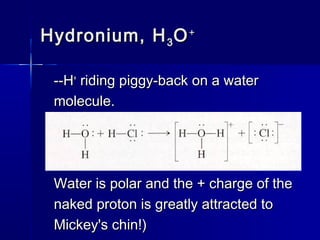
Hydronium, HHydronium, H33 OO++
--H--H++
riding piggy-back on a waterriding piggy-back on a water
molecule.molecule.
Water is polar and the + charge of theWater is polar and the + charge of the
naked proton is greatly attracted tonaked proton is greatly attracted to
Mickey's chin!)Mickey's chin!)
BasesBases
accept a proton (Haccept a proton (H++
))
Neutral CompoundNeutral Compound
NHNH33 + H+ H22OO  NHNH44
++
+ OH+ OH--
base acid CA CBbase acid CA CB
AnionAnion
COCO33
2-2-
+ H+ H22OO  HCOHCO33
--
+ OH+ OH--
base acid CA CBbase acid CA CB
AnionAnion
POPO44
3-3-
+ H+ H22OO  HPOHPO44
2-2-
+ OH+ OH--
base acid CA CBbase acid CA CB
In each of the basic examples--In each of the basic examples--
notice the formation ofnotice the formation of OH-OH- -- this-- this
species is named thespecies is named the hydroxidehydroxide
ionion. It lets you know that the. It lets you know that the
solution issolution is basicbasic!!
Exercise 1Exercise 1
In the following reaction, identifyIn the following reaction, identify
the acid on the left and its CB onthe acid on the left and its CB on
the right. Similarly identify the basethe right. Similarly identify the base
on the left and its CA on the right.on the left and its CA on the right.
HBr + NHHBr + NH33  NHNH44
++
+ Br+ Br--
What is the conjugate base of HWhat is the conjugate base of H22S?S?
What is the conjugate acid of NOWhat is the conjugate acid of NO33
--
??
ACIDS ONLYACIDS ONLY
DONATEDONATE
ONE PROTON AT AONE PROTON AT A
TIME!!!TIME!!!
– monoproticmonoprotic--acids donating one H--acids donating one H++
(ex. HC(ex. HC22HH33OO22))
– diproticdiprotic--acids donating two H--acids donating two H++
's (ex.'s (ex.
HH22CC22OO44))
– polyproticpolyprotic--acids donating many--acids donating many
H++
's (ex. H PO )
Polyprotic BasesPolyprotic Bases
accept more than one Haccept more than one H++
anions with -2 and -3 chargesanions with -2 and -3 charges
(example: PO(example: PO44
3-3-
; HPO; HPO44
2-2-
))
Amphiprotic or AmphotericAmphiprotic or Amphoteric
molecules or ions that can behave asmolecules or ions that can behave as
EITHER acids or bases:EITHER acids or bases:
water, anions of weak acidswater, anions of weak acids
(look at the examples above—sometimes(look at the examples above—sometimes
water was an acid, sometimes it acted aswater was an acid, sometimes it acted as
a base)a base)
Exercise 2Exercise 2 AcidAcid
Dissociation (Ionization)Dissociation (Ionization)
ReactionsReactions
Write the simple dissociationWrite the simple dissociation
(ionization) reaction (omitting(ionization) reaction (omitting
water) for each of the followingwater) for each of the following
acids.acids.
a. Hydrochloric acid (HCl)a. Hydrochloric acid (HCl)
b. Acetic acid (HCb. Acetic acid (HC22HH33OO22))
c. The ammonium ion (NHc. The ammonium ion (NH44
++
))
d. The anilinium ion (Cd. The anilinium ion (C66HH55NHNH33
++
))
e. The hydrated aluminum(III) ione. The hydrated aluminum(III) ion
[Al(H[Al(H O)O) ]]3+3+
SolutionSolution
A: HCl(aq) -> HA: HCl(aq) -> H++
(aq) + Cl(aq) + Cl--
(aq)(aq)
B: HCB: HC22HH33OO22(aq)(aq) 
HH++
(aq) + C(aq) + C22HH33OO22
--
(aq)(aq)
C: NHC: NH44
++
(aq)(aq)  HH++
(aq) + NH(aq) + NH33(aq)(aq)
Solution, cont.Solution, cont.
D: CD: C66HH55NHNH33
++
(aq)(aq)  HH++
(aq) + C(aq) + C66HH55NHNH22(aq)(aq)
E: Al(HE: Al(H22O)O)66
3+3+
(aq)(aq) 
HH++
(aq) + Al(H(aq) + Al(H22O)O)55OHOH22
++
(aq)(aq)
Relative Strengths of AcidsRelative Strengths of Acids
and Basesand Bases
Strength is determined by theStrength is determined by the
position of the "dissociation"position of the "dissociation"
equilibrium.equilibrium.
Strong acids/Strong basesStrong acids/Strong bases
dissociate completely in waterdissociate completely in water
have very large K valueshave very large K values
Weak acids/Weak basesWeak acids/Weak bases
dissociate only to a slight extent indissociate only to a slight extent in
waterwater
dissociation constant is very smalldissociation constant is very small
Strong
Weak
Do NotDo Not
confuse concentrationconfuse concentration
with strength!with strength!
Strong AcidsStrong Acids
Hydrohalic acids:Hydrohalic acids:
HCl, HBr, HIHCl, HBr, HI
Nitric: HNONitric: HNO33
Sulfuric: HSulfuric: H22SOSO44
Perchloric: HClOPerchloric: HClO
The more oxygenThe more oxygen
present in thepresent in the
polyatomic ion,polyatomic ion,
the stronger itsthe stronger its
acid WITHIN thatacid WITHIN that
group.group.
Strong BasesStrong Bases
Hydroxides OR oxides of IA andHydroxides OR oxides of IA and
IIA metalsIIA metals
Solubility plays a role (those thatSolubility plays a role (those that
are very soluble are strong!)are very soluble are strong!)
The strongerThe stronger
the acid, thethe acid, the
weaker its CB.weaker its CB.
The converse isThe converse is
also true.also true.
Weak Acids and Bases -Weak Acids and Bases -
EquilibriumEquilibrium
expressionsexpressions
The vast majority of acid/bases areThe vast majority of acid/bases are
weak.weak.
Remember, this means they do notRemember, this means they do not
ionize much.ionize much.
The equilibrium expression for acidsThe equilibrium expression for acids
is known as theis known as the KKaa (the acid(the acid
dissociation constantdissociation constant ).).
It is set up the same way as inIt is set up the same way as in
general equilibrium.general equilibrium.
Many common weak acids areMany common weak acids are
oxyacids,oxyacids,
like phosphoric acid andlike phosphoric acid and
nitrous acid.nitrous acid.
Other common weakOther common weak
acids are organicacids are organic
acids,acids,
those that contain athose that contain a
carboxyl groupcarboxyl group
COOH groupCOOH group
like acetic acid andlike acetic acid and
benzoic acid.benzoic acid.
For Weak Acid Reactions:For Weak Acid Reactions:
HA + HHA + H22OO  HH33OO++
+ A+ A--
KKaa == [H[H33OO++
][A][A--
]] < 1< 1
[HA][HA]
Write the KWrite the Kaa expression for aceticexpression for acetic
acid using Bronsted-Lowry.acid using Bronsted-Lowry.
(Note: Water is a pure liquid and(Note: Water is a pure liquid and
is thus, left out of the equilibriumis thus, left out of the equilibrium
expression.)expression.)
Weak bases (bases without OHWeak bases (bases without OH--
))
react with water to produce areact with water to produce a
hydroxide ion.hydroxide ion.
Common examples of weak bases areCommon examples of weak bases are
ammonia (NHammonia (NH33), methylamine), methylamine
(CH(CH33NHNH22), and ethylamine (C), and ethylamine (C22HH55NHNH22).).
The lone pair on N forms a bond withThe lone pair on N forms a bond with
an Han H++
. Most weak bases involve N.. Most weak bases involve N.
The equilibrium expression forThe equilibrium expression for
basesbases is known as theis known as the KKbb ..
For Weak Base Reactions:For Weak Base Reactions:
B + HB + H22OO  HBHB++
+ OH+ OH--
KKbb == [H[H33OO++
][OH][OH--
]] <1<1
[B][B]
Set up the KSet up the Kbb expression forexpression for
ammonia using Bronsted-Lowry.ammonia using Bronsted-Lowry.
Notice that KNotice that Kaa and Kand Kbb expressionsexpressions
look very similar.look very similar.
The difference is that a baseThe difference is that a base
produces the hydroxide ion inproduces the hydroxide ion in
solution, while the acid produces thesolution, while the acid produces the
hydronium ion in solution.hydronium ion in solution.
Another note on this point:Another note on this point:
HH++
and Hand H33OO++
are both equivalentare both equivalent
terms here. Often water is leftterms here. Often water is left
completely out of the equation sincecompletely out of the equation since
it does not appear in the equilibrium.it does not appear in the equilibrium.
This has become an acceptedThis has become an accepted
practice.practice.
(*However, water is very important(*However, water is very important
in causing the acid to dissociate.)in causing the acid to dissociate.)
Exercise 3Exercise 3
Relative Base StrengthRelative Base Strength
Using table 14.2, arrange theUsing table 14.2, arrange the
following species according to theirfollowing species according to their
strength as bases:strength as bases:
HH22O, FO, F--
, Cl, Cl--
, NO, NO22
--
, and CN, and CN--
SolutionSolution
ClCl--
< H< H22O < FO < F--
< NO< NO22
--
< CN< CN--
WATERWATER
THE HYDRONIUM IONTHE HYDRONIUM ION
AUTO-IONIZATIONAUTO-IONIZATION
THE pH SCALETHE pH SCALE
Fredrich Kohlrausch, aroundFredrich Kohlrausch, around
1900, found that no matter how1900, found that no matter how
pure water is, it still conducts apure water is, it still conducts a
minute amount of electricminute amount of electric
current. This proves that watercurrent. This proves that water
self-ionizes.self-ionizes.
Since the water molecule isSince the water molecule is
amphoteric, it may dissociateamphoteric, it may dissociate
with itself to a slight extent.with itself to a slight extent.
Only about 2 out of a billionOnly about 2 out of a billion
water molecules are ionized atwater molecules are ionized at
any instant!any instant!
HH22O(l) + HO(l) + H22O(l) <=> HO(l) <=> H33OO++
(aq) + OH(aq) + OH--
(aq)(aq)
The equilibrium expression usedThe equilibrium expression used
here is referred to as thehere is referred to as the KKww
(ionization constant for water)(ionization constant for water) ..
In pure water or dilute aqueousIn pure water or dilute aqueous
solutions, the concentration of watersolutions, the concentration of water
can be considered to be a constantcan be considered to be a constant
(55.4 M), so we include that with the(55.4 M), so we include that with the
equilibrium constant and write theequilibrium constant and write the
expression as:expression as:
KKeqeq[H[H22O]O]22
= K= Kww = [H= [H33OO++
][OH][OH--
]]
KKww = 1.0 x 10= 1.0 x 10⁻¹⁴-14
(K(Kww = 1.008 x 10= 1.008 x 10⁻¹⁴-14
@ 25° Celsius)@ 25° Celsius)
Knowing this value allows us toKnowing this value allows us to
calculate the OHcalculate the OH--
and Hand H++
concentration forconcentration for various situationvarious situations.s.
[OH[OH--
] = [H] = [H++
] : solution is neutral (in] : solution is neutral (in
pure water, each of these is 1.0 x 10pure water, each of these is 1.0 x 10⁻⁷-7
))
[OH[OH--
] > [H] > [H++
] : solution is basic] : solution is basic
[OH[OH--
] < [H] < [H++
] : solution is acidic] : solution is acidic
KKww = K= Kaa x Kx Kbb
another very beneficial equationanother very beneficial equation
Exercise 5Exercise 5
Autoionization of WaterAutoionization of Water
At 60°C, the value of KAt 60°C, the value of Kww is 1 X 10is 1 X 10-13-13
..
a. Using Le Chatelier’s principle,a. Using Le Chatelier’s principle,
predict whether the reactionpredict whether the reaction
2H2H22O(l)O(l)  HH33OO++
(aq) + OH(aq) + OH--
(aq)(aq)
is exothermic or endothermic.is exothermic or endothermic.
Exercise 5, cont.Exercise 5, cont.
b. Calculate [Hb. Calculate [H++
] and [OH] and [OH--
] in a] in a
neutral solution at 60°C.neutral solution at 60°C.
SolutionSolution
A: endothermicA: endothermic
B: [HB: [H++
] = [OH] = [OH--
] = 3 X 10] = 3 X 10⁻⁷-7
MM
The pH ScaleThe pH Scale
Used toUsed to
designate thedesignate the
[H[H++
] in most] in most
aqueousaqueous
solutions wheresolutions where
HH++
is small.is small.
pH = - log [HpH = - log [H++
]]
pOH = - log [OHpOH = - log [OH--
]]
pH + pOH = 14pH + pOH = 14
pH = 6.9 and lower (acidic)pH = 6.9 and lower (acidic)
= 7.0 (neutral)= 7.0 (neutral)
= 7.1 and greater (basic)= 7.1 and greater (basic)
Use as many decimal places asUse as many decimal places as
there are sig.figs. in the problem!there are sig.figs. in the problem!
The negative base 10 logarithm ofThe negative base 10 logarithm of
the hydronium ion concentrationthe hydronium ion concentration
becomes the whole number;becomes the whole number;
therefore, only the decimals to thetherefore, only the decimals to the
right are significant.right are significant.
Exercise 6Exercise 6
Calculating [HCalculating [H++
] and [OH] and [OH--
]]
Calculate [HCalculate [H++
] or [OH] or [OH--
] as required for] as required for
each of the following solutions ateach of the following solutions at
25°C, and state whether the solution25°C, and state whether the solution
is neutral, acidic, or basic.is neutral, acidic, or basic.
a. 1.0 X 10a. 1.0 X 10⁻⁵-5
MM OHOH--
b. 1.0 X 10b. 1.0 X 10⁻⁷-7
MM OHOH--
c. 10.0c. 10.0 MM HH++
SolutionSolution
A: [HA: [H++
] = 1.0 X 10] = 1.0 X 10⁻⁹-9
M,M, basicbasic
B: [HB: [H++
] = 1.0 X 10] = 1.0 X 10⁻⁷-7
M,M, neutralneutral
C: [OHC: [OH--
] = 1.0 X 10] = 1.0 X 10⁻¹⁵-15
M,M, acidicacidic
Exercise 7Exercise 7
Calculating pH andCalculating pH and
pOHpOH
Calculate pH and pOH for each ofCalculate pH and pOH for each of
the following solutions at 25°C.the following solutions at 25°C.
a. 1.0 X 10a. 1.0 X 10⁻³-3
MM OHOH--
b. 1.0b. 1.0 MM HH++
SolutionSolution
A: pH = 11.00A: pH = 11.00
pOH = 3.00pOH = 3.00
B: pH = 0.00B: pH = 0.00
pOH = 14.00pOH = 14.00
ExampleExample
Order the following from strongest baseOrder the following from strongest base
to weakest base. Use table 14.2.to weakest base. Use table 14.2.
HH22O NOO NO33
-1-1
OClOCl-1-1
NHNH33
Exercise 8Exercise 8
CalculatingCalculating
pHpH
The pH of a sample of human bloodThe pH of a sample of human blood
was measured to be 7.41 at 25°C.was measured to be 7.41 at 25°C.
Calculate pOH, [HCalculate pOH, [H++
], and [OH], and [OH--
] for] for
the sample.the sample.
SolutionSolution
pOH = 6.59pOH = 6.59
[H[H++
] = 3.9 X 10] = 3.9 X 10⁻⁸-8
[OH[OH--
] = 2.6 X 10] = 2.6 X 10⁻⁷-7
MM
Exercise 9Exercise 9
pH of Strong AcidspH of Strong Acids
Calculate the pH of:Calculate the pH of:
a. 0.10a. 0.10 MM HNOHNO33
b. 1.0 X 10b. 1.0 X 10⁻¹⁰-10
MM HClHCl
SolutionSolution
A: pH = 1.00A: pH = 1.00
B: pH = 7.00B: pH = 7.00
Exercise 10Exercise 10
The pH of Strong BasesThe pH of Strong Bases
Calculate the pH of a 5.0 X 10Calculate the pH of a 5.0 X 10⁻²-2
MM
NaOH solution.NaOH solution.
SolutionSolution
pH = 12.70pH = 12.70
Calculating pH of WeakCalculating pH of Weak
Acid SolutionsAcid Solutions
Calculating pH of weak acidsCalculating pH of weak acids
involves setting up an equilibrium.involves setting up an equilibrium.
Always start by…Always start by…
1) writing the equation…1) writing the equation…
2) setting up the acid equilibrium2) setting up the acid equilibrium
expression (Kexpression (Kaa)…)…
3) defining initial concentrations,3) defining initial concentrations,
changes, and final concentrations inchanges, and final concentrations in
terms of X …terms of X …
4) substituting values and variables4) substituting values and variables
into the Kinto the Kaa expression…expression…
5) solving for X5) solving for X
(use the(use the RICERICE diagram learned indiagram learned in
general equilibrium!)general equilibrium!)
Example:Example:
Calculate the pH of a 1.00 x 10Calculate the pH of a 1.00 x 10⁻⁴-4
MM
solution of acetic acid.solution of acetic acid.
The KThe Kaa of acetic acid is 1.8 x 10of acetic acid is 1.8 x 10⁻⁵-5
HCHC22HH33OO22 ↔↔ HH++
+ C+ C22HH33OO22
--
KKaa == [H[H++
][C][C22HH33OO22
--
]] = 1.8 x 10= 1.8 x 10⁻⁵-5
[HC[HC22HH33OO22]]
RReaction HCeaction HC22HH33OO22 ↔↔ H+ + CH+ + C22HH33OO22
--
IInitial 1.00 x 10nitial 1.00 x 10⁻⁴-4
0 00 0
CChange -x +x +xhange -x +x +x
EEquilibrium 1.00 x 10quilibrium 1.00 x 10⁻⁴-4
- x x x- x x x
1.8 x 101.8 x 10-5-5
== (x)(x) _(x)(x) _
1.00x101.00x10-4-4
-- xx
1.8 x 10-51.8 x 10-5 ≈≈ (x)(x) _(x)(x) _
1.00 x 101.00 x 10-4-4
x = 4.2 x 10x = 4.2 x 10⁻⁵-5
Often, the -x in a KOften, the -x in a Kaa expressionexpression
can be treated as negligible.can be treated as negligible.
When you assume that x isWhen you assume that x is
negligible, you must check thenegligible, you must check the
validity of this assumption.validity of this assumption.
To be valid, x must be less thanTo be valid, x must be less than
5% of the number that it was to be5% of the number that it was to be
subtracted from.subtracted from.
% dissociation =% dissociation = "x""x" x 100x 100
[original][original]
In this example, 4.2 x 10In this example, 4.2 x 10⁻⁵-5
is greateris greater
than 5% of 1.00 x 10than 5% of 1.00 x 10⁻⁴-4
..
This means that the assumption thatThis means that the assumption that
x was negligible was invalid and xx was negligible was invalid and x
must be solved for using themust be solved for using the
quadratic equation or the method ofquadratic equation or the method of
successive approximation.successive approximation.
Use of theUse of the
Quadratic EquationQuadratic Equation
a
acb
bx
2
42
−
±−=
ax2
+ bx + c
= 0
0108.1108.1 952
=×−×+ −−
xx
5
105.3 −
×=x 5
102.5 −
×−=x
)1(2
)108.1)(1(4)108.1(108.1 9255 −−−
×−−×±×−
=x
and
Using the values:
a = 1, b = 1.8x10⁻⁵
, c= -1.8x10⁻⁹
Since a concentration canSince a concentration can
not be negative…not be negative…
x = 3.5 x 10x = 3.5 x 10⁻⁵-5
MM
x = [Hx = [H++
] = 3.5 x 10] = 3.5 x 10⁻⁵-5
pH = -log 3.5 x 10pH = -log 3.5 x 10⁻⁵-5
= 4.46= 4.46
Another method which some peopleAnother method which some people
prefer is the method of successiveprefer is the method of successive
approximations. In this method, youapproximations. In this method, you
start out assuming that x isstart out assuming that x is
negligible, solve for x, and repeatedlynegligible, solve for x, and repeatedly
plug your value of x into theplug your value of x into the
equation again until you get theequation again until you get the
same value of x two successivesame value of x two successive
times.times.
Exercise 11Exercise 11
The pH of Weak AcidsThe pH of Weak Acids
The hypochlorite ion (OClThe hypochlorite ion (OCl--
) is a) is a
strong oxidizing agent often foundstrong oxidizing agent often found
in household bleaches andin household bleaches and
disinfectants. It is also the activedisinfectants. It is also the active
ingredient that forms wheningredient that forms when
swimming pool water is treated withswimming pool water is treated with
chlorine.chlorine.
In addition to its oxidizing abilities,In addition to its oxidizing abilities,
the hypochlorite ion has a relativelythe hypochlorite ion has a relatively
high affinity for protons (it is ahigh affinity for protons (it is a
much stronger base than Clmuch stronger base than Cl--
, for, for
example) and forms the weaklyexample) and forms the weakly
acidic hypochlorous acid (HOCl,acidic hypochlorous acid (HOCl,
KKaa = 3.5 X 10= 3.5 X 10⁻⁸-8
).).