Review
Definition of burns
What is burns?
 It is a type of coagulative necrosis
caused by heat . transferred from
source to the body.
 It never occur at temperatures less
than 44℃.
Inhalation injury
The chemical damage caused by inhalation of
toxic fumes or chemicals to the respiratory
tract may directly damage the lung
parenchyma.It occurs in a large area, especially
in patients with head and face burn.
**
Inhalation injury
Classification
Classification of burns
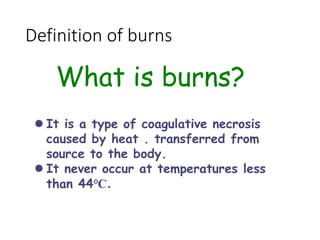
 Flame
 Hot water, steam
Thermal burns
(common type)
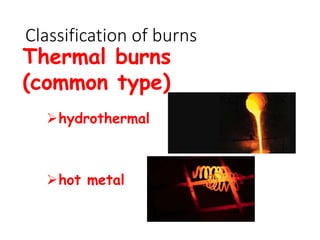
Classification of burns
Thermal burns
(common type)
hydrothermal
hot metal
Classification of burns
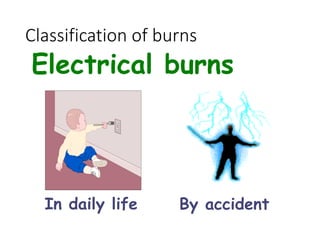
Electrical burns
By accident
In daily life
Classification of burns
Electrical burns make up only 4% of U.S.
hospital admissions but have special concerns
including the potential for cardiac
arrhythmias and compartment syndromes with
concurrent rhabdomyolysis.
A baseline ECG is recommended in all patients
with an electrical injury, and a normal ECG in a
low-voltage injury may preclude hospital
admission.
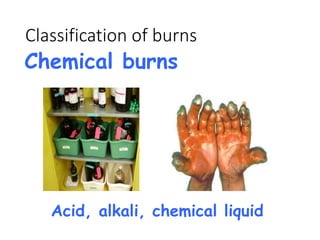
Classification of burns
Chemical burns
Acid, alkali, chemical liquid
Airway management
Signs of impending respiratory compromise may
include a hoarse voice, wheezing, or stridor;
subjective dyspnea is a particularly concerning
symptom and should trigger prompt elective
endotracheal intubation.
In patients with combined multiple trauma,
especially oral trauma, nasotracheal intubation may
be useful but should be avoided if oral intubation is
safe and easy.
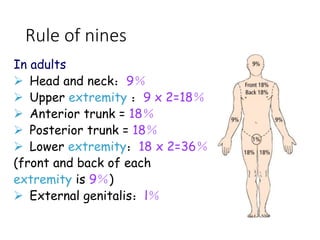
Rule of nines
In adults
 Head and neck:9%
 Upper extremity :9 x 2=18%
 Anterior trunk = 18%
 Posterior trunk = 18%
 Lower extremity:18 x 2=36%
(front and back of each
extremity is 9%)
 External genitalis:l%
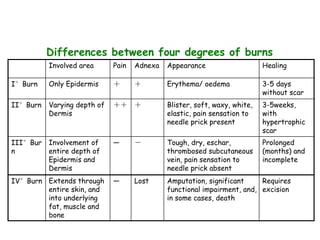
Involved area Pain Adnexa Appearance Healing
I°Burn Only Epidermis + + Erythema/ oedema 3-5 days
without scar
II°Burn Varying depth of
Dermis
++ + Blister, soft, waxy, white,
elastic, pain sensation to
needle prick present
3-5weeks,
with
hypertrophic
scar
III°Bur
n
Involvement of
entire depth of
Epidermis and
Dermis
— - Tough, dry, eschar,
thrombosed subcutaneous
vein, pain sensation to
needle prick absent
Prolonged
(months) and
incomplete
IV°Burn Extends through
entire skin, and
into underlying
fat, muscle and
bone
— Lost Amputation, significant
functional impairment, and,
in some cases, death
Requires
excision
Differences between four degrees of burns
It depends upon several factors. The
most important being percentage of burns
and facilities of treatment.
Factors affecting outcome
1. Extremes of age
2. Depth of burns
3. Inhalation of noxious fumes
4. Cardiopulmonary disease
**
Prognosis
Resuscitation
Parkland’s formula
4 ml /% of burns/Kg in the first 24 hours.
½ : In 1st 8 hours
¼ : Next 8 hours each
Example: 40% burns patient weighting 60kg.
Resuscitation
Muir and Barclay Formula
1 ration =
3 rations in 12 hours,
2 rations in next 12 hours,
1 ration in next 12 hours.
Example: 40% burns patient weighting 60kg.
2
t
body weigh
burns
of
% 
Treatment of wound
1. Bandaging therapy: for small wounds, bandaging limbs
or child burns is easier.
2. Exposure therapy: for easy dressing wounds
scattered in the area, or extensive burns, adult burns.
3. Balneotherapy.
4. Surgical treatment: tangential excision, skin grafting,
free flaps and so on.
Wound coverage
There are promising developments in skin culturing
techniques and engineered skin development, but no other
products are Food and Drug Administration approved and
commercially available.
Thighs make convenient anatomic donor sites; they are
easily harvested and relatively hidden from an aesthetic
standpoint.
The thicker skin of the back is useful in older patients,
who have thinner skin elsewhere and may have difficulty
with healing of donor sites.
The buttocks are an excellent donor site in infants and
toddlers; silver sulfadiazine can be applied to the donor
site with a diaper as coverage.
Wound coverage
The scalp is also an excellent donor site; the skin is
thick and the many hair follicles allow rapid healing,
with the added advantage of being completely
hidden once hair regrows.
Epinephrine tumescence is necessary for
harvesting the scalp, for both hemostasis of this
hypervascular area and also to create a smooth
contoured surface for harvesting.