Under one roof: Unifying the guest experience
Charting the future of payments
运行时间
填写表单,观看完整视频
Guests don’t think in channels. They book online, check in at a kiosk, order room service from their phone, and expect it all to feel like one experience. Hear how hospitality and travel businesses are unifying their financial infrastructure to meet customer expectations, boost revenue, and adapt for the rise of AI-assisted guest journeys.
Speakers
Paolo Dona, Chief Information Officer, Staycity Group
Peter Hammer, Managing Director, Global Travel and Hospitality Industry Lead, Slalom
James Lemon, Global GTM Lead, Hospitality and Travel, Stripe
JAMES LEMON: Good morning, everyone. You enjoying Sessions so far this morning? Good, good. My name’s James Lemon. I’m Stripe’s global lead for all things hospitality, travel, and leisure. And delighted to welcome you to this session this morning on unifying the guest experience, all the ways that we can make the travel, hospitality, leisure industries better for our teams and for our customers.
So I’m pretty lucky. I get to travel a lot with work and I get to see the best and the worst of the industry. A couple of months ago, I was at a hotel in Berlin and I was at the front desk and I had a long form to fill out and a card to hand over. And I thought, I’ve already given you my card online. Why am I standing here again feeling like I’m paying again? Later that night, I had already given my card over at the bar. I was in my room. I grab a sports massage. They didn’t even take an online booking. So at this point I’m phoning them and reading my card numbers out over the phone. And I think by the time I was standing at checkout, filling in another form and handing over my card, this hotel must have had my card, I don’t know, five or six times. And I thought, there must be a better way. It’s 2026. Why doesn’t this hotel... Trust me. Why does payments keep getting in the way of my experience? And why doesn’t my card just follow me around on my trip? And so we wanted to dig a little deeper into this.
So we did some research with Skift that many of you will know. We interviewed nearly 400 travel and hospitality execs around the state of payments and the way they were thinking about payments in their businesses. And one of the questions we asked them is, “What would a single, connected view of payments do for your business?” And here’s what they told us. Firstly, they could improve their back-office reconciliation, just making life easier for finance and operations teams by having all of their reporting and reconciliation in one place, thousands of hours saved. Second, they could better personalize travel offers, find the right guest at the right moment in the journey, because when you’ve got a single view of payment data, you can really tailor what you offer and when. Thirdly, they could reduce manual fraud management. They could combine all these different sources of information and make sure they were keeping the bad actors at bay. Fourth, they could optimize costs and the financial efficiency of their business. And what I love is, lastly, is they could innovate. They could think about how to make the most of new revenue streams. They could automate that spa booking process. They could start inserting offers around room upgrades and in-trip purchases. They could create their own travel marketplaces and capture more of that trip spend.
Now, here’s the gap. While 86% of hospitality and travel execs told us that they would love to have a single integrated financial stack, they’ve really got the value of achieving that for their business. Actually, only 23% of their systems were fully integrated. So if you’re sitting here thinking, look, I really know I need to do this, but I just can’t figure out how, you’re not alone. But that gap is also our opportunity as an industry. The companies that are closing it now are seeing higher booking conversions. They’re capturing more revenues across the trip, and they’ve got happier staff across finance, tech operations, and technology.
What does that look like in practice that we’re seeing? Well, they have a much smoother online checkout. We work with around 40 airports in the world. We work with Edinburgh Airport, and they saw a 3% uplift in conversion just by turning on specific local payment methods. I spent a lot of time with the Edinburgh Airport team, and they told me every time they turn on a new payment method, their revenues go up. They turned on Klarna for their car parking, and their travelers absolutely loved it.
More revenues. So Tripadvisor improved their authorization rates by 1.5%. Now, for a global company of that size, they’re recovering millions in previously failed transactions.
Seamless traveler journeys. So Hertz have consolidated their payments, not only online, but with 11,000 different locations around the world using Connect. So drivers get the same consistent experiences, whether they’re picking up in New York or LA, whether they’re taking care of ancillaries or last-minute parking costs, or without ever re-entering their car details again.
And much more efficient back offices. So with Stripe, Oasis Hotels reduced their fraud rates by 90%, which is just saving their staff hours of manual work each week. And a fun fact, a third of Oasis Hotels guests now check out with Link.
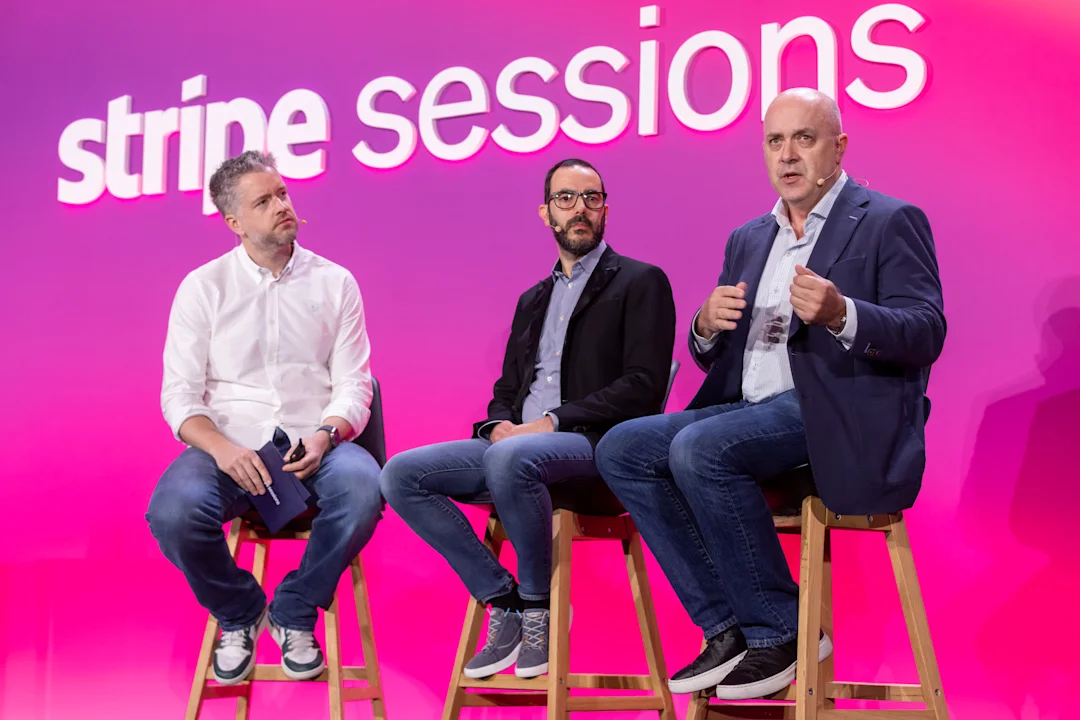
So let me tell you what’s going to come up in this session. First, I’m so excited to welcome Paolo Donà. He’s the CIO of Staycity Group. And for those that don’t know them, Staycity Group’s one of Europe’s leading apart-hotel operators. And he’s going to be sharing his blueprint of how they unified payments from online to in person, right across the portfolio, and some of the lessons and tips that they learned across the way. Next, we’re going to have a bit of a panel and we’re going to zoom out and talk about what this means, not just in hospitality, but for the wider travel and experiences industry. So I’m really excited to welcome Peter Hammer to join the stage, who’s the head of travel and hospitality at Slalom, to talk all things about what’s happening now in travel, but also a big theme of sessions, what’s coming next for our industry. So with that, please welcome to the stage, Staycity CIO, Paolo Donà.
PAOLO DONÀ: Hello, everybody. How are you? My name is Paolo Donà. I look after technology for the Staycity Group. That means from AI, automation, data warehouse, IT infrastructure, a bit of everything. I split my time between Dublin, Ireland, which is where the company is based and Italy, which is where I’m from. Like you can probably tell from my accent or like my 10-year-old son would say, say, “It’s-a me. It’s a Paolo.” So Staycity redefines what accommodation can be. So we blend the space and flexibility of apartments with kitchenettes, with extra storage, with room to work, with multiroom apartments, with the concept of a hotel and the convenience of a hotel. So a 24x7 reception, gym, bar, laundry, and so on and so forth. We try to focus... We’re very fastidious about guest scores. We want the guest experience to be as streamlined and flawless as possible, and that’s where payments come into play. We want a very seamless payment experience. So they’re very key to deliver the streamlined experience.
Staycity is three or four times bigger than it was when I joined six years ago. We operate in 41 hotels across eight countries, from Ireland, UK, France, Italy, Germany, Austria, Portugal, the Netherlands, about 20 different cities. And we have plans to grow 3x in the next few years. So we’re opening in Amsterdam, Porto, Belfast, Warsaw, Berlin, London, Oxford, Bordeaux, Munich, Vienna, Dublin. And this kind of growth really puts pressure on the payment infrastructure, in particular because in Europe, every country, every jurisdiction has different rules, different payment suppliers, so it’s not as seamless to grow at this pace.
We had a number of problems across the whole customer journey due to our old payment infrastructure. So in our ecommerce and website checkout, we offer a lot of contextual upsells, from room upgrades, late checkout, parking, and so on and so forth, but customers could not really pay in the wrong currency or with their preferred payment method. So imagine a customer from Japan trying to stay in a hotel in Dublin. They wouldn’t be able to pay in Japanese yen. This created a discrepancy in conversion rates on the website. For example, for Germany, where a customer want to pay with PayPal, we saw a big drop in conversion there.
We also had big problems with authorization rates. Our old suppliers had an authorization rate of roughly 75, 76%. So we were stopping people from actually buying our services just at the moment when they were committed and proceed with transactions.
Then we move on to the check-in experience. So you arrive at the hotel, we want to offer flexibility. So you can check in the self-service kiosk, you can check in at the front desk, you can pay multiple ways, but having payment terminals scattered across 30-plus locations was hard to manage, especially with the different jurisdiction and different suppliers. So we didn’t have an overall visibility of the payment terminals or proactive maintenance. So whenever those terminals will malfunction, they will impact the guest journey without us being able to manage that directly from our central location.
And then we move to the back office. So our experience is multichannel. So guests can book online, add an upgrade on-site, ask for a refund or through the contact center on the phone. And it’s important that at all these touch points, the payment infrastructure converges to the same place. Imagine with a number of suppliers scattered across different touch points, a refund becomes very difficult. Reconciliation becomes very difficult.
So the wake-up call really came when we had to expand to new jurisdictions and the current suppliers for the different touch points wouldn’t be enabled in a given country. So we had to keep adding suppliers and keep patching and patching the tech stack to support our growth. We needed a partner and an infrastructure, not only that was good for where we were, but where we wanted to go, so as they could keep up and enable our growth.
So we chose Stripe for four reasons. The first one, it’s obvious, is the unified architecture. So it’s one single platform from API to ecommerce, to payment terminals, to back office that powers the whole tech stack. Then we had localized checkout. So specifically for every jurisdiction, we could offer the correct currencies, we can offer local payment methods. But while this is local, it is also global. So we have global fraud prevention, global compliance, and the ability to open in new countries very quickly without having to go through KYC processes or merchant ID setup a very, very long process and tedious. And then very, very important for hospitality is a deep technical integration with our software. We use Oracle OPERA, which is the main software that’s using to check in people, to keep reservation, prices, and all the information is the hub in a hub-and-spoke architecture for us. And Stripe were able to integrate very deeply with this OPERA system that was key to the development.
So we used a number of products from Stripe. The Optimized Checkout Suite and the payment element UIs on the storefront. We also added Link, which is the Stripe accelerated checkout. Then we rolled out all the Stripe terminals across all the estate, the Stripe OPERA connector to our back office, and then we also added Radar for fraud prevention.
We approached the transformation in three main phases. The first one is the technical one. So we unified the tech stack through the different touchpoints. Then, once that was stable, we added new payment methods—Apple Pay, Google Pay, PayPal, local payment methods. And then once that was stable, we went into new revenue streams, in particular multicurrency conversion.
Okay. In terms of deployment, we started with the storefront, so the online checkout. We replaced it fundamentally what we had before with different suppliers. That was fairly easy and straightforward thanks to all the documentation that Stripe offers. Simultaneously, we integrated with the back office, so the OPERA Cloud system, and we also simultaneously worked on the terminal deployment. For us, it was key to do this vertical integration. Again, because the customers... We’re in a multichannel setup and customers can interact with payments at different stages. It was important for us that everything converged, so we had to deploy everything at once. We deployed the full stack to one test property first. We made sure that the experience was good and was streamlined, and then we started roll out hotel by hotel. We were a bit scared. At the beginning, it was one hotel per day, in a day, and then we saw that it was pretty easy. We switched to three hotels and then five hotels per day, and we only had one person in our team managing the full process. So with travel and so on, in three months, we could roll out this full new financial architecture across all of our estate.
Once that was done, we moved on to new payment methods. So the payment element makes this very, very easy. You can go to the back office, you can start switching on new payment methods, obviously. So that’s very, very straightforward. And we also wanted to use the Stripe’s accelerated checkout, so Link. That was great for us because with Link, every guest that has used Stripe in a Stripe-enabled checkout anywhere else, not only on our website, has a one-click checkout experience, their payment details are already saved. So that makes it much easier to complete at the moment of commitment. So that means less abandonment, a greater conversion rate on the storefront.
And once all these new payment methods were implemented, we started experimenting with new revenue stream. This is another payment method, buy now, pay later, which is a Klarna. It was an interesting, a particular payment method that we wanted to try. Accommodation can be quite expensive. It’s a type of payment that would benefit from having multiple installment payments. We weren’t really sure because obviously the commissions are a bit higher, what the ROI of this payment method will be. What we could do with Stripe is go into the Dashboard, set up an experiment, and feed this new payment method to a portion of our guests. So we could see in this A/B testing what the return on investment would be, and try to determine what cohort of customers will benefit from this the most. And after our testing period, we rolled it out to the whole estate.
Now that we’re done with a basic and a few extended payment methods, we switched our attention to new revenue streams. With the previous suppliers, we have dynamic currency conversion at the terminals. So that’s something that’s been around for a long time, but our setup was very static. So it was a 3.5% markup if you were to pay in your own currency, and we would get, let’s say, roughly half as a rebate. That didn’t convert well, didn’t work in every jurisdiction, didn’t really generate a meaningful revenue stream. We moved this to the Stripe FX conversion, and we saw that we can control the markup so we can move it to 5% to 4% based and find the right level and we actually can get more of a share of the increased revenue through the terminals.
But really, where this shines is implementing it on the ecommerce platform. So on our website and booking platform. What we wanted to do is present all of our prices in a lot of local currencies in Japanese yen or pesos and so on. And we didn’t want to penalize the customers, but we also wanted to make some money off it. We don’t penalize the customers because banks already take that money. If you are a Japanese customer booking a hotel in Dublin or in the UK, your payments will be settled in British pounds. Your credit card is in Japanese yen. Your Japanese bank is going to charge you an inflated FX fee and an FX conversion. So you’re still paying more than what the accommodation costs. Instead of letting the bank make their money, we control that through the FX Stripe APIs and make that margin rather than letting the bank have it without increasing the complexity of the system, because our financial infrastructure is still based on euro and British pounds because Stripe handles all the conversion and settles the money in our Stripe account. So the prices, the revenue management, all the difficult stuff and all the financial strategies still in our base currencies, Stripe locks in the FX rate, valid for an hour, 24 hours, so you can decide with published prices in all the currencies that we want with the markup, and then that flows through in our local currencies at the end with the markup.
So what did we actually see from all this, the combined effect of all these initiatives? We saw a 70% decrease in checkout abandonments. We saw a 10% increase in auth rates. This flows to conversion on the website, which means that we can spend more money on advertising for direct sales. So the return on ad spend for the marketing team has improved, and we generated over a million dollars in extra revenue from multicurrency conversion. We’re not done. We’re looking at Pay by Bank, for example. So we have a cohort of corporate customers for which this will be very, very interesting, for example, and we can reduce our credit card bill dramatically by implementing this. And also we can expand and implement more alternative payment methods as we go based on traffic and based on return on investment.
If I were to give you my advice for implementing and restructuring your payment infrastructure, I would start with a very solid business case. You can model it based on the conversion uplift and Stripe can give you data that it’s fairly reliable on that. You calculate your conversion uplift, model it, versus the commission of the different alternative payment methods that you want to implement. You need to consider the new revenue streams like the multicurrency conversion. You need to model the reduction in costs for Pay by Bank, for example, and all the efficiency gains of having a single consolidated architecture with the reconciliation and the finance team doesn’t have to deal with multiple suppliers and try to reconcile everything. When we did this exercise and tidied everything, the business case became very clear very quickly. I hope this was helpful for you, and thank you for your time.
JAMES LEMON: Thanks, Paolo. So I’ve been following Paolo and the Staycity journey for a couple of years. I think it’s just such a great example of how modern hospitality businesses can really transform the guest and the staff experience. So that’s hospitality, but two questions you want to answer next is, do similar rules, a similar thinking apply to the wider travel industry? And then also, what’s going to be next for travel? How are we going to be thinking about some of the AI topics that we’ve been talking about over the last couple of days at sessions? To help us answer those questions, I’d love to welcome to the stage Peter Hammer, who’s Slalom’s global travel and hospitality lead. Peter’s been working with travel brands over the years and has done this dozens of times and tons of segments. So Peter, great to have you with us. Cool.
So look, we’ve just been hearing from Paolo about how they’ve been transforming payments in hospitality, thinking about the guest experience. What patterns are you seeing if we step back across the wider travel industry around kind of unified traveler experiences? Do these themes hold true?
PETER HAMMER: Yeah, they really do. So let’s take a look across travel and hospitality. If we look at airlines, they’re the great aggregator of content through airline agreements. We see content now from airlines in the areas of hotel, rental car, adventures, others being all aggregated and offered by airlines today, certainly in a differentiated and more intelligent offered way than before. Hotels have become true destination experiences. They’re able to leverage data and analytics to really personalize, offer customized, unique services, unique stays, unique experiences to guests even before they arrive and throughout their experience. If you look at rental cars, it’s an amazing opportunity now that we’re seeing really play out in the market where they are the real leaders in mobility and that broader concept. And finally, cruise, you think of it as an all-inclusive experience. Today, they’re really able to offer not just that inclusive experience, but build up the experience so that it includes ancillaries that really meet the needs, the real-time, in-sale needs of guests, and really realize the true value of what that full ecosystem represents.
Now, let’s step back to a different part of the industry. The OTAs, OTAs are tremendous in that they are able to offer supply from all the different parts of travel. They’re able to look across the entire travel experience from their vantage point. And what’s most enticing is that they’re really meeting the traveler at the point where the traveler is most apt, most interested in consuming and making those critical decisions along the way. But there’s some certain things that OTAs really do need to get right. So one is, are they able to aggregate that supply efficiently? Are they able to leverage advanced data and analytics so that they’re able to see and offer intelligently across that entire travel experience? If you also though look at what’s required, it’s their infrastructure. And the real question is, does the infrastructure stand up to offering that full opportunity, taking advantage of that?
Slalom is working today with a really interesting adventure travel company. If you want to go kayaking in adventurous places, if you want to see the big five in Botswana, for example, this is your agency. We’re working with them to implement Stripe and Stripe’s capabilities and that full ecosystem of payments, which is really exciting to see grow and increase its share of value. What’s exciting about this is it’s really offering two real critical points of value to that agency. One, it’s experience. We’re really leveraging experience and offering unique differentiated experience to the traveler. Number two, we’re able to really efficiently make use of the staff of that company. No longer are we doing things like taking staff’s time to be on the phone with that traveler, to process payments. We’re able to now receive as a traveler an email, a text message with that ability to process payment in a way that’s convenient for the traveler. The staff, on the other hand, is really able to focus on personalized critical points of engagement. So real differentiator in the market, real differentiator value creation, both for the travel agency as well as the consumer.
JAMES LEMON: Yeah. Thanks, Peter. I think it’s just so interesting the way that travel feels like the ultimate ecosystem. One of the themes of Sessions of just these network effects feels like the more businesses work with Stripe, but the better, really. I think one of the things that we’re seeing travelers get to experience is when one brand puts other partner offers into its ecosystem. So a seamless traveler of kind of booking, but actually behind the scenes you’re booking with two or three suppliers. I always think when I come to San Francisco, I open up my Lyft app and I can order a Lime bike, right? It’s that kind of network effect and they just automate with something like Stripe Connect, kind of payouts behind the scenes. Paolo, we can’t get away without talking about agentic commerce. So this has been a big theme of the last couple of days.
Potentially, as John was saying this morning, we are seeing a future where travel could be discovered, searched, booked, paid by agents. In a world where the customer relationship’s so important for hotel brands, how do you think about that booking experience changing and the way you’d maintain the customer relationship?
PAOLO DONÀ: Agentic commerce and it’s something that we’re definitely looking into. Specifically, we’re seeing a tiny percentage of the traffic on our website coming from agents at the moment. However, even if it’s tiny, it’s growing double-G digits month to month.
So what that means is we need to put a lot of effort into discoverability and exposing information that maybe before wasn’t exposed through the website. Imagine someone makes a decision now looking at the pictures and say, “I like that hotel. I like that room.” How do you make sure that your brand translates to something that the LLMs can then propose to the customer to pick the right accommodations? So that’s something that we’re working very hard and we’re learning on the go what to expose. But to go back to your point about the loyalty, I guess, element, for us it’s still based on our stuff. So you know that the Booking.com scores, right? The properties nine out of 10 or so on, and then there’s subscores about location and this staff scores that we have are, and I quietly proudly say that are world class, like we’re amongst the best in staff scores. So we don’t want AI to take that away. We still want to use people to make the difference, however, leveraging AI to try to expose and lift the brand through these new channels and avenues for booking a hotel.
JAMES LEMON: Yeah. I think that’s I think such a great point. It’s in a world of AI, actually, in a way the physical experience becomes even more important. Again, John was talking upstairs about the role of hardware, but in our industry, it’s that staff experience, the touch points you have with the team. And I guess it kind of reinforces that point. If you can just make payments invisible, if you can take away, create an online check-in so it becomes much more about a greeting, help people access the ancillaries and meet staff at different points around the hotel. I think it really gives brands a chance to stand out as new distribution channels emerge.
And I guess this same true we’re finding in the online space as well, we know that agents are starting to refer traffic to hotel sites and agentic commerce is coming. A kind of framework I’ve really thought about thinking about this is right now, travel brands need to be modernizing their financial infrastructure. Your systems need to know whether agents or humans are hitting your technology. Then you need to start experimenting with AI. Seeing more and more people thinking about ChatGPT apps or building agentic commerce experiences on their own site. What would happen if you gave someone a natural language prompt, showcased your content and gave them a one-click checkout on your own site? And I think it’s those two kind of capabilities, if you like, that will really set the stage for those early adopters when third-party agentic commerce comes, whether that be through startup travel agencies in the AI space or the big generic LLMs, I think. And Peter, on that second step, seeing travel brands experimenting on their own sites, what kind of use cases are you seeing across the travel ecosystem?
PETER HAMMER: Yeah. I mean, let’s think about it. It’s a really great question. Really important, especially today in, and we look at the way that capital is invested today. So let’s break it out into three different phases or three different stages. So the first is search and packaging. So the ability to aggregate content, to inform, to educate, and to lead. Today we’re seeing all sorts of travel companies now provide insights, lead the consumer to intelligent, informed answers about their booking preferences, booking needs, and meet those needs along the way. Here’s a real example to bring this to light. Slalom’s working with Norwegian Cruise Lines, we’ve deployed a tool that if you understand the world of cruise, the biggest question is if I’m a first-time cruiser, the cruise is so complex. How do I make a decision? What information do I need to know? How do I make decisions around ship and market and all these complexities?
We deployed an AI tool called Nora. Nora today for the guest that goes through the Nora experience and the guest is prompted through a natural language query. The guest has now represented or presented three different options that meet the unique needs of that guest while they’re traveling. So what’s interesting about this experience is that it solves this big problem of cruise, but it really provides value to the guest. And today, the guest that goes through that experience with Nora, they are, number one, almost 60% more likely to purchase that cruise versus guests that go through the traditional channels. Number two, they’re paying almost 30% more for that cruise. What’s really interesting is at the end of the cruise, those guests are reporting much, much higher satisfaction rates and higher preferences to return to Norwegian Cruise Lines, so increased brand preference going forward. So really, really remarkable experience.
The second stage, so think of it as servicing and disruption. We’ve all been through that airline disruption, regular operation scenario and can certainly personally relate to this. We’re now able to bring AI into that ecosystem and into the stage in a very critical way. One, to early-detect irregular operation scenarios. Number two, we’re able to intelligently present based on the needs of that traveler, solutions, recovery solutions that best meet the needs of that traveler. Number three, we’re able to take into account efficient operations such that where the traveler’s not able to solve given the options presented perhaps through mobile, when they connect with the contact center, we’re able to serve contact center agents, intelligent options to rapidly and in an intelligent way, different solutions to solve for that guest next-step travel needs. So incredibly remarkable results and seamless experience and uplifted experience to serve travelers. When I step back then to the third, it is an on-property or in-travel experience. And where cruise lines are able, for example, to offer intelligent offers not just on top of the all- inclusive experience of the cruise, but also in travel to offer unique experiences that uplift both the engagement and the experience of that traveler.
JAMES LEMON: Fantastic. Well, look, I think one of the things we’re really learning is that when you talk about dynamic shopping, the servicing, personalization, it really feels like the whole industry, as you were saying, Paolo, needs to think about unified data stack, unified architecture, and a flexible infrastructure for scale. So thank you, Paolo, Peter. That’s been fantastic.
As we wrap, I just wanted to kind of share the three horizons we think about when we think about the benefits of unified infrastructure across travel. The first is really about the immediate return. So driving better conversions on your sites, higher auth rates, incremental revenue growth across the business. The second of these compounding effects, so suddenly you have more loyal guests, your marketing spend becomes much more efficient. A consistent checkout experience drives more people to your site and then brings them back as loyalty members. And finally, I think flexible global architecture just speeds up that pace of innovation and market entry around the world.
And what comes next is this world of agentic discovery, booking through channels, thinking about how to get your content out into the world so agents and humans can find you. And I think if you get that wrong, you probably risk being invisible to the next generation of travelers. So here’s where to start. Go back to your businesses and understand, where’s your conversion falling off today? Where could you take some of the thoughts from Sessions and think there’s so much more we can drive out of the value of our payment stack? Which markets are underperforming? Where are we not getting the direct bookings that we want? We’d love you to kind of dig into our data a little bit more, so feel free to scan the QR code and grab that Skift report that we’ve done. If you could please join me in thanking our guests and sharing their insights. It’s been a great session, and thanks so much.