Agentic commerce under the hood
Charting the future of payments
Runtime
Complete form to watch full video
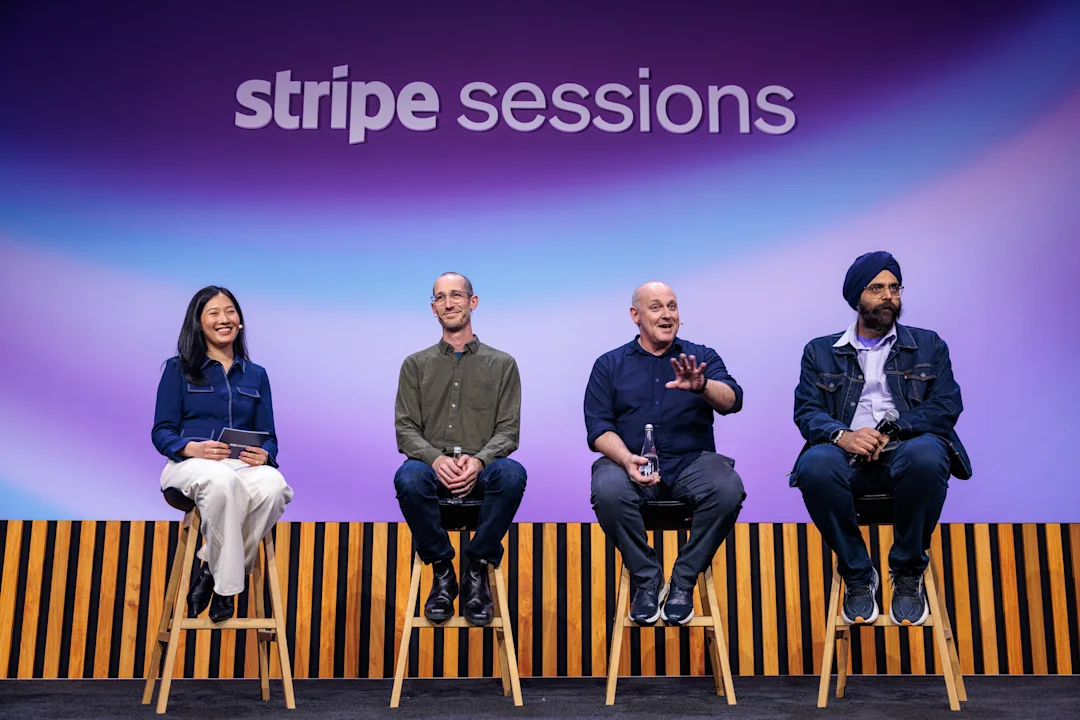
Agentic commerce is an entirely new type of sales channel—one where algorithms evaluate your products, initiate transactions, and return as customers. Learn about the production challenges in making catalogs legible to agents, embedding customer context into agent-mediated flows, and re-architecting fraud and pricing models for autonomous buyers. You’ll see concrete patterns from teams already shipping with Stripe—and the trade-offs they’ve experienced.
Speakers
Mandeep Bhatia, SVP, Global Digital Product and Omnichannel Innovation, Tapestry
Kyle Dorcas, Head of Product Management, Ashley Global Retail
Beau Lebens, CEO and Artistic Director, WooCommerce
Marvin Duddek, Agentic Commerce, GTM, Stripe
Allison Xu, Product, Agentic Commerce, Stripe
ALLISON XU: Hello everyone. I’m Allison, and I work on the agentic commerce product team.
MARVIN DUDDEK: And I’m Marvin. I work with businesses as they explore agentic commerce solutions.
ALLISON XU: Now, at this point of the day, you probably already know that AI is changing the way people are finding and buying products. Now, true story, I’m very lucky to be going on vacation to Spain next week. And normally I would spend a couple of weeks researching cities, building an itinerary, and spending way too long trying to figure out what to wear. This time, I used an LLM and in the matter of a few prompts, I had a multiday itinerary built for me, a packing list that even incorporated the latest weather forecasts, and it even gave me wardrobe suggestions, so I got a new dress for the occasion. For consumers, agentic commerce is here. People are discovering and finding new products and services via AI or agentic channels every day. But for many businesses, this still feels inaccessible. So today, we’re here to change that.
MARVIN DUDDEK: Over the next 30 minutes, we’re going to cover three things. First, we’ll look at where the industry’s at today. Then we’ll do a deep dive into the Agentic Commerce Suite for agents and businesses. And third, we’ll have a panel discussion with three brands that are already building with the stack. Woo, Ashley Furniture, and Tapestry, the company behind Coach and Kate Spade. Let’s start with the industry landscape. At Stripe, we’re very fortunate to have a front-row seat across the entire ecosystem of players. We’re working with buyers, agents, and sellers. And we observed a couple key learnings on each. Actually, we’ve seen it ourselves. Monthly Stripe sign-ups from users who’ve found us by agents have tripled over the past year. On the agent side, agentic commerce capabilities are getting embedded into more and more surfaces. LM chats, website assistants, agentic browsers, or even in-ad shopping. Some just focus on discovery and then redirect to a business side for checkout. However, many already start to experiment with embedding native checkout capabilities.
ALLISON XU: Now on the seller side, we’re seeing different levels of agentic activity vary by vertical. Now, taking a step back, we see agentic commerce as a spectrum between fully human-led buying and fully agent-led buying. Let’s walk through my dress as an example. Level 1 is no more forms. I can tell the agent exactly what I want, and it buys it for me. Level 2 is descriptive search. I don’t have to tell the agent what I want. I can actually just describe it, and it’ll recommend and buy something for me. Level 3 is persistent memory. The agent knows my preferences and can actually recommend products based on that.
Delegating decisions means I can actually just give the agent a budget and it can execute the task end to end. And Level 5, invisible anticipation. Weeks before my trip, a dress shows up magically on my doorstep, and it’s because the agent knows I needed it and knows that I would like the dress. If some of these feel far-fetched to you today, that’s because most consumer use cases are largely still at Levels 1 and 2, but we’re already starting to see B2B software use cases emerge at Levels 3 and 4. The industry is evolving quickly, and it varies by vertical. And so what does this mean for you? You need a tech stack that evolves with it.
MARVIN DUDDEK: That’s why Stripe is building the Agentic Commerce Suite or ACS. It allows to connect buyers, agents, and sellers on any surface with minimal effort. For sellers, it gives you the ability to sell via multiple channels with a single integration. On the agent side, it gives you the ability to embed native checkout capabilities, allowing customers to convert directly within the surface. ACS solves for agentic needs across the transaction lifecycle. Discovery, checkout, fraud, and of course, agentic payments. So let’s walk through each.
ALLISON XU: Let’s start with discovery. Since before any transaction can take place, your agent needs to know what products to sell and when to recommend them. That’s why product catalog data is so important. Humans can look at a dress on the left and assume it’s black, it’s loose, it’s probably good for warm weather. But agents perform best when they interpret data, not visuals. They’ll see the data on the right and their knowledge is only as good as the quality of the catalog behind it. Now, the challenge is that data is often messy or even incomplete. Catalogs have different fields, different attributes, and different formats, and agents use different specs to interpret it. ACS simplifies this complexity. Sellers can upload a single catalog that can be distributed to any ACS agent. We make this as easy as possible. You can upload a CSV, use our Import API, or coming soon, connect your commerce platform or catalog syndication partner directly. And as you can see on the screen, ACS can translate a single field like “description” into any agent’s preferred format. Marvin’s going to show us what this looks like.
MARVIN DUDDEK: Let’s say I’m a business owner of Galtee, a company selling outdoor equipment. And right now I’m looking at my Stripe Dashboard, specifically the Agentic Commerce tab. And as you can see, I’m already selling via agentic channels. In this case, Elementara, our demo agent for today. And there are two things I want to do. First, I want to request access to a new agent, and I want to take a look at the feed and make sure it’s still up to date. So I really want to sell via Copilot, and because I’ve already prefilled all my profile information, I can request access with the single click of a button. And now I’m just waiting for the Copilot team to approve my application.
Let’s take a look at the feed. It seems like we are right now not sending the information for our latest tents and backpack yet. So let’s change that. I’m switching over to a feed tap and click upload CSV. Select the latest file and upload. As you can see, I can manually upload the catalog via the Dashboard. We also support SFTP and as of today, the API. Once the product catalog is updated, all the agents that I have enabled will automatically receive the updates and will be able to show the latest product information. So let’s switch over to Elementara and make sure it actually shows up. So let me look for the latest products. Please.
ALLISON XU: So nice.
MARVIN DUDDEK: And here we go. The backpack intent now show up all with information that you as the merchant provide. So product description, pricing, even the imagery. That’s all information you provide and you’re not reliant on the agent scraping your website for the most up-to-date information. Back to you, Allison.
ALLISON XU: Now, once your products are discoverable, the next step is checkout. Now we see a future where more and more checkouts are shifting from a seller’s site to an agent’s interface. ACS provides agents with the delegated checkout API, which embeds checkout natively within your own product experience. It’s built upon Stripe Checkout elements, which leverages over a decade plus of experience optimizing checkouts for buyer conversion because we know that matters. Now, importantly, sellers still get to retain control where it matters. Sellers remain the merchant of record. They control the shipping and tax logic. They own the order fulfillment and management, and of course they select payment method options shown at checkout. In fact, ACS dynamically shows these payment methods, again, optimizing for buyer conversion. And today, ACS supports all major card types and their agentic network tokens, including Visa, Mastercard, and American Express. Buy now, pay later platforms like Klarna and Affirm, wallets like Apple Pay and GPay, and of course, one-click checkout with Link.
MARVIN DUDDEK: Doing the checkout, all the important information like pricing, availability, and shipping fees is shared directly between the agent and the seller. So let’s see that in action. Allison, I think we should buy something from Galtee. What do you think we should buy?
ALLISON XU: I could do some camping. Let’s do yellow tent. Go.
MARVIN DUDDEK: Go with the tent. When I click buy, the agent is now going to render a payment sheet. And as you can see, I can, as a customer, select my preferred payment method. It’s important to note that the seller ultimately has control over which payment methods actually show up. So the agent technically needs to support them, but then you can configure in your dashboard your preferred settings for your agent to checkout. All the information that’s shared in the checkout form is now real time between agent and seller. So when I update my shipping information, that’s an update that’s immediately communicated to the seller so they have the latest information. We can see the total is now updated and because my information is prefilled, I can pay Galtee with a single click. Galtee remains the merchant of record for this transaction. So I purchase in Elementara, but thanks to the dedicated checkout API, the merchant itself retains full control, and the agent now is just responsible for displaying the right surface. Over to you, Allison.
ALLISON XU: Looks like I have to go camping in Spain then. Now, once the buyer finishes checkout or completes checkout, our fraud and payment systems get to work under the hood. Now, in traditional payments, a seller collects the buyer’s payment information and processes that payment. But with the agentic payments, the agent collects the buyer’s payment information, but the seller still processes that payment, not the agent. That’s why ACS is built on our new payment primitive, the Shared Payment Token. SPTs manage that handoff of payment credentials between agent and seller, and it doesn’t just pass the payment credential. It actually helps control how that payment credential is used. It can be scoped to a specific seller, a specific time duration, and a specific amount. Now, we love our agents, but we don’t want them to go rogue with our money.
MARVIN DUDDEK: So let’s look at how SPTs are used as part of an agentic payment. First, when the buyer submits the payment information, the agent can create the payment method. Once the payment method is created, the agent can create the SPT, and you can think about the SPT as an object that’s basically permissioning access to the underlying payment method. Once the SPT is created, the agent can send it to the seller. If Radar is used, additional fraud signals can be included in the SPT. Now, on the seller side, the seller can decide if they want to approve or decline the transaction. If they approve the transaction, they can create the Payment Intent and charge the underlying payment method without ever actually seeing it. This is all natively built into our processing solutions, and if Radar is used, businesses can get access to a built-in fraud prevention trend on Stripe’s overall transaction data.
The good news is that so far, we haven’t seen any material increase in fraud when it comes to agentic channels. In part, that’s because humans are still in the loop for a lot of these flows. However, the steps that you’ve seen outlined as part of this process really allows to future-proof the stack so that we can prevent any new fraud patterns that might arise in the future.
ALLISON XU: So that’s the Agentic Commerce Suite in a nutshell. Now let’s spend a minute on what this means for you. Now we’re very fortunate to be building our agentic commerce products alongside highly innovative partners across both agents and sellers. Now we’re already working with many agents to bring these new commerce experiences to life, from AI leaders like OpenAI, Google, Meta, and Microsoft, to even newer startups like Wizard, an AI native shopping agent. Now, starting today, we’re excited to say that all US businesses looking to embed commerce capabilities into their own product experiences can sign up for access via their Stripe Dashboard.
MARVIN DUDDEK: And industry-leading retail brands like Etsy, Best Buy, Fanatics, or Quince, and many more are already integrating with ACS. Similar to agents, ACS is now available for US sellers via the Dashboard, so you can configure checkout settings and upload your product catalog. Once you’ve completed those steps, you can join an agent’s waitlist and connect directly as they become more broadly available.
ALLISON XU: Now let’s hear from the people who are actually building these integrations themselves. Join me in welcoming to the stage, Beau from Woo, Kyle from Ashley Furniture, and Mandeep from Tapestry. Great. Thank you all for being here today. Let’s dive right in. Kyle, I’m going to start with you in the middle. Ashley Furniture is an 81-year-old company, yet you guys have been a pioneer in AI and agentic commerce. What kicked off the investment at Ashley and what’s the broader strategy or vision?
KYLE DORCAS: Sure. I’m pretty confident in saying there’s absolutely no one that’s in this room that thought, “I wonder what’s happening with agentic commerce?” So let me go look at an 80-year-old company in the furniture vertical based out of Arcadia, Wisconsin. If you did, I’m not calling you a liar, but I would say you’re probably stretching the truth. However, our founder has a saying, “Don’t be along for the ride.” And by that, he means companies get successful and they rest on their laurels and that slowly degrades their business. And his view is, you always have to meet the consumer where they want to shop, not the easy path that we want to take. And that has guided our company from the time that this company was founded. I’m going to, humbly, but not really humbly brag, that Furniture Today publishes a list of the top 100 furniture companies, and they’ve been doing it for a number of years.
Ashley Furniture has been number one on that list for 16 consecutive years. And the reason why we are is because of that mantra. It’s a relentless pursuit of excellence in meeting our consumers where we are. And the final thing I would say on it, and I was asked at lunchtime today, knowing everything that I know now, would we have jumped into it as quickly as we did a few months ago? My answer to that is absolutely unequivocally yes. We walked into this knowing that most people are probably not going to buy a $6,000 sectional using an LLM this early in the lifecycle. We knew that. And I probably should tell you the results reflect that. We haven’t sold a ton even though we were live by Black Friday, but the learnings that we’re taking out of this are absolutely critical and phenomenal for us so that ultimately we can continue to not be along for the ride and be able to meet our consumers where they want to be met when they’re ready to start buying furniture.
ALLISON XU: I love that. I love that. And Beau, switching to you, so Woo is actually an ecommerce platform. You guys work with thousands of merchants across product types, cross verticals, and a lot are actually SMBs. So same question to you. What really kicked off the investment there, and what are you hearing from your merchants, particularly the SMBs?
BEAU LEBENS: Yeah. So for us as a platform, we sort of see it as our responsibility to enable our merchants to be where their customers are, to run their businesses effectively. And so we’re always keeping an eye out on, what do we need to do to support that? And we obviously have been keeping track of agentic commerce as this sort of emerging trend and hearing a lot from our merchants saying, “How do we get on this? What does this mean for us? How do we participate in this?” And so we knew that we had to get involved there and actually enable them. They’re looking to us to provide the solutions so that they can get access to this new distribution and sales channel. And from their perspective, the biggest thing we’re hearing initially is they’re seeing some of their organic traffic disappear because it’s shifting to LLMs.
And so they’re wondering, well, how do we either get that back or be a part of where it is now? So that sort of discovery and distribution mechanism is really important for them. And as their platform provider, we’re sort of in the position to say, “Well, here are all of the emerging protocols. Here are the systems that you need to be a part of.” And we can set that up in a way that they can just hit a button and turn it on.
ALLISON XU: I’m hearing this theme of “meet the consumers where they are.” So Mandeep, I want to actually move to you, and in the spirit of that, so let’s talk about brand. You want to meet consumers where [they] are, but inevitably there’s also some risk in not being able to control the surface that they are seeing. So how do you preserve brand identity in a world of agentic commerce?
MANDEEP BHATIA: Okay. Well, I’m going to make an assumption. How many of you here are wearing a Tabby bag or a Brooklyn bag or a Coach or a Duo bag? If you are, you’re one of my favorite people, those are our brands. You know them, Coach and Kate Spade. So I think in this agentic world, standing out, telling your story is going to become even more important. I do not believe that people are just going to buy a Tabby or a $400 bag just by looking at it on an LLM. They want to go... And there is a much richer story that brands need to tell. So my take is it becomes even more important. Now, we are very consumer obsessed. So we believe if you are one of them who wants to buy on one click, then we want to be there for you. And that is what customer obsession means.
ALLISON XU: Great. And speaking of brands, Kyle, I want to come back to you for a second. Again, Ashley is a furniture brand, which is a very different buying experience than let’s say a handbag. How do you think about the products and SKUs that are the best fit for agentech commerce? Are all products and SKUs a good fit?
KYLE DORCAS: You’ve got to look at it through a couple of different lenses because it’s not one-size-fits-all. First of all, you got to look at where we are in time with agentic commerce, particularly for us from furniture perspective. As I said earlier, no one’s probably right now going to buy a $6,000 sectional just with the state of how an LLM transaction goes down. So when we looked at what we wanted to go forward with, we went for smaller AOV items, more consumables that the consumer would be interested in, and we wanted to see what the reaction would be and whether or not they would transact. And they have for the smaller dollar ones. The other lens though of where we are today is you got to look at this from a product discovery perspective, and that was already mentioned. The referral traffic that we’re seeing on the website is through the roof.
And so even though from a transactional perspective, we were looking at an assortment that was somewhat stripped down and a little bit cheaper. That doesn’t mean you can stop paying attention to the overall assortment that you have because you have to make sure that it’s discoverable. If not, you’re going to be left behind. And then when you go forward in time where we think agentic commerce is going, that’s where we’re going to start to hit the sweet spot for people like us in that there will be additional tools that will complement the LLM and be built into them. So things like a room builder. I want to upload a picture of my living room and now I want to see what a couch looks like inside that living room. Then we can start to see where people will become more and more and more comfortable.
They’ll either purchase it there or it may even be a tool to get them into one of our brick-and-mortar stores across the nation. So either way, there’s a little bit more that has to happen for a retailer like us before agentic commerce truly unlocks its full potential.
ALLISON XU: I love that learning because I think it’s a good reminder that you even, I should say, especially in the early days, you don’t have to start with the full catalog. You can definitely start with the pieces that make the most sense. Now, Beau, I want to go to you. We’ve talked a little bit about discovery, but of course there’s the full transaction lifecycle. So how do you think about, what are the technical or most challenging technical pieces of agentic commerce and how do you think about where to allocate your valuable technical resources versus maybe partnering with a third party?
BEAU LEBENS: Well, so we do a lot of partnering, including with Stripe and—
ALLISON XU: That was a little bit of layup.
BEAU LEBENS: Yeah, a little bit. And obviously Stripe is sort of very central to parts of the actual transaction process in particular. So a lot of those, I think that’s actually some of the gnarliest technical pieces of exactly how do we navigate these transactions. There’s, I think things like Kyle mentioned, the catalog and ingestion of all of the product attributes and that sort of thing. That’s not particularly complex, frankly. It’s like a scale challenge, but we’ve been doing all sorts of content syndication and things like that for decades on the web at this point. I think what’s uniquely difficult there is just how real-time it needs to be. So it’s one thing to ingest the full catalog or even a partial catalog of a complex merchant, but if you go search in an LLM today, you’ll find a lot of content or catalog materials that’s actually two, three years old.
And so then when it comes time to go to an actual purchase, that doesn’t cut it. In fact, down to the second might not cut it if there’s a flash sale or inventory update or something like that. So getting that real actual live data, I think is the unique part of the technical challenge there. And then all the way through on the other end, I think agentic commerce opens up all sorts of new and different attack vectors and fraud vectors that are going to be, again, probably not uniquely technically challenging, but at a different scale and a different velocity than we’ve really seen before.
ALLISON XU: Absolutely. Now, Mandeep, I want to flip to you. Let’s have a little bit of real talk. You guys have been hearing about agentic commerce all day at Sessions, but there’s other people, I’m not saying anyone in this room, who are saying it’s overhyped. What do you have to say about that? Is agentic commerce overhyped?
MANDEEP BHATIA: No, I think again, if you are consumer obsessed, if consumer, you want to be where the consumer is. I mean, 900 million weekly active users for ChatGPT and other LLM engines, I mean, is that hype? That is something that you decide. So you have to be, like I said, where your customers are. Discovery is the starting point, right? And it was mentioned here, if they want to research about your product, then you need to have that data that, there was a slide here where you showed this is what the agent sees. So no, it’s not hype because that’s where they are researching, right? A simple tip for you, if you want to know more about yourself, go to ChatGPT and tell me, ask it, tell me about myself, the brutal truths based on everything that I’ve worked with you. I did it, I didn’t like it, but anyway, that was aside.
Coming back to it, but people are using it. People do want to discover products and so on and so forth. And from there, we don’t believe it’s a hype. In fact, if you want to buy a Mother’s Day gift, we just launched our gift concierge on Kate Spade site. So if you go to katespade.com or katespadeoutlet.com and on the hamburger menu, you can find the gift concierge because we believe, I believe that’s how people are going to shop. It’s going to go from keyword-based to conversation-based. You guys talked about how it’ll be more personalized. So no, it’s not a hype. I think it’s real.
ALLISON XU: And Beau, I actually want to come back to you for a second. Along those lines, let’s talk about some risks. What worries you the most about the future of agentic commerce, particularly again as a platform, but also on behalf of the long tail of merchants you represent?
BEAU LEBENS: Yeah. So I mentioned fraud. I think that’s a pretty obvious risk. As a platform, we’ve had completely open APIs and we give our merchants a lot of access to all of their data, all of their customization and everything. And something that we stayed away from historically is APIs that enable actual transactions. And it was always because the technology wasn’t really there, but also because there was this sort of known potential vulnerability there or potential security risk. So I think that’s probably the big one that stands out as a platform of like, “Hey, as an industry, we need to make sure that this is all super secure and that that doesn’t get in the way of the experiences that we’re trying to create.” And then on behalf of the merchants, I would actually say we’ve talked a little bit about sort of brand, voice, and representation of the merchant.
And I have a lot of our merchants, actually most of our merchants, they choose our platform because it’s customizable, because they can really choose how they portray themselves on the web. And I fear that we lose some of that as we switch to these agentic transactions and agentic experiences and everything becomes kind of commodified down to just “ask a question, perform a transaction.” And I think that’s ultimately not good for merchants. They might sell some things, and that’s great for some folks who are selling like commodity goods, but we have merchants who are selling really unique, interesting, bespoke products. They’re often very niche. A part of their whole sort of modus operandi is having a really loud brand voice and that gets diluted in this environment.
ALLISON XU: I think it comes back to something Mandeep was saying earlier just around brand and identity. It’s beyond just the surface that you’re going to see it now. It’s really about a holistic consumer experience in and off that platform.
BEAU LEBENS: Yeah.
ALLISON XU: Okay. We have a couple minutes left. So I wanted to end with a couple fun rapid-fire questions. So maybe we’ll start with you Mandeep and just work our way down the line. Based on your experience, what’s your best piece of advice for a new seller and the audience looking to start with agentic commerce?
MANDEEP BHATIA: I think, find a partner like Stripe.
ALLISON XU: I didn’t plant that.
MANDEEP BHATIA: No, on a serious note though, I think you need someone, when we started partnering with them, it was like how quickly they built this product, how quickly they innovated with us. I think there is something to it. So find partners who can bring that innovation to you.
ALLISON XU: Love it. Kyle?
KYLE DORCAS: I would say from a piece-of-advice perspective, understand as you go forward in an agentic world, the normal ecomm levers of conversion—AOV, traffic—are really starting to change. Traffic is going to be more curated, but it’ll be less. There are going to be differences on AOV because the agent is probably going to try and take apart your bundles and the promos are going to be a little bit different. You still have levers to pull, but just recognize some of the business landscape that you’re used to today to drive your ecomm business is going to change and the sooner you get in to understand that, the better off you’re going to be.
BEAU LEBENS: I would say definitely get in there soon and use these tools, understand how they work, experience AI for yourself. And I’d say don’t be scared of this as something that’s completely alien or completely new. I think a relatively simplistic way of looking at it is this is just another channel. Yes, it’s a different channel. Yes, some of the dynamics are different, but it’s just another channel. And so just think about it as a new way to sell your products. What do they need to look like? How do they need to be distributed into this channel? And what are the sort of purchasing dynamics that happen there?
ALLISON XU: Great. Okay. Last question. One-word answers. What’s one product or service? What’s the one product or service you’re most excited to buy agentically?
MANDEEP BHATIA: Our own product.
ALLISON XU: Always be selling.
MANDEEP BHATIA: The Empire bag. That’s what I’m looking forward to buying.
KYLE DORCAS: Okay. For me, I like to think that I’m an attentive husband, but every time my wife has a birthday, Christmas, anniversary, I twist myself into knots to try and figure out what to buy her. My agent today is my 16-year-old daughter. She gives me some advice, but she always somehow manages to rat me out that that was my idea. I am looking forward to an agent that will never miss a birthday, will never miss an anniversary, and knows what my wife wants, and can scour the world to find it.
BEAU LEBENS: I’m a lover of cocktails, so I’m looking forward to having an agent that can find me obscure Italian amari and basically just get them for me on a subscription.
ALLISON XU: I love it. Thank you guys so much for being with us today.
KYLE DORCAS: Thank you.
ALLISON XU: To everyone else, thank you for joining. We’ll see you around.