Launch and scale a financing program with Stripe Capital
Growing platform economies
Runtime
Complete form to watch full video
Learn how to add financing to your platform and scale it effectively—from choosing the right integration approach to identifying which user segments drive the best results to optimizing your program over time. Get industry benchmarks, learn expected outcomes at each scaling stage, and hear from platform leaders who’ve done it well.
Speakers
Obi Omile, Cofounder and CEO, theCut
Duncan Harrison, Product Lead, Capital for Platforms, Stripe
Keerthana “KK” Kumar, Head of Engineering, Stripe Capital, Stripe
DUNCAN HARRISON: Back in February 2024, theCut—a fast-growing booking app for barbers—hit a wall. Their business needed to hire a team to market their platform, but they had a cash flow gap. Then, theCut got an email from Stripe. They were prequalified for financing without having to lift a finger. Minutes later, they’d finished their application and within days, they had the money in their bank account. It was exactly the practical lifeline they needed to scale. Fast forward to late 2025, and theCut has over 25,000 barbers actively using their platform. And they realized their barbers were hitting those same walls. So they turned on Stripe Capital to help their barbers get access to the financing they needed, and the results were immediate. Within 24 hours, 167 barbers had accepted offers. And for the finance and product leads in the room, here’s the real kicker: they went from idea to revenue without a single line of new code.
They didn’t have to bump a single roadmap item or tie up a group of engineers for months. Later, you’ll hear from Obi Omile, CEO of theCut, about exactly how Stripe Capital transformed his business—twice.
But first, I want to walk you through the three-part playbook successful CEOs like Obi used to launch financing programs. We’ll cover how to decide whether financing fits your customers and your priorities, how to build a seamless program with the right integration path that protects your roadmap, and how to grow your program by pulling on the levers of eligibility and conversion.
So let’s start with step one, deciding. When we talk to platforms, they often say, “I know this works in theory, but is it right for my customers?” So think about your own users. Do you know how much operating cash they have? When we look at automotive businesses on Stripe, for example, we see a median runway of only six days. This isn’t unique to this industry. In fact, across the vast majority of industries we track, we find median runways of less than one month.
Whether it’s a retailer needing inventory for a busy season, or a law firm waiting 90 days for an insurance payout, or a telehealth startup who wants to start marketing to grow their client base—cash flow gaps are universal. And when you’re operating on a six-day runway, one surprise expense—a broken piece of equipment or a slow paying customer—can have significant impact on your bottom line.
And yes, your customers could go down to a bank branch and apply for a loan or charge it to their personal credit card, or they could go apply for some business loan now somewhere online. But these either take time, or impact their personal credit score, or risk high fees with unknown lenders. But what if instead they could go to you: their trusted platform who deeply understands them and has a stake in their success? Tech-first organizations like yours are best positioned to solve this for your users. Because of your deep understanding of their business, you can tailor their experiences to fit their needs, and you already have a foundation of trust.
Now, even if you’re set on launching a capital program for your users, building a financing program from the ground up is a daunting task. There are compliance and regulatory implications, capital markets and treasury problems, credit risk exposure, new customer support flows, and so much more. And with all of this complexity, you may be wondering, where’s the ROI? But with Stripe, you can launch a financing program for your users without navigating that complexity or taking any credit risk yourself. Stripe Capital for platforms is an end-to-end financing program, specifically designed for SaaS platforms and marketplaces. You can get started in minutes, not months, by leveraging your existing Stripe integration.
And for many of our most successful platforms, Capital is now their number one revenue-generating product on Stripe, even more than core payments. Payments is a high-volume, thin-margin business, but because Stripe manages the underlying complexity and shares the program revenue with you, you aren’t just adding a feature. You’re adding a new high-margin revenue stream. And my favorite part: Capital also boosts your payments revenue. Take the SaaS platform Shopmonkey. They started offering auto shops access to Capital to help them expand. And to date, they’ve issued nearly $54 million in financing, but they also saw payment volume grow 30% for accounts that take out a loan.
Platforms using Stripe Capital also see a 20 to 40% increase in user retention. It’s simple. When you’re the one that funded a business’s new location or their holiday inventory, you aren’t just a software provider anymore. You are a partner in their survival and their success, and they don’t leave. But the impact goes beyond retention. We ran a study that found a strong causal link between SMBs accepting financing and growing faster. On average, they grow 27 percentage points faster. And for some segments, that’s as high as 200. You’ve removed their growth ceiling. It’s what happens when a business finally has that cash to run that ad campaign, or hire that second stylist, or buy that extra pallet of stock.
So how do you actually get this into their hands? Once you’ve decided that your customers have a real cash flow gap, the next logical question is how to launch a financing program. The good news: you don’t need to build the infrastructure, as we already did. I’d like you to meet ZenFlow, a fictional yoga studio management platform. ZenFlow already monetizes payments. So when they log in to their Stripe Dashboard, this is what they see: over $20 million in financing offers, available to 744 of their accounts today. And so we click “Get started,” and we can see how the program works, and we can choose our integration path. And we’re going to go with the fast track here, the no-code option.
We can preview the emails our users will receive, and we can customize the branding so it matches the look and feel of ZenFlow, and set our integration preferences. And then, all I have to do is agree to the terms, make sure to read them first, then agree to the terms, sign the contract. And just like that, I’m ready to launch my Capital program. And when I click “Start sending offers,” those 744 users will receive their Capital offer instantly. So how’s that? It is cool. You’re right. That was under two minutes, and you can go live with a full end-to-end financing program. And our no-code experience is exactly how theCut got their start. Think of this as your fast-forward button. You can start generating revenue and helping your users today without opening a single Jira ticket. And to be clear, no code doesn’t mean small scale.
Since we stood on this stage at Sessions last year, platforms have sent over 400,000 financing offers to their businesses. And because there’s no engineering work required, you can launch Capital whenever you’re ready. Okay. So you’re live. Offers are going out and revenue is coming in. But the platforms that get the most out of Capital don’t stop there. To walk you through exactly how the top platforms scale their Capital programs, I want to bring up KK, our engineering lead who works directly with platforms on exactly this: how to grow a Capital program once it’s live.
KEERTHANA “KK” KUMAR: Thank you, Duncan. Platforms like Ignition, Clio, FreshBooks, all treat capital as a core part of how they grow. What are they doing differently? They are focused on two main drivers that grow adoption: increasing conversion and expanding their pool of eligible users. First, to drive conversion, you must optimize the user experience by meeting your users where they already are. While no code is the fastest way to start, the next step is putting the financing offers in the context of your platform. You want to show the offers at the exact moments your users are more likely to act and convert. You can integrate embedded components onto your platform experience. These are prebuilt, customizable UI elements like promotional banners that you can add to your dashboard. This is exactly how platforms like Squarespace have scaled their financing program. To their users, it looks and feels like their product. By putting the offers directly into the user’s daily workflow, Squarespace can drive higher trust and significantly higher conversion.
Conversion isn’t just about where you show the offer. It’s about what the offer is. The second growth lever is your product mix. For every gym owner that needs a $15,000 in a lump sum for equipment, there’s a contractor who needs smaller and regular draw for materials. And to meet that need, we are expanding our financing products to include line of credit. Line of credit gives your users flexible and ongoing access to funds. Let’s go back to ZenFlow. And this time, we’re looking at the ZenFlow dashboard, and my yoga studio, instead of seeing just a single loan, also sees a line of credit. This works better for my yoga studio’s ongoing need. So I decide to view the offer, and let’s say start the line with a $10,000 drop. It’s simple. I review my personal information, my business information, agree to the terms, and submit. Just like that, I have an active financing and an active line of credit.
Managing my line is just as easy. On my ZenFlow dashboard, I’m able to see the outstanding balance, the monthly payment, and actually the available credit I can draw from and say, “Next month, I need another $10,000.” I don’t need to start from scratch. I can access my funds similarly, and once again, draw $10,000. With line of credit, your platform is now supporting your user’s ongoing needs.
The third lever: to expand your reach is solving the data gap. By increasing the number of users you can actually give an offer to. Historically, we could only underwrite based on the volume we directly saw on Stripe. But for many of your users, that’s only a fraction of their business. Last year, we announced that we can take multiprocessor and offline data to underwrite your users. Take a look at GlossGenius, a platform for beauty professionals who handle a lot of cash, checks, and tips. By sharing these offline transactions and volume from other processor, we finally have a holistic view of their business. The result: GlossGenius saw loan eligibility increase by 30%. Simply by layering in additional data, we can offer more loans to more of your users. But what about your users who are not yet processing on Stripe?
You can now offer financing to your users who haven’t even processed a single dollar through Stripe. This opens up a brand new audience for your platform. In other words, you can now use Capital as a customer acquisition tool. By sharing data for your users, you can lead with the financing offer, get them into the door, and then watch them move their entire payments business over to you. This is especially powerful if you’re trying to move offline transactions onto your platform. Finally, the fourth lever is to expand your Capital business into new markets. Capital for platforms is now live in UK, France, and Germany, with Australia and Canada launching later this year. So if you have an international footprint, you can expand into new markets by just turning it on.
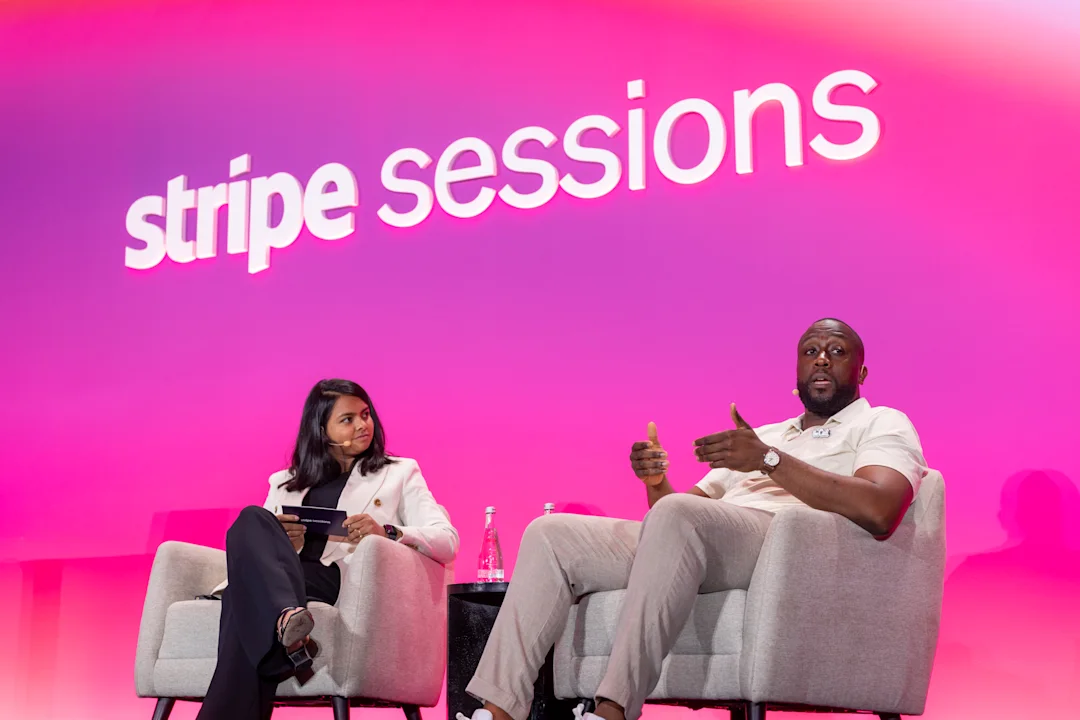
So with these four levers, your platform will not only grow your revenue, but also make it significantly more valuable to your users. So this brings us back to the playbook—the same framework we see the fastest-growing platforms on Stripe use to take idea to revenue, decide, validate the user need, build and go to market in minutes, and grow by increasing your conversion and expanding your reach. So we’ve spent the last 15 or so minutes looking at this from a Stripe lens, but the most important perspective is from someone who’s actually lived the journey. So let’s welcome the CEO of theCut, Obi Omile, to the stage.
So Obi, thank you for taking the time. And like Duncan shared, theCut took financing through Stripe very early on. So how did that experience influence the way you designed your program for your barbers?
OBI OMILE: A lot, actually. To your point, it was two years ago maybe at this point. We were looking to explore different financing options to scale our business. We’d gotten to the point where we were just about profitable and breaking even, and however, we still wanted to grow our team, so that we can really think through our go-to-market strategy and start to build that out. And we’d gone through the process talking to banks, talking to other types of short-term lenders. However, one of the things that was really important to us was speed to financing as well as level of effort. And through Stripe, being one of our great partners, they were able to leverage all of our historical transaction data. And as Duncan mentioned, we received an in-platform notification that we were eligible for up to a million dollars. We were able to apply within two or three minutes, and within 48 hours, we were funded.
So it was an incredible experience of how well technology can work to amplify kind of funding and access to capital. And so, when we were thinking about, how do we introduce this product to our barbers, that was the main thing that came to mind is like, “How do we reduce the amount of effort and the time it takes for them to go through the funding process? And how can we work with Stripe to make it as fair, as transparent, and as quick as they would like.” And so yeah, that was the journey from start to finish. And we rolled out our no-code solution earlier this year, or I’m sorry, at the end of last year. And it’s been gangbusters, honestly. Our barbers love it. And again, they’re accepting transactions or financing offers almost immediately.
KEERTHANA “KK” KUMAR: Yeah. I mean, you basically saw over $700,000 in financing accepted in the first 24 hours. How did that Slack room look like when this was happening live?
OBI OMILE: Sure. I mean, we knew there was demand, but what we were really surprised with was the speed of acceptance. We rolled it out, I think it was mid-December. And within the first hour, we were seeing barbers accept their financing offer within three to four minutes after receiving the email. So that really told us one thing is, or told us two things actually. One, there was an immediate need, and this was a real product that they were clamoring for, and then two, that it actually worked. We could distribute the product via no-code solution and see incredible amount of uptick and participation by our audience. It’s been about four to five months at this point, and we continue to hear kind of the same three things from our barbers. This helped them grow their business, it helped them build more resiliency in their business, and also helped them expand their business.
So one of the anecdotes is, we had a barber reach out and let us know that with the capital, he was able to buy new equipment, remodel his shop, and kind of offer more higher level services that he didn’t necessarily have the equipment for previously. And with the capital, he made those purchases, and within a few months, he was able to increase his prices and drive 30% more revenue year to date than he was previously. And so that was one of the… This is the theme that we continue to hear from our barbers is that they were able to buy the product to grow their business. Secondly, it was resiliency. We have barbers basically all around the country. And so one of the archetypes we heard from a few times were those barbers who worked on or around college campuses. You can imagine the cyclical nature of their business when students go away for the holidays or the summer, then they see a detraction in volume and activity.
And in those downtimes, they were able to use this capital to help them kind of smooth all those periods. And so again, creating more resiliency in their business, which they really value. And then lastly was expansion. So we have several barbers who own barbershops who were able to remodel those shops and introduce suites for individual barbers to work in, or professionals to work in. So they were able to expand their revenue potential and their earning potential simply by the virtue of new capital to work on their business. That as well as, you could think, just traditional running ads—now they have that capital to invest in their business, which has continued to pay dividends.
KEERTHANA “KK” KUMAR: Incredible. I mean, you guys started with no code, like you shared. So what’s next for your platform?
OBI OMILE: What’s next is to really scale visibility, eligibility, and adoption across our platform. With the no code, it was incredible. We were able to launch again, like you just showed, in just a few minutes, and we saw adoption from our audience. However, we still heard anecdotes that there were barbers who did not even know they were eligible because they didn’t see their email. Typically, emails will get 30 to 40% open rates. So you can imagine the other 60% of your audience not actually having awareness that they have this Capital offer. And so, as she was previously showing, we have now that we’ve validated the actual demand and have a better understanding of how to use the product, we’ve spent the time building it in-app. So increasing that visibility, we’re excited about because that’ll drive overall adoption. With simply just the email, we were able to see one out of five people an offer was extended to actually accepted and were funded, which over email was incredible.
I think you guys told us something like mid-teens with numbers before. And so we’re already outpacing that in just the first quarter and really excited to see how we can continue to scale that. Secondly is around eligibility. So the barber’s total amount eligible for financing is dictated upon their historical transaction volume. One, also we’re really excited about the ability to now share data, because that’ll bring in a lot of the barbers who don’t currently process payments and also help drive more of that loan access and eligibility. So, excited about that later to roll out. But with eligibility, we should be able to drive more barbers’ awareness of the loan offer, so that we can convert those nonmerchants, which we refer to as barbers who don’t process payments today, to now become payment processing barbers. That along with showcasing two barbers in-app of how their transaction activity directly ties to their loan eligibility, we expect both of those flywheels to drive higher levels of platform adoption, so that we can get them access to the capital that they really need.
And then lastly, confidence and trust is at the most paramount. Building it in-app so that barbers have really clear insights into the cost of Capital, how their earnings and payouts will be impacted, and the total payback time, we expect we’ll build a lot of trust as well as a lot of confidence in our platform, so that we will see set adoption. So that’s kind of how we’re thinking about scaling the program.
KEERTHANA “KK” KUMAR: Obi, this is exactly our vision. So, super excited to hear that. If there’s a product leader in this room sitting here, what’s your one thing you’d like them to take away?
OBI OMILE: Get it out the door as fast as possible. With the no code, we were, again, able to launch in a few minutes. And with that, you can really validate if this is something that value, two, see how your customers actually engage with it, as well as three, determine what the best next steps are and how to build around it. And in doing so, you’ll end up building a better product versus waiting for the perfect integration. And so, simple: crawl, walk, run. It’s been working for years, and it continues to work here.
KEERTHANA “KK” KUMAR: Yeah, it’s a great way to validate the story. Well, this was a fantastic little chat, Obi. Thank you.
OBI OMILE: Thank you for that.
KEERTHANA “KK” KUMAR: Hearing exactly how the capital has impacted the barbers on your platform is really exactly why we do what we do. And what Obi described here obviously isn’t just for theCut; it’s for every platform in this room. So if there’s one thing I want all of y’all to take away is, you don’t need a six-month roadmap. You don’t need a dedicated squad of engineers. You just need the decision to start. Thank you.
OBI OMILE: Thank you.